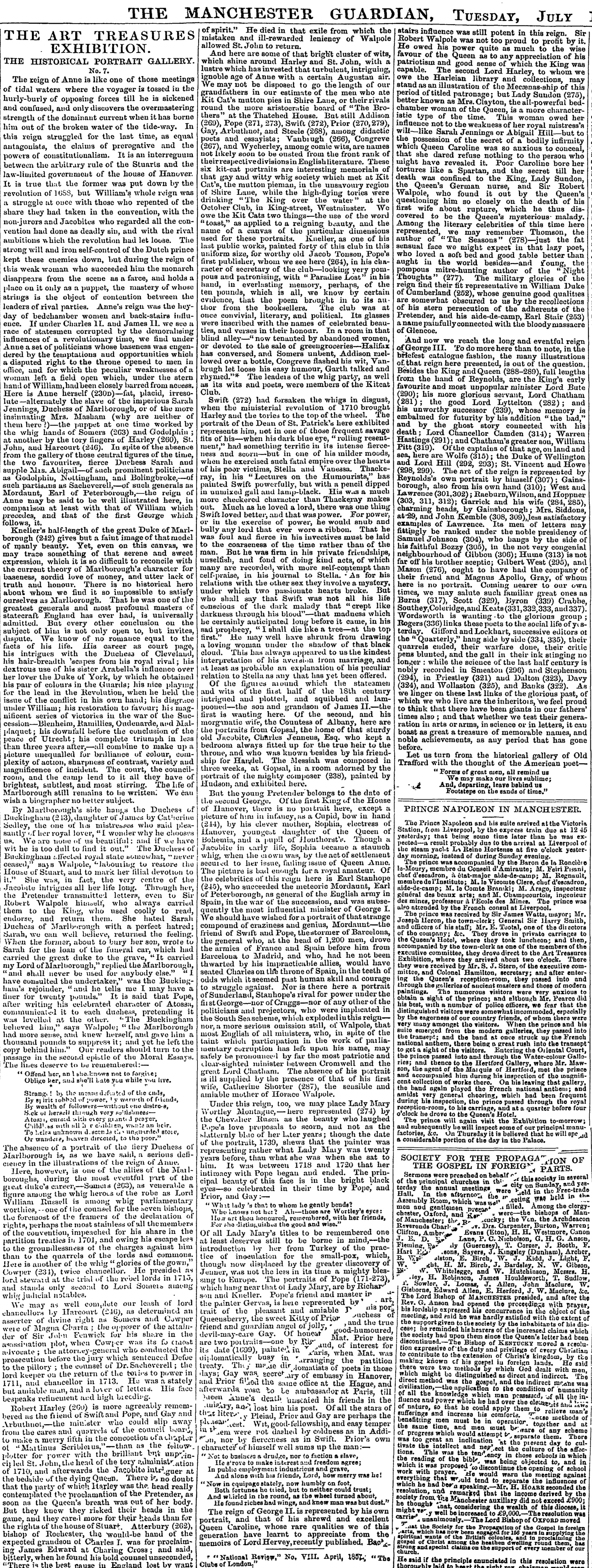
The reign of Anne is like one of those meetings of tidal waters where the voyager is tossed in the hurly-burly of opposing forces till he is sickened and confused, and only discovers the overmastering strength of the dominant current when it has borne him out of the broken water of the tide-way. In this reign struggled for the last time, as equal antagonists, the claims of the prerogative and the powers of constitutionalism.
It is an interregnum between the arbitrary rule of the Stuarts and the law-limited government of the house of Hanover. It is true that the former was put down by the revolution of 1658, but William’s whole reign was a struggle at once with those who repented of the share they had taken in the convention, with the non-jurors and Jacobites who regarded all the convention had done as deadly sin, and with the rival ambitions which the revolution had let loose.

The strong will and iron self-control of the Dutch prince kept these enemies down, but during the reign of this weak woman who succeeded him the monarch disappears from the scene as a farce, and holds a place on it only as a puppet, the mastery of whose strings is the object of contention between the leaders of rival parties. Anne’s reign was the heyday of bedchamber women and back-stairs influence.
If under Charles II and James II we see a race of statesmen corrupted by the demoralising influences of a revolutionary time, we find under Anne a set of politicians whose baseness was engendered by the temptations and opportunities which a disputed right to the throne opened to men in office, and for which the peculiar weaknesses of a woman left a field open which, under the stern hand of William, had been closely barred from access.
Here is Anne herself (230D) – fat, placid, irresolute – alternately the slave of the imperious Sarah Jennings, Duchess of Marlborough, or of the more insinuating Mrs. Masham (why are neither of them here?) – the puppet at one time worked by the whig hands of Somers (263) and Godolphin; at another by the tory fingers of Harley (260), St. John, and Harcourt (246).
In spite of the absence from the gallery of these central figures of the time, the two favourites, fierce Duchess Sarah and supple Mrs. Abigail – of such prominent politicians as Godolphin, Nottingham, and Bolingbroke,– of such partisans as Sacheverell,– of such generals as Mordaunt, Earl of Peterborough,– the reign of Anne may be said to be well illustrated here, in comparison at least to that of William which precedes and that of the first George which follows it.
Kneller’s half-length of the great Duke of Marlborough (242) gives but a faint image of that model of manly beauty. Yet, even on this canvas, we may trace something of that serene and sweet expression, which it is so difficult to reconcile with the current theory of Marlborough’s character for baseness, sordid love of money, and utter lack of truth and honour.

There is no historical hero about whom we find it so impossible to satisfy ourselves as Marlborough. That he was one of the greatest generals and most profound masters of statecraft England has ever had, is universally admitted. But every other conclusion on the subject of him is not only open to, but invites, dispute. We know of no romance equal to the facts of his life.
His career as court page, his intrigues with the Duchess of Cleveland, his hair-breadth ’scapes from his royal rival; his dextrous use of his sister Arabella’s influence over her lover the Duke of York, by which he obtained his pair of colours in the Guards; his nice playing for the lead in the Revolution, when he held the issue of the conflict in his own hand; his disgrace under William; his restoration to favour; his magnificent series of victories in the war of the Succession – Blenheim, Ramillies, Oudenarde, and Malplaquet; his downfall before the conclusion of the peace of Utrecht; his complete triumph in less than three years after,– all combine to make up a picture unequalled for brilliance of colour, complexity of action, sharpness of contrast, variety and magnificence of incident. The court, the council-room, and the camp lend to it all they have of brightest, subtlest, and most stirring.
The life of Marlborough still remains to be written. We can wish a biographer no better subject.
This is an extract, read on for more from the British Portrait Gallery of the exhibition.
Art Treasures of Great Britain, at Old Trafford in Manchester in 1857, was the largest art exhibition ever held in the UK, with over 16,000 artworks housed in a temporary glass pavilion. The catalogue is available online.