
Imagine a boy from a sheep farm, who grows up and moves to a faraway city, where he overcomes obstacles, does important work and blazes a trail for others to follow. It would make a great plot for an anime.
Or maybe not.
"I'm not into animation or manga whatsoever," said Josh Grisdale, a native of Canada and now a citizen of Japan.

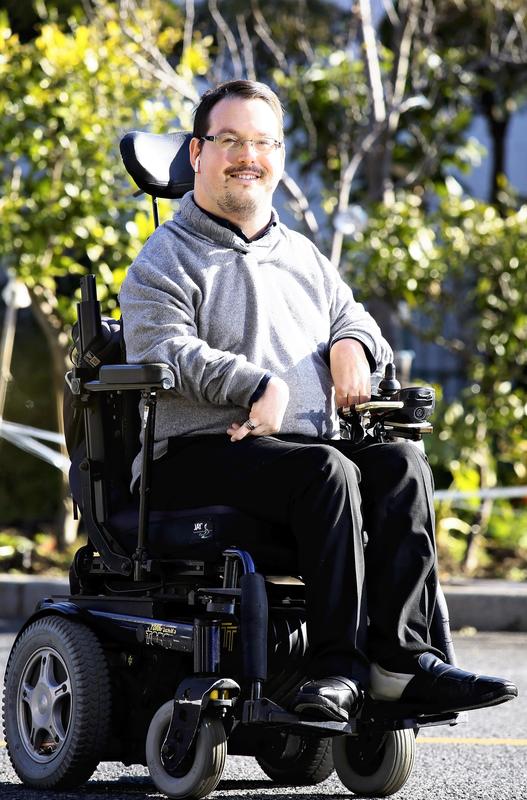
Grisdale, 39, literally wrote the book on traveling to Tokyo with a disability. It's called "Accessible Japan's Guide to Tokyo," based on the Accessible-Japan.com website that he created. Diagnosed with quadriplegic cerebral palsy as an infant, Grisdale uses an electric wheelchair to get around.
Growing up on his family's "hobby farm" outside of Uxbridge, which is in turn outside of Toronto, Grisdale didn't have to deal with the flock of about 15 sheep. But he wasn't sitting on the sidelines, either, as he told The Japan News in a recent interview.
"My family always made sure I was participating in family life," Grisdale said. His chores included dusting whatever shelves were within reach, pulling a lawnmower behind his wheelchair and doing the family's computer work, such as preparing documents and schedules.
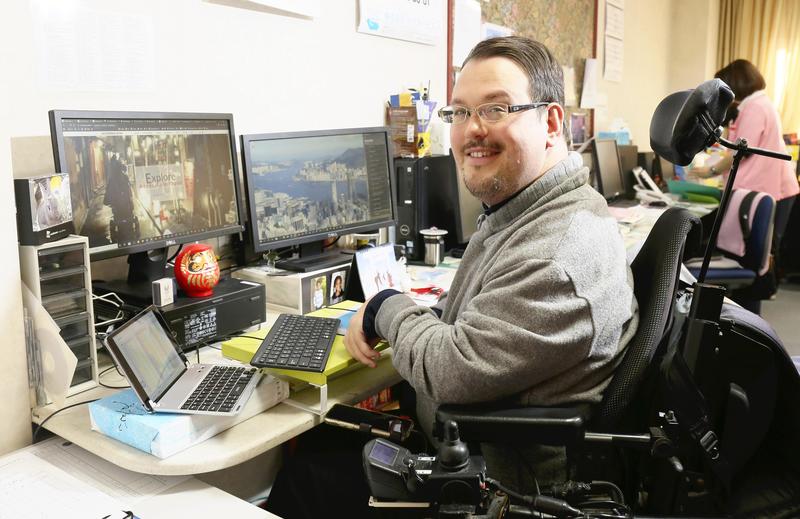
"My dad worked at IBM, so they wanted to make sure that I had experience with computers as well. Back then [in the early 1980s] it was really uncommon for people to have computers in their home ... I've been using a computer since I was 3 or 4 years old."
'Culture Friday'
In high school, Grisdale studied Japanese with a memorable teacher named Jim Johnstone. "His main subject was auto mechanic class ... His students were very rough and maybe not really interested in homework and all that kind of stuff. So he didn't teach like that; he was a lot more laid back. We took maybe three years to go through [the textbook] 'Japanese for Busy People.'"
Each week ended with "Culture Friday. We would watch some sort of bootlegged NHK drama or some horror movies from Japan or whatever, and he'd use those to explain Japanese culture. He had an infectious love for Japan."
Grisdale decided it was a place he wanted to go. After a few visits, he moved to Japan for good in 2007, having secured a tech job with a nonprofit organization called Wheelchairs of Hope. The NPO "would collect [secondhand] wheelchairs, clean them and prepare them and send them to other parts of Asia where there might be a need."
He currently works as the webmaster for the Azalee Group, which has multiple websites for its various operations, including nursery schools, kindergartens, childcare services and elder care services.
In January 2015, he started the Accessible Japan site by writing about places he traveled to in terms of touristic appeal and accessibility. He said it gets about 90,000 visitors per year. "It started out as a blog on the weekends, and it's sort of gotten out of control now."
"The biggest barrier for people who have disabilities or other special needs -- and that can be including the elderly or families traveling with children -- is a lack of information," he said. Accessible Japan addresses that need.
"My goal is to provide as much information on travel in Japan as possible so that people can not spend their time worried about accessibility but instead spend their time enjoying and looking forward to their trip."
Grisdale said he was impressed by how accessible Tokyo was when he first arrived, particularly regarding major train stations. "But for the most part, regular stations weren't accessible. You had to pick and choose where you were going to get on and off. Sometimes if you wanted to go to a station, you'd have to get off at the station before that and walk the rest of the way because the place you wanted to go wasn't accessible."
But over the years, transportation has "improved incredibly," with even buses becoming more accessible, at least in large urban areas.
He's less impressed with Tokyo's vaunted new and more accessible taxis. "You've probably heard the news, about [some] drivers refusing people rides." He said the vehicles were "sort of designed with a Japanese wheelchair in mind. A lower wheelchair, as well as a push wheelchair. I rode in one once for a TV show, but I had to take off my headrest, and I had to take off the cushion underneath my seat in order to get low enough to go in properly."
He prefers a different model "that loads from the back, which is much easier to get into."
Money to be made
Grisdale stressed the business advantages of accommodating disabled travelers. He said that companies now renting wheelchairs or organizing accessible tours for Japanese senior citizens could make additional money by providing similar services for foreign tourists with disabilities.
Many people have seen the portable ramps used to enable wheelchair users to board trains. He said restaurants should consider buying inexpensive versions of such ramps to help wheelchairs get past the genkan -- a traditional entryway where visitors typically move up one step to the establishment's interior. "If five people in wheelchairs end up using it, then it's probably [enough for] the return on their investment."
"If you were to make your business more accessible, then you're opening up potentially to 10% more customers, just because 10 to 15% of the world population is disabled," Grisdale said. "Also, people with disabilities tend to not travel alone. I can't go on an airplane by myself, so I always have to buy two airplane tickets wherever I go. When I go out to dinner, it'll be me and whoever is with me, eating as well. I probably have a bigger economic footprint than a lot of people who are backpackers going around the world."
Becoming a citizen
In 2016, Grisdale became a Japanese citizen. "I wanted to stay permanently in Japan. I wanted to be involved in all levels of Japanese society. And part of that was also politics as well -- not running for office or anything like that. The ability to vote was important to me, particularly because there's a lot of policies that have to do with my life probably a lot more than other people's."
"I think everyone laughed at me when I got really excited because I got the envelope with my voting card," he recalled. "I put it on Facebook ... and all my Japanese friends couldn't understand why I was getting excited about that. But it was kind of an emotional thing to be able to go do that."
He may not be an anime or manga fan, but his website features a trip he made to Nakano Broadway, a major pop culture destination in Tokyo, where he evaluated the accessibility of elevators, toilets and shops selling anime and manga goods. He did this "at the request of a person hoping to visit Japan."
In other words, one of Japan's newest citizens is a model of the nation's omotenashi spirit of hospitality.
Quick Questions
Q: Do you have a favorite Japanese word?
A: Komorebi. Light going through the trees. I like the sound of it; I like the idea that there's a word for that.
Q: What was your first impression of Japan?
A: "This place really exists." I had always seen it in TV and movies.
Q: What is your favorite Japanese food?
A: Unagi.
Q: What is your favorite app?
A: [My] probably most-used app is Google Analytics, to see who's looking at the website.
Read more from The Japan News at https://japannews.yomiuri.co.jp/