Open kitchens, popular for their unrestricted layout, are evolving in terms of looks and user-friendliness. Newer versions offer a more refined sense of design in the same way as living room furniture, or enhance functionality by allowing two or more people to cook at the same time. The kitchens are tailored to the lifestyles of people who enjoy cooking with family members or friends.
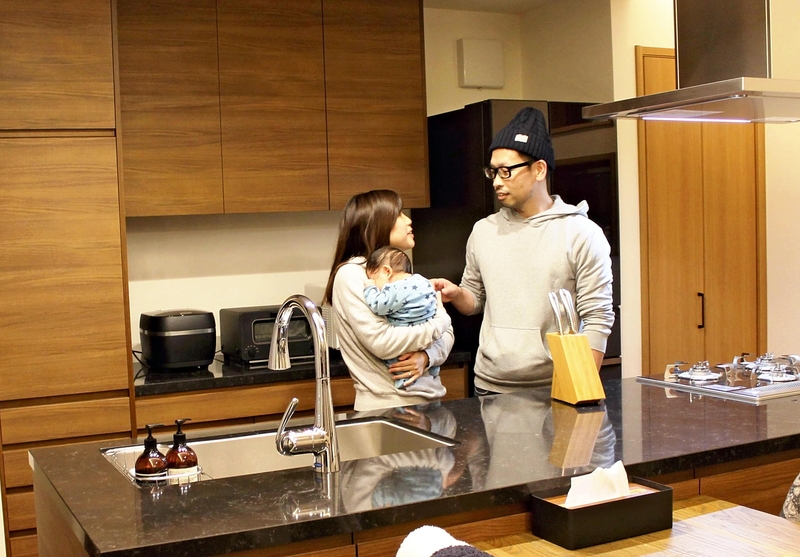
Koji Terada, 38, lives in a detached house in Yokohama with his 33-year-old wife Megumi and his two-month-old son Keisuke. Terada's house has an open kitchen that leads directly to the living and dining room.
"I wanted to make the kitchen a space where we can cook and eat together with guests when they visit," Terada said.
This is why he paid careful attention to spatial design. He used the couple's favorite wood-grain material throughout the living room, dining room and kitchen to tie the space together. While white is usually used for countertops and other accents, he used black instead, along with shiny artificial stone in the kitchen.
The black color brings out the warm feeling of the wood grain. They also chose black, sleekly designed cooking appliances, placing them along the wall so they resemble stylish furniture.
According to interior designer Kazuko Murakawa of Mitsui Home Co., the Tokyo-based firm that built the house, simple white designs have been mainstream because people tend to view the kitchen as requiring a clean feel. However, as more people have begun to think of the kitchen as a place to show off, an increasing number are seeking kitchens that, like furniture, can display a sense of style.
Murakawa says that choosing colors and materials that give the entire living room, dining room and kitchen space a uniform look is a good way to emphasize design. "This can make the space look simple and more spacious than it actually is."
Open kitchens that allow parents and children or a couple to work together have also been attracting interest.
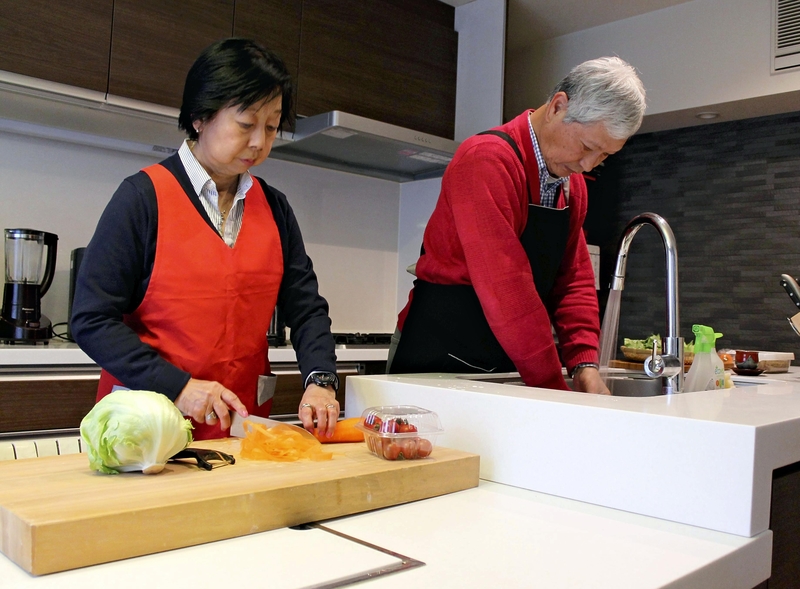
A 71-year-old man and his 66-year-old wife in Setagaya Ward, Tokyo, have an open kitchen in which the sink and stove are placed opposite each other. Since both like cooking, they created a space between the two counters that is wide enough for them to pass each other.
"It's easy to use the kitchen even when both of us cook together," the two agreed.
At 87 centimeters high, the kitchen counter is slightly taller than average so that men can easily use it. A dining table 15 centimeters lower than the counter is placed just beside it, and the wife usually works there.
Osaka-based Sekisui House Ltd., which built the house, said that a space big enough for just one person was considered sufficient in an era when women often did all the housework. However, more companies have recently begun to focus on designing kitchens based on the assumption that two or more people, including men and children, will cook together.
Men who cook sometimes complain that low kitchen counters force them to work in a painful position. The company responded to the frustration by proposing a kitchen where the sink and stove are separated.
"Make the sink and stove different heights, and you have a comfortable kitchen for both taller and shorter family members," an employee of the firm said.
Kitchens divided this way also increase cooking efficiency, according to the company. It measured the time it took two people to cook and the distance they moved about in a kitchen where the sink and stove were side by side, as well as one where the sink and stove were opposite each other. It found that they spent 42 minutes cooking and moved about 520 meters in the former kitchen, versus 34 minutes cooking and 380 meters moving in the latter.
"We hope people can enjoy the time they spend cooking in an efficient kitchen," the employee said.
Read more from The Japan News at https://japannews.yomiuri.co.jp/