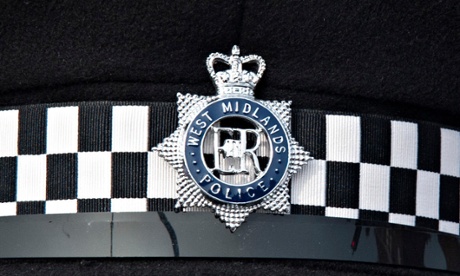
Britain’s second biggest police force is facing criticism for failing to reflect the community it serves, after it emerged that only one recruit out of its latest tranche of 162 new officers is black.
The West Midlands force covers a region where nearly 30% of people identify themselves as from black or minority ethnic (BME) groups, yet just 13% of the its new intake described themselves as black, Asian or mixed.
The figures were revealed by the region’s police and crime commissioner, David Jamieson.
He said the force needed to do more to reach out to BME people, adding: “The police service should look like the public it serves. I believe that West Midlands police is an open organisation that is welcoming of people from all backgrounds, but also an organisation that needs to do much more to ensure that people from all backgrounds apply to join their ranks.”
One local activist in Birmingham said he was not surprised by the lack of diversity among applicants, particularly black people.
“In certain parts of Birmingham, there are very good relations with local communities, including black people. But on the whole, as an institution, there is still a lot of negativity around police procedures,” said Tippa Naphtali of Naphtali and Associates, a community collective.
The new officers began duty last month, after West Midlands police’s first recruitment drive in more than five years. They are the first of 450 new officers promised by Jamieson.
Of the 162 new officers, 138 (85%) identified themselves as white, plus one as white European, 13 (8%) as Asian, seven (4%) as mixed ethnicity and one (0.6%) as black. Two chose not to state their ethnicity. Census results for the area covered by the force show two-thirds of the population are white, while 18% identify as Asian, 6.8% as black and 2.7% as mixed.
Yvonne Mosquito, the deputy police and crime commissioner for the region, said West Midlands police needed to work harder to attract people from minority groups in its latest recruitment drive, which opened on 23 March. “The number of BME people recruited by the force so far is disappointing and needs improving. What is important now though is making sure that West Midlands police gets it right with the next set of recruits,” she said.
The figures were presented at a meeting of the police and crime commissioner’s strategic policing and crime board. They also showed that only 21 of 123 officers promoted over the past 12 months were BME candidates. Of those promoted to the rank of chief inspector or above, only one was from a BME group.
Janet Hills, chair of the Metropolitan Black Police Association (MetBPA), said the statistics highlighted a problem with recruitment that went well beyond one police force.
She said: “Clearly the stats that have been released highlight an issue that is not just specific to the West Midlands. This is a national issue that needs to be addressed by the College of Policing. There needs to be a clear strategy that encompasses best practice around the country as well as scrutinising current processes.
“In the Met, the BPA plays an integral part in addressing the community trust and confidence issues and supports the current residential criteria put in place to address BME recruitment. It’s about time that policing took this issue seriously so that it can truly reflect the communities that it serves.”
Naphtali said there were a number of factors dissuading ethnic minority candidates from joining the police. “One is the perception that black people have of the police,” he said, citing controversy over the ongoing inquest into the death of Kingsley Burrell, a black man who died in March 2011 after he was arrested and sectioned.
“Second is the concern that people have that if you join the police you will be ostracised by the community,” who regard the police, he said, as “bad people”. This was less of a problem among the Asian community, he suggested, because their better political representation meant that police treated Asians better.
“The police need to focus on tightening up their general practices, not just their recruitment practices,” Naphtali said.
A spokesman for West Midlands police said: “Clearly, these figures show more needs to be done to attract certain groups when compared to the population of the West Midlands and understand the barriers which may hold potential candidates back from applying.
“Since the last intake, we have changed the positive action approach to be more targeted towards under-represented groups, including pre-recruitment workshops, discovery days, myth-busting presentations and personal mentoring support.
“Applications are currently open for another 200 PCs and signs so far are encouraging. Compared to last year, we have received 50% more applications from black African-Caribbean candidates.”