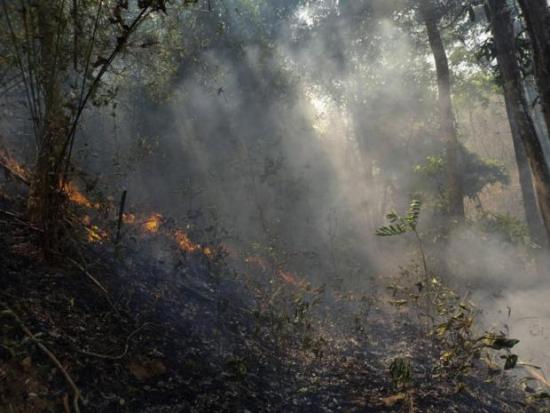
The bushfires that have ravaged parts of northern Thailand this year have been unusually fierce.
In some areas such as Doi Chiang Dao in Chiang Mai, a major hotspot, flames have reached a height of five metres, and unlike the past, they have taken days, not hours, to subdue.
So far, four firefighters -- two volunteers and two attached to the northern region -- have died trying to extinguish the flames between February and the end of April, commonly regarded as fire season in the region.
However, this year, the bushfires have lasted longer. Usually, the fires are gone by the end of April, but this year, they have persisted as was the case when they reappeared again earlier this week in Chiang Rai and Chiang Mai provinces.
According to the Forest Department (RFD), the latest bushfires were caused by villagers who started a fire to clear forest, a practice known as "open burning" in order to prepare the land for harvesting.
The timing concurred with the ending of the 60-day-ban on open burning.
From the end of last year, the government has started to arrest farmers who engage in open-burning practices in the wake of the PM2.5 haze crisis. Governors in nine provinces, in line with the government's zero-tolerance approach towards open burning, slapped a ban on the practice.
Open burning -- forest clearing and garbage burning -- has been blamed as a major cause of air pollution and the driving factor killing off our country's natural environment. As the situation gets worse, the culprits behind this crisis must be identified.
Usually, state authorities and some media outlets point the finger at ethnic hill tribes, accusing them of igniting fires in their quest for wild mushrooms and ant eggs -- active ingredients used in northern and northeastern culinary recipes.
Meanwhile, little has been mentioned about the mass plantations of cash crops such as corn and rice even though it's known that forests have been cleared for this purpose.
In my opinion, there is a lack of neutral academic studies that address the matter without bias and provide adequate solutions.
Without concrete and academically unbiased knowledge of open-burning practices and forest fires, the problem will never go away.
We also need to focus on sustainable solutions that go beyond arresting those who start the fires. Society has been vocal in their complaints about farmers who set fires, yet, there are few solutions to help these same farmers whose plight often falls on deaf ears.
However, there is one concrete solution I know of -- the "Biomass Shredder" -- which was invented by members of the Rotary Club in Lampang province three years ago. They donated their device to a few farming communities in the province.
Made of propellers and a motor, the shredder can fit in the back of pickup truck. The farming communities that received the shredder in Lampang now have the option of collecting their waste to be shredded and converted into organic fertilisers instead of burning it.
Despite this, the project remains limited in its scope. The government should invest more in such innovations that help farmers. We should always remember that the farming sector is one of the top three sources of national revenue. The food that we eat, sell or trade comes from their harvests which might be a result of burning of land or forest. So, we have a duty to help.
Another solution that I hardly see a focus on is the lack of marketing campaigns by the private sector and consumers to promote farm products produced from zero open burning.
Without consumers asking for and companies selling zero-burned maize, rice, sugar cane or even wild mushrooms, the problem will not end.
Despite these shortcomings, we can still remain hopeful.
According to Dunrit Ruethaiwarunrat, head of the Forest Department's Forest Fire Control Division, the government plans to involve farming communities and forest dwellers as part of the solution.
The officials have plans to cultivate a better network with the local communities -- some of them farmers, to help prevent forest fires and combat open-burning.
Although the Ministry of Natural Resources and Environment has already established firefighting initiatives with 3,100 villages in the North, the number is nowhere near enough.
Partner communities will receive money and equipment to solve forest fires. They will also receive help in taking up new professions related to tourism and/or sustainable campaigns to help them make a living.
In my opinion, the government's strategy is worth applause and I hope it works.
After all, it is not water bombing but only nam jai or kindness and compassion from society that can douse the fires.
Anchalee Kongrut is assistant news editor, Bangkok Post.