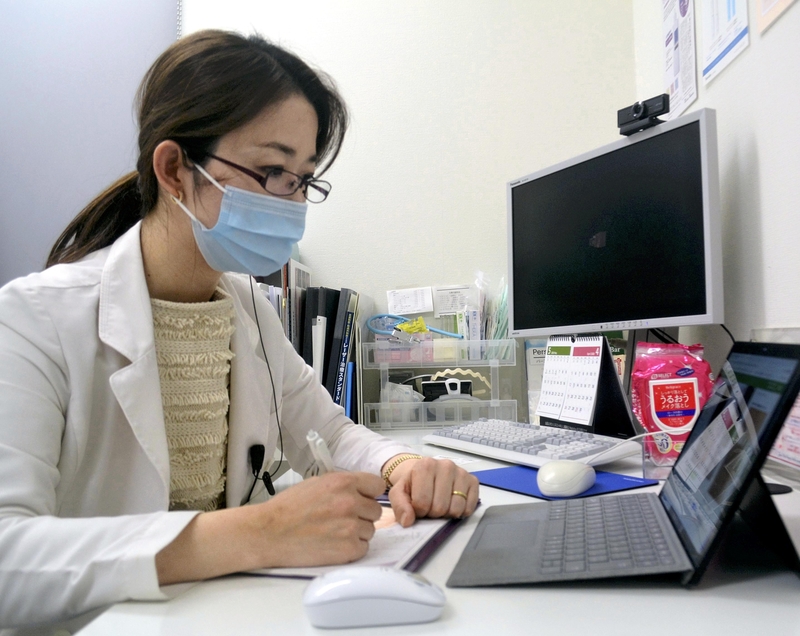
Online medical examinations via smartphones, tablets and computers are increasingly being used as the coronavirus continues to spread. The government authorized the use of online exams in April to even cover first-time patients who have no history of receiving a medical exam at that specific institution, as a way to prevent the virus from spreading.
Although the expanded use of online medical exams is only permitted until the COVID-19 infection is brought under control, officials involved in health care services have called for prudent use of the online medical exams.
Kaya Hara, director of Yaesu Plastic Surgery and Cosmetic Dermatology in Chuo Ward, Tokyo, was on the computer speaking with a male patient in his 30s whom Hara had not examined before.
"What kinds of issues are you having?" Hara asked the patient.
"I'm worried that I may run out of my current medication," the patient responded.
The patient had a rash and was taking medication prescribed by another medical institution. As the coronavirus starting spreading earlier this year, he became worried about becoming infected at the places he would normally go to or in the hospital waiting room, and he was hesitant to go.
The patient found Hara's clinic by looking for medical institutions offering online exams. He underwent the exam, which was conducted by Hara, via his smartphone.
"Receiving a medical consultation while at home is convenient and reassuring," he said.
By allowing medical consultations to be conducted online, the risks of the virus being brought into the medical institution and increasing the number of people becoming infected in the hospital are mitigated.
"It is effective in protecting medical staff and also in maintaining health care services," Hara said.
The use of online medical examinations have been authorized since 1997 for people living in remote locations, such as on islands. It has been considered to be a supplement to in-person medical consultations, as some relevant information cannot be collected through online interactions.
With the revision for fiscal 2018 of the remuneration for medical treatment received by medical institutions from health insurance societies, online medical exams became covered by public medical insurance. However, insurance only covered follow-up exams. The patient had to have received more than six months of in-person consultations at the specific medical institution where they wish to receive an online exam, and only for lifestyle-related diseases and intractable diseases.
For fiscal 2020, discussions began for the remuneration for online medical treatment last spring and concluded in February this year. The conditions were slightly eased, making it necessary to receive in-person consultations for only three months prior to receiving an online follow-up exam at the same institution.
However, in response to the spread of the coronavirus, Prime Minister Shinzo Abe promoted the idea of utilizing online medical care services in late March. This gave impetus to moves toward having online medical services be available to first-time patients as well, regardless of the type of illness the patient was suffering from, and have it covered by public health insurance.
As discussions started at an experts' meeting at the health ministry, doctors and organizations in support of patients raised their voices of concerns one after another as to whether online medical exams should be given at an institution to a first-time patient at that institution.
"If an illness was left unchecked and [the patient's health] deteriorated, it would be too late for treatment," or, "It is extremely risky to prescribe medications that have side effects."
There was a lot of discussion between the government's Council for Promotion of Regulatory Reform, which tried to remove relevant regulations, and the health ministry, which was opposed to such moves, against the backdrop of concerns in medical circles. As a result, on April 10, it was approved that online medical care services for first-time patients will be covered by public health insurance.
Although it was emphasized that it was meant more to prevent infections, a senior official of the Japan Medical Association gave a warning, saying: "The latest measure is the rarest of exceptions. Once the [pandemic] is brought under control, medical examinations for first-time patients should be brought back to in-person consultations only."
A director of a clinic in Tokyo confided that "Online medical services take a lot of work, compared to a low level of remuneration."
The amount that a medical institution is paid for a first-time patient receiving an online consultation (in addition to the actual exam) is 2,140, yen which is about three-quarters of what the institution would be paid for a first-time patient receiving an in-person medical consultation.
While the work needed for the introduction of relevant systems will place an extra burden on medical practitioners, it will also require them to set aside time for online exams in between the in-person consultations.
In medical circles, there are also such concerns that if the use of online medical care services is widely recognized, more well-known medical institutions will become more popular, leading to less well-known medical institutions going under.
On the other hand, Hiroshi Kondo, president of the Japanese Telemedicine and Telecare Association and a professor at Tottori University, said that such abnormalities as shallow and frequent breathing and bad complexion can be detected even through a screen. Also, the quality of medical care services can be ensured to a certain extent if the online exams are utilized appropriately.
As to conducting online exams for first-time patients, Kondo said, "It would become more difficult to notice abnormalities, so doctors will be required to listen more carefully to their patients. Also, if patients could keep a record of their body temperature, heart rate and respiratory rate, it would be easier for doctors to conduct the exam."
Read more from The Japan News at https://japannews.yomiuri.co.jp/