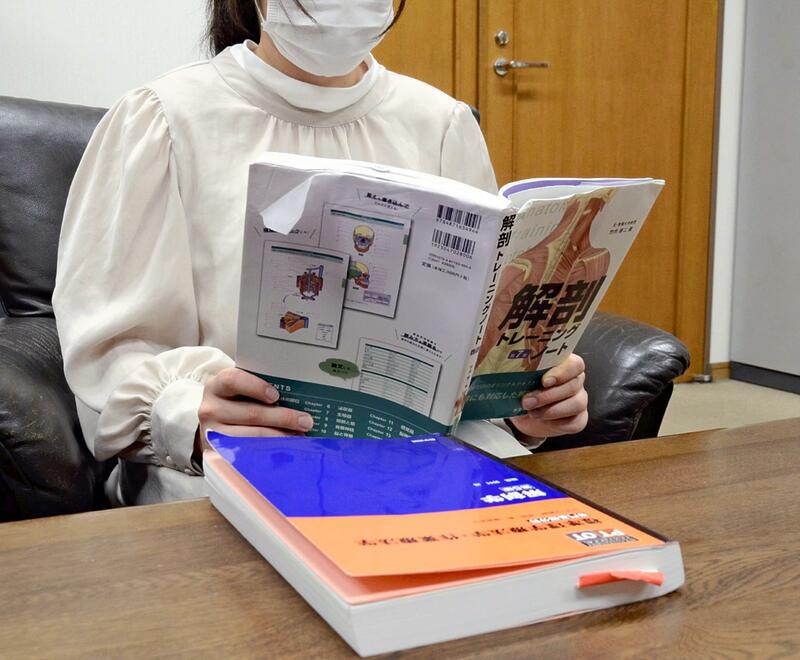
An Osaka-based charitable foundation has been matching former foster children with sponsors, through an online financial aid initiative that helps students from abusive and impoverished backgrounds pursue their educational dreams after aging out of the foster care system.
Under the program, launched this spring by the Mirai Kodomo Foundation in Kita Ward, Osaka, the foundation acts as an intermediary that passes anonymous monetary donations from sponsors to students in need. Donors and recipients are not given each others' names or contact information, but are able to communicate online in exchanges facilitated by the foundation.
Foster children are asked to leave care facilities upon turning 18, in principle. As these young people embark on independent lives, financial straits often prevent them from enrolling in universities or other forms of tertiary education.
The program, one of the only of its kind in Japan, has already connected two students to financial support since April.
One of the two inaugural recipients, a 19-year-old who chose the pseudonym Nanami Tsuda, spoke with supporters for the first time in April in a videoconference, bashfully sharing her impressions of freshman year.
"Now that the school entrance ceremony is over and classes have started, I've been pretty busy," she said.
Tsuda moved out of a foster facility in the Kinki region earlier this spring.
Not long after starting elementary school, Tsuda lost her mother to illness, and became estranged from her father. Although she lived with her grandparents for a while, they had already reached an advanced age, and Tsuda was placed in a foster care facility when she was in fifth grade.
In high school, Tsuda joined the school's volleyball club. As a manager of the club, her remit included nursing injured athletes, and the experience awoke an interest in pursuing a career in physical therapy. But becoming a professional physical therapist requires coursework at an accredited university or vocational program, and Tsuda did not have any family to turn to for help with tuition.
Tsuda found a part-time job and applied for scholarships. But she also had to move out of foster care upon graduating from high school and knew her meagre savings would barely be enough to afford an apartment on her own, let alone attend college.
When agonizing over her dilemma, a counsellor at the foster facility suggested that she try applying for the Mirai Kodomo Foundation initiative.
-- Connecting via Zoom
The foundation website contains a list of students who have been recommended for the program by their foster centers, replete with introductory profiles highlighting the students' backgrounds and intended courses of study.
After passing an interview screening process, sponsors commit to sending 10,000 yen each month to students up until their graduation from university or vocational school. Multiple sponsors may be assigned to students according to their level of financial need.
The foundation keeps supporters abreast of students' progress with monthly email newsletters, although it is careful to obscure personally identifying information. Supporters and students are also able to touch base once every three months in video chats conducted over Zoom.
In its first round of recruitment this March, the foundation successfully placed Tsuda and another student with 10 supporters each, securing the students monthly stipends of 100,000 yen.
Tsuda said she is grateful for the help making ends meet as she juggles her coursework with a part-time job at a convenience store.
"People just assume that foster kids can't go to university, so I wanted to prove them wrong," she said. "I'm really thankful for all the sponsors who have supported me, even though I'm a complete stranger. I hope to be able to show them that I've continued to thrive."
-- Pandemic pitch-in
Since its creation in 2015, the Mirai Kodomo Foundation has actively donated daily necessities and other items to foster facilities across Japan.
But after the outbreak of the novel coronavirus, the foundation was contacted by a former foster care resident, who had been surviving on bean sprouts alone after the restaurant they worked at was forced to shutter during the pandemic.
What started as a shipment of food and other supplies to one individual in need grew into a larger project to help former foster youth on a more continuous basis.
Sponsors have signed up from across Japan. Some said they also experienced abuse firsthand in the past.
One supporter, a 48-year-old business-owner and father of four in Saitama, said: "I've seen motivated and smart children forced to give up their dreams due to their family backgrounds or financial reasons. I want to do all that I can to help kids in that position."
The foundation plans to start seeking supporters for two other former foster students, as it gradually expands the project.
Masahide Taniyama, 56, representative director of the foundation, said: "Many people who went through the foster system end up dropping out of school because they cannot afford tuition. I hope more community members will extend a helping hand to young people who have nowhere else to turn."
-- 2% matriculation rate
There are nearly 600 foster facilities across the nation, accommodating about 24,900 youths.
The Child Welfare Law has stipulated that youths move out of the foster system when they reach age 18. However, provisions went into effect in fiscal 2017 that allow people to continue living in foster care until the end of the fiscal year before they turn 23, if they are not yet able to set out on their own.
Former residents of these facilities or foster families are known as "care leavers." Many have nobody to rely on after leaving the foster care system and face significant hurdles as they make the transition to independent life.
The results of a first survey on the educational and work status of care leavers by the Health, Labor and Welfare Ministry were announced in April this year. The study found that immediately after leaving foster facilities, 53.5% of youth had entered the workforce and 36.3% were attending school.
In terms of educational attainment, 64% had graduated from high school, while 15.4% left school after completing junior high. University graduates account for only 2% of youths covered in the survey, whereas the national average for university matriculation last spring was 54.4% of all students, according to the Education, Culture, Sports, Science and Technology Ministry.
Read more from The Japan News at https://japannews.yomiuri.co.jp/