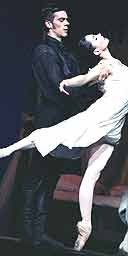
In the 1950s John Cranko was one of Ninette de Valois's most prized proteges, the choreographic link between Ashton and MacMillan. Despite his rise to international ranking, Cranko's works have long been neglected by the Royal Ballet. It has taken outsider Ross Stretton to bring Cranko's celebrated romantic tragedy, Onegin, to Covent Garden. Many fans at last night's opening would have remembered Onegin well, as one of the old mainstays of English National Ballet's repertory. It make sense for the Royal to have got their hands on it.
There may be flaws in Cranko's ballet: its rented-by-the-yard choral dances, its trite minor characters, and its cobbled together Tchaikovsky score. But successful story ballets are a rare commodity. This one is not only well crafted overall, but the central pas deux for its four principals plumb real intensities of emotion.
The libretto follows Pushkin's verse novel closely, especially the complex role of Tatiana as she matures from awkward susceptible schoolgirl to a married woman with a secretly broken heart. Tamara Rojo, making her debut in the role, started with a demeanour too classically pretty to convey real vulnerability; but there are moments of ragged impetuosity in her dancing that promised well, and by her third act the enormity of all Tatiana has lost in loving Onegin, and all that she could briefly dream of gaining, rips through Rojo's dancing with raw immediacy.
Adam Cooper, returning to the Royal as guest, could have been born to dance the role of Onegin, given how ruthlessly glamorous his looks become under the alchemy of stage lighting. His dancing may at times be slightly underpowered, but his partnering is good and his acting is superb. Onegin's moody arrogance layers just the right mix of poetic torment and banal self absorption to create the perfect romantic shift.
Also superb are Alina Cojocaru as the butterfly ingenue Olga, and Ethan Stiefel as her lover Lensky. The pair dance on a giddy impulse so pure and simple they look fatally easy to crush; at the climax of Onegin's betrayal, the damage to their innocence feels brutal.
These four dancers add up to a stellar cast, and the chemistry is sometimes as thrilling as their combined reputations promise. The rest of the cast have a less flattering time of it. There are long sections where this ballet looks older than its 36 years, where its coarse stage business, and crude minor characterisation oblige the dancers to look undeservedly stodgy. Onegin will stay in the repertory because of its sublime central tragedy. But, unlike some great story ballets by Ashton and MacMillan, it is not a first class showcase for the company.
In rep until January 29. Box office: 020-7304 4000.


.png?w=600)