Twelve months into Donald Trump’s second term, a presidency driven by impulse rather than restraint is hollowing out US institutions at home while sending shockwaves through NATO, the UN and the wider international order.
A year after Donald Trump's return to office, the shock persists – but the consequences grow starker. Power is wielded impulsively, institutions appear weakened, and policy often follows presidential whim over process. Critics call it monarchical governance. What does this mean for American democracy and the global order?
Speaking to RFI, former US diplomat William Jordan says what we are witnessing is not simply an unconventional administration, but something far more radical.
“What’s happening in Washington is basically a revolution – a far-right or reactionary revolution – that is playing out every day,” he says. “It’s driven by agitation and then propaganda to support it.”
Jordan points to what he describes as a deliberately performative strategy, popularised by Trump allies like Steve Bannon, designed to overwhelm opponents and institutions alike.
“There’s a certain theatricality to it – flooding the zone, making it impossible for anybody to focus on anything else,” he says. “And the institutions that should be protecting the American system are proving they’re not up to the task.”
Trump 2.0: tariffs, trade and the state of the US economy one year in
Checks, balances and a broken Congress
The United States’ constitutional architecture – its checks and balances,its bicameral Congress – is often held up as a model of democratic resilience. But Jordan is blunt about how well it is functioning today.
“Is it working? I would say no,” he says. “Congress has not been insisting on any sort of real accountability from the executive – at least not anything the executive would have a hard time ignoring.”
While courts are clogged with legal challenges to Trump administration actions, Jordan notes that even there, resolution is slow and often indulgent.
“The court system is choked with pending cases, and we have no clear resolution,” he says. “So the real stakes now are how much has already changed – and how much of that we won’t be able to change back easily, or at all.”
Recent, tentative pushback from Republican senators – particularly over Venezuela and Trump’s threats towards Greenland – may hint at limits, but Jordan cautions against optimism.
“Congress, as an institution, is simply not functioning in the way it’s supposed to,” he says. “The House is basically deadlocked, and the Senate has only shown resistance in very limited areas.”
Trump has openly suggested that a Democratic victory in the midterm elections could lead to impeachment – and has even hinted at blocking or cancelling the vote altogether. Constitutionally, Jordan says, that line is difficult to cross.
“I’m not aware of any provision that+ allows a president to suspend elections,” he says. “Even during the Civil War, the United States continued to hold federal elections. Abraham Lincoln was re-elected in the middle of it.”
The real battleground, he argues, lies elsewhere – in voting rules, redistricting and restrictions on mail-in ballots.
“If the Democrats do take control of the House, it would at least allow hearings and some level of accountability,” Jordan says. “It could also open the door to articles of impeachment – and frankly, they’d likely have even more material to work with than before.”
American expansionism
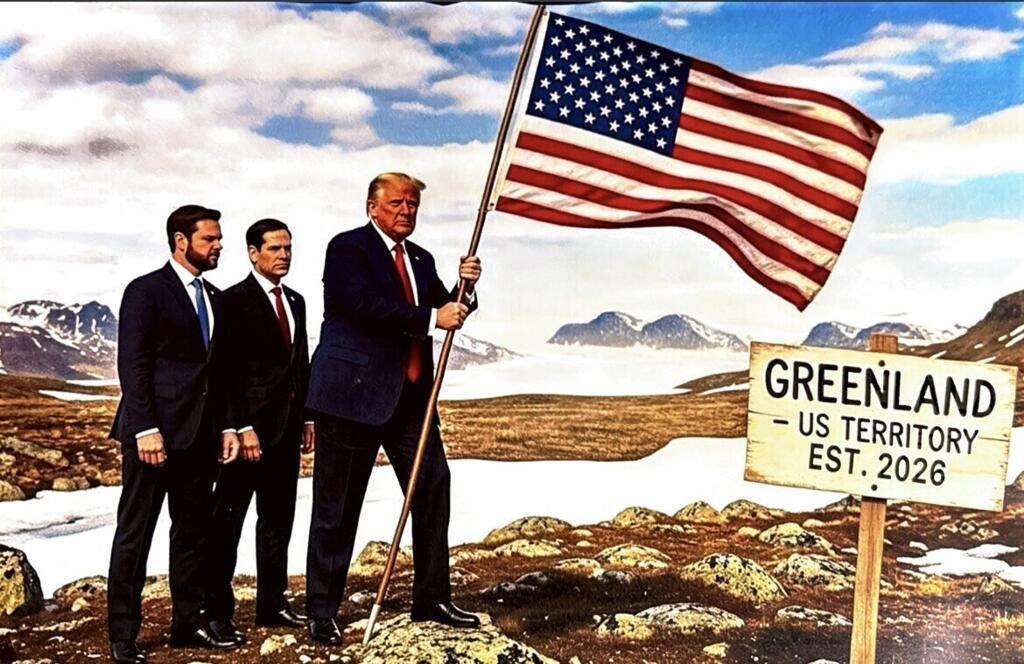
Abroad, Trump’s expansionist rhetoric is being digested very differently depending on the capital.
“The Russians are much more publicly in a celebratory mode,” Jordan says. “The Chinese are more inscrutable – and I think more apprehensive.”
Far from welcoming chaos, he argues that Beijing sees itself as a status quo power.
“What the United States is doing is undermining the status quo,” he says. “And I don’t think that’s in China’s interest.”
European allies hit back at US threat to start trade war over Greenland
Few issues encapsulate the current unease more clearly than Trump’s repeated threats to take control of Greenland – a move that would strike at the heart of NATO.
“If the United States were to move on Greenland, that would effectively spell the end of the transatlantic alliance as we know it,” Jordan says.
Could NATO survive without Washington?
“I think something would emerge from the ashes,” he says, though he acknowledges it would be an “extremely heavy lift” for Europe. “Europe remains heavily dependent on American equipment and capabilities. That’s a vulnerability that will last for decades.”
Still, he believes the political will is growing – and that Canada, in particular, could play a key role in keeping NATO genuinely transatlantic.
“I can’t help but think Canada will continue to see value in a very close relationship with European partners,” he says.
France's refusal to join Trump's 'Board of Peace' sparks new wine tariff threat
Pulling back the curtain
Commentators argue that Trump is merely exposing behaviour the US has long practised behind closed doors, and Jordan agrees – up to a point.
“What we’re seeing now is the culmination of decades of the US undermining the rules-based international order it helped create,” he says, pointing to Iraq, the war on terror, and long-standing double standards over issues like Palestine.
But he warns that what comes next could be even more destabilising.
“I think the next target is the United Nations,” Jordan says. “I’ve been waiting for the guns to come out and start blasting at what remains of the UN system.”
He sees recent talk of an alternative "board of peace" as the opening shots in a broader campaign.
“This is being carried out in stages,” he says. “What we’re seeing now is likely the first salvo in a much larger battle to undermine the international order.”