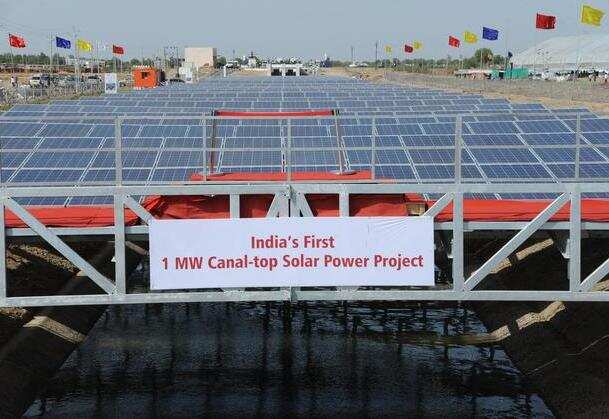
Access to land for solar farms is becoming a problem worldwide. Solar panels require a lot of land, but farmland already has other uses. Over a decade ago, engineers in Gujarat pioneered one of the world's first canal-top solar power projects by placing solar panels above an irrigation canal instead of on farmland. The project produces renewable energy while saving water, one of the country's most precious resources.
Get breaking news anytime, anywhere. Download the TOI app now!
An innovative concept using existing infrastructure
The solar farm spans 750 metres along the Sardar Sarovar Narmada canal at Chandrasan village in Mehsana district, Gujarat. According to Gujarat State Electricity Corporation Limited (GSECL), the 1 MW Canal Top Solar PV Project was launched in March 2012 and was among the first canal-top solar power plants in the world. Instead of using any agricultural land, the solar panels were installed on steel structures placed above the canal so that irrigation water could still flow below the panels. According to GSECL, the power plant generates about 1.6 million units of electricity annually without using land for solar power generation.
The shade does more than produce electricity
Open canals can lose water to evaporation, especially in Gujarat's arid climate. Installing solar panels above the canal shades part of the water surface, helping reduce evaporation. GSECL and contemporary reports estimated that the pilot plant saves about 9 million liters of water a year. Moreover, the flowing water may have a cooling effect on the panels.
Ground-mounted solar parks can require hundreds or even thousands of acres. Canal-top solar power helps address this challenge by making use of existing canal infrastructure. Land does not have to be bought, and there is no need for the clearing of new land before setting up the panels. The idea drew attention because it addressed two problems at once: generating renewable energy and conserving land and water.
As per the report published by the Centre for Science and Environment , if solar panels are installed on 10 percent of Gujarat's canal cover of about 19,000 km, then 2,200 MW of electricity could be produced each year with savings of 11,000 acres of land and 20 billion liters of water. Despite these benefits, canal-top solar power has not replaced traditional solar fields.
Building above a flowing canal is more complex than building on land. Steel support structures are more expensive, the system is harder to maintain, and it requires specialised engineering expertise. These extra costs have limited wider adoption, even though the project has attracted attention from policymakers and researchers. Since the pilot project, Gujarat has built additional canal-top solar installations.
More than a decade later, the project is still notable
As governments look for renewable energy sources that do not compete with farmland or strain water supplies, Gujarat's canal-top solar project remains a useful example of infrastructure reuse. Rather than acquiring new land, engineers explored whether existing canal infrastructure could serve a second purpose. More than a decade later, the project remains a notable example of innovative renewable energy infrastructure.
It has inspired similar initiatives elsewhere in India and abroad, where efforts have been made to integrate renewable energy into existing systems. Although canal-top solar power is unlikely to replace traditional solar farms entirely, it offers an alternative in areas where land and water are scarce. The Gujarat case shows that existing infrastructure can help shape the future of renewable energy.