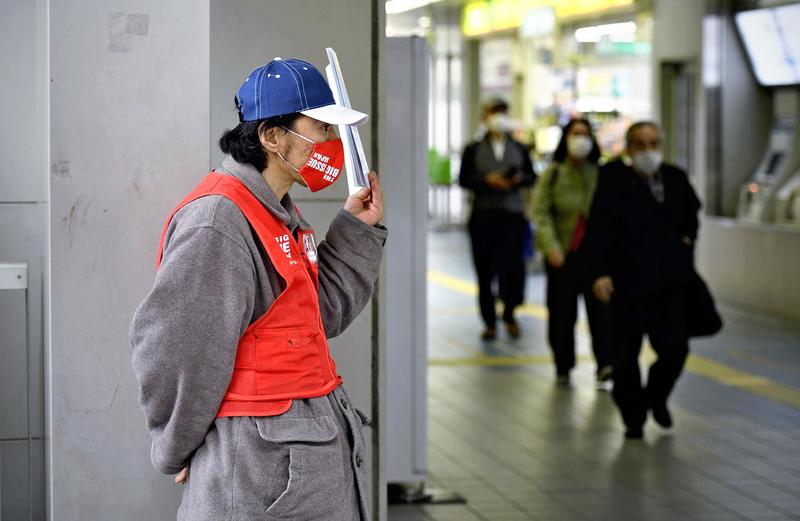
People wearing face masks walk pass and pay no heed to a man selling the Japanese edition of the Big Issue magazine at a connecting passageway at Hotarugaike Station in Toyonaka, Osaka Prefecture.
The man, 40, had been standing there for seven hours, since 9:00 a.m. Then, an elderly woman stopped and bought a magazine -- it was his seventh one sold on that day.
He has been selling the magazine alternately at Hotarugaike Station and the nearby Toyonaka Station since last fall.
Passengers to and from Itami Airport used to buy magazines from him, but the new coronavirus has reduced the traffic and his sales have dropped to less than half.
"The number of magazines sold determines the grade of my meal," he said.
That evening, he was prepared for cup noodles again.
The Big Issue is a magazine dedicated to helping the homeless rebuild their lives. The seller buys a magazine at 220, yen sells it at 450 yen and gets 230 yen for their share. The man can earn 1,610 yen by selling seven magazines.
The man's "residence" is at a park in Osaka and the cost of transportation to and from the park is not insignificant. Also, a library and a dining area at a supermarket, which had been valuable places for him to stay, are now closed.
"The only place where I can keep the wind and rain out is under overpasses," he said.
The man, who lived in an orphanage when he was a child, admires the author Haruki Murakami and dreams of becoming a novelist.
However, he was dealt a bad hand in life and has been in harsh situations.
When he was 25 years old and a temporary worker at a factory, he was thrown out on the street after he lost his job and housing due to his company. The 15 years since then are not easily explained. He did a day-labor job and got welfare benefits. He moved around the country. And whenever he got stuck, he sold the Big Issue.
He often thinks back to 2008 when he first took to the streets as a seller of the magazine. The world at the time was facing a global financial crisis. There was a lot of attention paid to temp workers being laid off and poverty among young people, and he was able to sell up to 50 magazines a day.
This time, however, is different. "Maybe people just don't have leeway, because they have to take care of themselves," he said.
Still, there is hope. The magazine's publisher has begun mail-order sales as an emergency relief measure. The proceeds from sales will be distributed to about 100 sellers nationwide. The initiative has been spreading across social media platforms, and more than 6,000 purchase orders have so far been received.
"The good intentions have not disappeared, they are just not visible," he mused.
He said he wants to live in an apartment eventually and get a regular job. However, he thinks he can't realize his hope in the foreseeable future if this situation continues. His current goal is simply to buy Haruki Murakami's full-length novel that came out three years ago.
Read more from The Japan News at https://japannews.yomiuri.co.jp/