Britain does Shakespeare brilliantly, but it mostly does Shakespeare a certain way. So much of our Shakespeare looks and sounds the same, with classical actors and perfect verse-speaking. House styles may differ but the starting point is the same: close textual analysis and a predetermined reading.
That’s not to knock that approach. It yields top-drawer – not to mention varied – productions: everything from Gregory Doran’s loving reverence to Rupert Goold’s vivid reinvention.
But it isn’t the only way to make theatre or, indeed, to play Shakespeare. This week, Improbable present their production of The Tempest at Northern Stage in Newcastle upon Tyne. After 20 years of devised theatre, it’s the company’s first shot at Shakespeare. Over the last decade or so, a number of other experimental ensembles – Kneehigh, Told by an Idiot, Oily Cart – have also turned their hands to the Bard for the first time.
It’s thrown up some remarkable shows. Filter’s party-fuelled Twelfth Night, with tequila and takeaway pizza. Frantic Assembly’s physical Othello, fought out over a pool table in an East End boozer. Complicite’s intricate Measure for Measure, which played out like a political thriller.
With these companies, the play’s not the thing. The playing of it is. They use clowning and physical theatre, improv and music, always placing performative elements on a par with a text.
When Paul Hunter directed A Comedy of Errors for the RSC in 2009, for example, he used Told by an Idiot’s clowning style, deploying his classically trained cast as a troupe of actor-musicians. “I wanted the feeling that, if there was a fire alarm, you could go out into the square and just carry on. It was closer to street theatre – which isn’t a million miles from Shakespeare’s day, if you think about it.”
“It was less about the shape of the text or the form of how it sat together, and more about a really robust investigation of what happened when you got up and tried it out.” In the end, Hunter says, it was the music – Iain Johnstone’s Balkan ska – that provided a way in, not so much Shakespeare’s words.
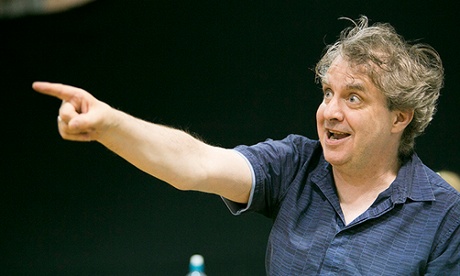
In Newcastle, meanwhile, Improbable are using a method known as the Whelan Recording Technique, or instant acting, an approach rooted in improvisation. Actors record their lines then improvise alongside the recording, repeating that cycle a number of times before going off-book. “Sometimes people will remember all of it,” says director Phelim McDermott. “Iambic pentameter just comes out of them. It’s like, where the hell did that come from?”

Photograph: Alastair Muir/Rex
The point is to keep things fresh and instinctive. “You’re not working out how to say a line in advance, just saying it.” With each repetition, the acting accumulates detail and mistakes iron themselves out. It’s a bit like bringing a performance up to the boil and, aside from the odd bit of business or set-piece, most of McDermott’s production will remain unfixed when it opens, free to shift night by night. “It’s basically an improv show,” he continues. “You’re at performance level from the get-go.”
It’s not that text isn’t important, just that the process allows meaning to emerge organically. It chimes with something Hunter says: “With Shakespeare, often I only understand it when I’m up doing it.”
Obvious though it sounds, that’s because Shakespeare was writing for performance. Simon McBurney, Complicite’s artistic director, stresses that each of the plays is “an embodied text”: its meaning wrapped up in speaking and acting. Equally, he adds, they’re “just extraordinary poems” and their meaning is manifold. “When you start to analyse Shakespeare it simply starts to fall apart. What’s beautiful about a poem, like a piece of music, is that you can’t always say exactly what it means. The moment you try, you realise that it also means exactly the opposite.”
You feel that when you watch Shakespeare, I think. We don’t grasp every phrase in full, certainly not every allusion therein, and yet it still makes sense as we watch. For Kneehigh’s Emma Rice, soon to take over at the Globe, it’s all about storytelling. When she staged Cymbeline – “an impenetrable text” – they changed the script freely. Imogen’s alter-ego became Ian, not Fidele. “It’s not the text that’s leading,” says artistic director Emma Rice, “but it is the story.”
The response was, at times, vitriolic. Critics pooh-poohed it. They weren’t alone. “Late in the run, one audience member tried to punch an actor.” There is, she believes, a level of protectionism. (Witness, too, the recent fuss over moving “To be or not to be” in Hamlet at the Barbican.) “It’s guarded by the few people that have dedicated their lives to understanding it’s richness, but 99% of people who come and watch a play have not made that pact. If we’re to keep telling stories, we have to change them.”

If an orthodoxy’s problematic, it’s because it creates the sense that there’s a right way of doing Shakespeare. McDermott believes that creates barriers, like if you don’t understand every word, you’re not allowed to put the plays on. He’s been directing for 30-odd years. “It’s amazing how strong that feeling is that says, ‘You’re not a proper director if you don’t do it this way.’”
However, ex-artistic director of the RSC Michael Boyd is quick to warn against a false dichotomy. It’s not as simple as text-based versus devised, hierarchical versus collaborative, he says. Every director discovers things in the rehearsal room and every ensemble working on Shakespeare will, at some stage, pay heed to the text. Even the most conventional theatremaker is trying to create something that works onstage, live, in performance. Likewise, says Boyd, “some of the most experimental work isn’t in the least bit collaborative.” A lot of international work – Thomas Ostermeier’s Hamlet, for example – wouldn’t fit neatly into either camp.
Even so, that division holds sway in the UK. It’s telling that these alternative companies are often shunted towards Shakespeare’s lighter, fanciful fare: the Tempest’s magic, Comedy of Errors’s anarchy, Cymbeline’s fairytale. It’s mostly a case of matchmaking – suit the play to the players – but it’s problematic too, a case of pigeonholing artists.
Why are Hamlet and Othello the preserve of big-name actors and mainstream directors? What might an alternative approach to the Histories look like? It’s almost patronising. Do what you will with Twelfth Night, but keep your hands off Titus Andronicus.
“Nick Hytner asked us to do A Midsummer Night’s Dream for the National,” remembers Simon McBurney. “I thought ‘Fuck that.’ Everybody wants to see Complicite’s fairies. I decided to take a really political play instead.” He ended up directing Measure for Measure and, shortly after 9/11, putting Paul Rhys’s Claudio into a high-security prison in an orange jumpsuit.
Such companies often get secondary status too, either confined to the studio or palmed off into making work for schools and young audiences. That’s to do with the emphasis on storytelling and, dare I say, fun, and the artists themselves see the worth of such work. Tim Crouch, for example, sees his I, Shakespeare series as partly an introduction to Shakespeare, a leg-up to the full plays. “It’s to do with defusing some of the scarier bits of Shakespeare and I’m thinking of an audience that doesn’t know him that well, an audience that goes ‘Fuck off Shakespeare. I don’t understand it. I don’t get the language. It’s not for me.’”
The problem is that imposes a hierarchy of sorts, elevating the straight, “adult” approach above the alternative “junior” version. The implication is that you graduate from Tim Crouch to Greg Doran, that one is more legitimate than the other.
The solution is to open spaces on the main stage, as Northern Stage are doing for Improbable and Shakespeare’s Globe have done by appointing Emma Rice. We don’t need alternative Shakespeares, but a pluralist attitude that places every approach on a par. Because, as Crouch says: “Shakespeare can take it. He can take kabuki and punk rock, clowning and improv. He will take Kneehigh and he will take Improbable and he will still be going strong long after we’re dead.”