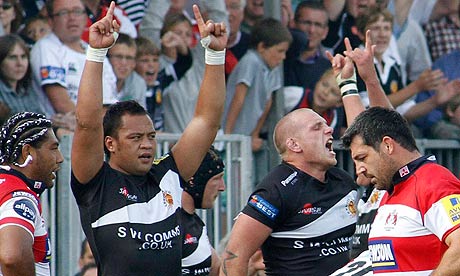
Exeter have made a notable start to their first campaign in the Premiership, defeating Gloucester at home and leading for much of the game at Leicester, but for every success in sport there is a casualty.
While the Chiefs entertain Newcastle on Saturday, in a game that will provide a different test because they will not be going into it as underdogs, the team they pipped for promotion last season in a two-legged play-off final, Bristol, will be travelling to Moseley looking for their first victory of the season after three defeats, two at home.
Bristol's failure to get back into the Premiership at the first attempt last season cost them. No longer inflated by a parachute payment, they lost a number of players and the rest had to take a pay cut. Bristol had been there before, seeing virtually an entire squad depart in the summer of 2003 after relegation and the withdrawal of the club's then owner, Malcolm Pearce.
They failed to win promotion in 2004 but, with Richard Hill at the helm, made it the following year and in 2007 finished third in the Premiership, qualifying for the Heineken Cup. Hill is now in charge of Worcester, the favourites to win promotion from the Championship, and money is not a concern at the Warriors.
Bristol could argue that they were a victim of the play-off system that was introduced in the Championship last season. They finished at the top of the table but then had to go through a series of matches before facing Exeter in the final. The Chiefs proved tactically superior in both legs, but the system that proved Bristol's undoing may now be their salvation.
Three defeats before they had met Worcester would, under the old system, have made promotion highly unlikely. Bristol have only to finish in the top eight to qualify for the play-offs, and if that is anything but a given after defeats to Rotherham, Esher and Doncaster have left them 10th in the table, they still have a number of players with Premiership experience.
"These are dark times for us," said the Bristol head coach, Paul Hull. "It is unbelievably challenging, a very troubled and difficult period, but we will get through it. We have a small squad and we have to work very hard as a group and be really tight. When you lose two games at home, and three in all, you have to look at yourself."
Not surprisingly, Bristol's crowds have dropped. Little more than 4,000 turned up to the Recreation Ground for the visit of Rotherham and there were some 400 fewer when Doncaster dropped in. Is there a glut of professional rugby in the West Country?
Exeter expected a sell-out against Gloucester, but they were more than 1,000 short of capacity. Bath extended the number they could accommodate at the Recreation Ground to 12,300 in the summer, but only 11,000 spectators turned up to watch London Irish last Saturday, a day when Gloucester attracted their lowest crowd (9,994) for a Premiership match in the regular season since September 2005 when Leeds visited Kingsholm.
Bristol's demise is a symptom of professional sport. In the days before leagues, clubs arranged their own fixtures and effectively decided who enjoyed first-class status. Worcester and Exeter were not part of the inner circle then, while the likes of Richmond, Blackheath, Rosslyn Park, London Scottish, Coventry and Moseley were among the game's big names.
Leagues have turned an oligarchy into a democracy. The Premiership clubs have done their best to turn the top flight into a closed shop with the parachute payment giving the relegated club a significant financial advantage over the rest of the Championship sides, but the play-off system, while unwieldy and incongruous because a number of the sides in it are playing for a prize they cannot claim given the stringent entry criteria, redresses the balance in part, as Exeter showed last season.
Exeter offer the way forward for Bristol, a club that has struggled financially for most of the professional era. Money problems forced them to sell their ground to Bristol Rovers and they nearly went bust in their last season in the Premiership, bailed out halfway during the campaign by an investment from local businessmen.
They have failed to create a solid foundation, focused on survival rather than success. Exeter planned carefully for their assault on the Premiership and have not overreached themselves. A promising start guarantees nothing - Burnley defeated Manchester United a year ago in the Premier League only to go down - but the Chiefs do not look out of place.
Bristol may find themselves better off redefining their values in the Championship than scrambling around in the nether reaches of the Premiership. It may not look that way now, but the examples of Exeter and Leeds provide pause for thought. Being a yo-yo should be a no-no.
Closing the book on Bloodgate
The punishment handed out to Steph Brennan this week should finally close the file on the Bloodgate affair. What started as a farce ended in tragedy for the former Harlequins physiotherapist who was this week struck off by the Health Professions Council for giving fake blood capsules to players to simulate mouth injuries, subject to appeal.
Brennan first lost his job with England when he was given a 24-month ban last year for giving the Harlequins wing Tom Williams a fake capsule, admitting it was the fifth time he had indulged in such subterfuge in three years, and he has been deprived of his living as a physiotherapist.
Dean Richards, the former Harlequins director of rugby, is one-third of his way through a three-year ban from the game while the former Harlequins doctor, Wendy Chapman, last month escaped being struck off by the General Medical Council after admitting cutting Williams's mouth following the end of the Heineken Cup quarter-final against Leinster to sidetrack suspicious match officials. Unlike Brennan, she had not been part of the plot to cheat.
One notable aspect of the affair was the lack of condemnation from other clubs. The practice of using blood capsules was said not to be confined to Harlequins and there were any number of suspicious examples of sides finding themselves short of front rowers during a game and having to resort to uncontested scrums.
Richards and Harlequins were rumbled, compounding an act of cheating by then mounting a cover-up, which may have worked had not Williams turned whistleblower in return for a reduced sentence after being banned for a year, the only person in the saga who was punished at the original European Rugby Cup disciplinary hearing.
Richards realised the implications for Chapman and Brennan should the truth come out and that it would be their professions, and not just rugby, that would judge them. It is more the pity that he did not appreciate that earlier: while he did not directly involve Chapman, he used Brennan over a period of years.
Brennan, like Williams, should have stood up to Richards if he felt that what he was being asked to do was wrong. The perception at the time was that Harlequins were not the only ones who regarded rules and regulations as an occupational hazard. It was about giving yourself an edge.
The substitution itself was ridiculous, bringing off a fit player for one who, even if he were a specialist goal-kicker, had a serious knee injury. Richards had a duty of care to his players and his back-up team, one he abdicated. He will be able to resume a career in rugby but Brennan, unless he wins an appeal, faces an uncertain future.
While there remain concerns about the process used by ERC to snare Richards and Brennan, the appeal hearing had the touch of the Bloody Assizes about it, sympathy is reserved only for Chapman.
This is an extract taken from The Breakdown, guardian.co.uk's weekly rugby union email. You can sign up here.