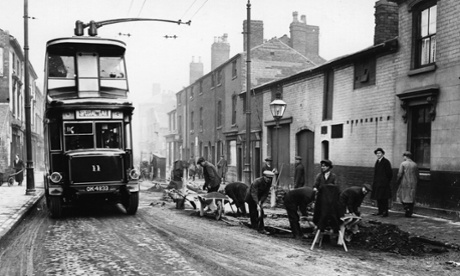
For more than two centuries Birmingham has been engaged in an ambitious and unending transport experiment. Since the moment in the 18th century when one of England’s largest conurbations was dropped into the heart of country, the challenge has always been the same: how to get in and out of it.
The construction of an elaborate canal system came first, followed a century later by the railways, and Birmingham embraced the new technologies with gusto, making the hardware for them as well as plugging into the network. It’s one of the historical reasons why the proponents of high-speed rail link HS2 have been preaching to a city largely converted to its cause. Its terminus will sit next to the former Curzon Street station, final destination of the original London to Birmingham route and the oldest railway station still in its original location in the world. Estimated time of arrival is around 2026 on current calculations.
By then, Birmingham’s tram system will have successfully integrated HS2, the city centre, the Black Country and the NEC. On a more modest, but no less vital scale, the Cross-City line ties together the towns and communities to the north of the city, such as Lichfield and Sutton Coldfield, with the burgeoning commuter suburbs to the south. It has also connected Birmingham to a considerably expanded rural hinterland, embracing the wider West Midlands and Coventry, as well as the surrounding counties of Worcestershire, Staffordshire and Warwickshire, meaning you can take in the grim demise of Richard III at the RSC in Stratford-upon-Avon and be home with your feet up in less than 60 minutes.
As the second-largest higher education centre in the UK, with five universities and approximately 65,000 full-time students, the West Midlands has commuters of all ages.
The trick has always been to juggle the options to suit the time of day and the depth of your pocket. For all of the alternatives, 70% of West Midland commuters still travel to work by car and the battle over Birmingham’s roads continues. However, major improvements to the Aston Expressway, the M6, the M5 and the M42 have made the city just as much the hub for the motorway network as it has been for trains and canals – and just as keen to be at the heart of the action.