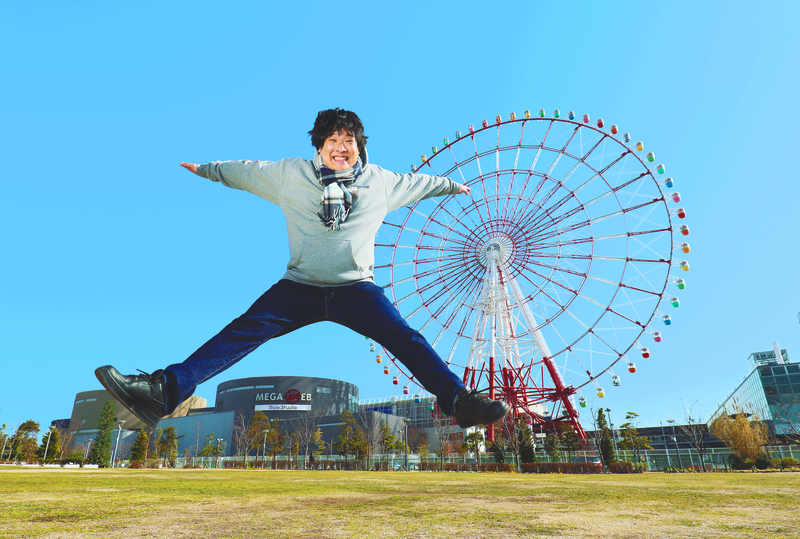
No one can dispute that Taiiku Okazaki is a highly innovative musician. Since making his major-label debut three years ago, Okazaki has repeatedly stirred things up with his comical songs and music videos that poke fun at the music industry.
Some admirers deride his sound as a waste of talent, but this is the music he will present at his concert scheduled for June at the Saitama Super Arena, a venue that typically hosts the biggest music stars.
Okazaki, 29, has surprisingly created these sounds not in a sophisticated music studio, but in a six-tatami-mat room at his parents' home in Uji, Kyoto Prefecture.
Okazaki says he has worked hard to spread the fictitious genre of "basin techno" to the rest of Japan from his hometown, which sits in a geographical basin.
"Am I really capable of giving a concert at Saitama while I keep working in this environment? It's a personal research theme for me, too," he said.
In his room, Okazaki creates music on a computer and a small keyboard on a writing desk that he has used since elementary school. He also sticks to innovative cost-cutting techniques that he devised before he was famous, such as putting his mother's pantyhose over a microphone to filter noise when recording.
Okazaki suddenly became known in 2016 when he released a video online for the song "Music Video." In the song, he parodies elements routinely used in music videos, with lyrics such as: "A singer walks while singing and looking into the camera. Suddenly, his band members emerge on both sides of him. His image is multiplied and projected side by side, but it's done for no reason."
Okazaki's immensely catchy tune, portly physique and lovable character only add to the video's appeal. It's no wonder it has been viewed more than 34 million times.
He keeps releasing highly original works that demonstrate his abundant talent.
In the music video "Kanjo no Pixel" (Pixel of emotions), he plays loud rock music in an unusually laidback manner. The playful lyrics in the chorus, which are in stark contrast to the aggressive music, include the lines: "You cute animals, come together and have fun. Piggy dear, over there, come here."
This video has been viewed more than 11 million times.
His distinctive living environment and creative style also attract people's attention. It is rumored that he can't move out of his parents' home due to his limited ability to live on his own. He also worked part-time at a supermarket until very recently, even while his star was ascendant.
His everyman image and soothing appearance are not the only things he has going for him. He's intelligent, tactical and ambitious, too.
"All I can say now is that I'll continue to lead my current lifestyle until my concert at Saitama," Okazaki said with a wry smile. "Some fans say things like: 'Don't move out of your parent's house' and 'Stick to that environment.' But that doesn't mean I've listened to them. I just want to be acknowledged as a singer who can attract 16,000 people to the Saitama arena while based in that room."
The full capacity of the Saitama Super Arena is more than twice that of the Nippon Budokan hall in Tokyo, which is considered a sacred spot for rock musicians.
Okazaki said he started setting sky-high goals after watching amateur musicians at a large-scale event when he was a student at Doshisha University in Kyoto Prefecture. Around that time, he posted music online with the Vocaloid singer Hatsune Miku. "My songs were played only 100 or 200 times at most," he said.
Ever since, he's repeatedly told people that he wanted to have a concert at the Saitama Super Arena.
After graduating from university, he started to work. But half a year later, he still hadn't given up on becoming a professional musician. His mother told him to pack it in if he couldn't make his debut within four years.
"I started to thoroughly analyze myself to find out how I could be recognized by people." He soon realized it would be best to try and make himself stand out from the crowd. He worked hard to incorporate unusual ideas into his work and make his performances more frenetic.
He made his debut with the album "Basin Techno" in May 2016. At that time, he asked his record company to let him do what he wanted, without a record producer.
In October 2018, Okazaki announced on NHK radio that he would be performing at the Saitama arena.
"It was amazing," he said. "I had just one or two audience members at some concerts just five years ago, you know." That night, he created a song titled "Ryu" (Dragon), which is included in his latest album "Saitama," released in January. The soothing song, which is accompanied by a simple piano melody, also has a melancholy sound, as if he is recalling the days that preceded his stardom.
The new album leaves out some of the surprises and comedy that have featured in his earlier songs. Explaining the bold move, he said: "I wanted to test myself to see if I could be successful with serious songs."
Asked about his future goals, he said: "I originally wanted to be a composer or backstage worker. I now want to write theme music for NHK's taiga period drama series." His goals are as ambitious as ever.
Okazaki's concert at the Saitama Super Arena, titled "Basin Techno," will take place on June 9. Tickets will go on sale on March 30.
Read more from The Japan News at https://japannews.yomiuri.co.jp/