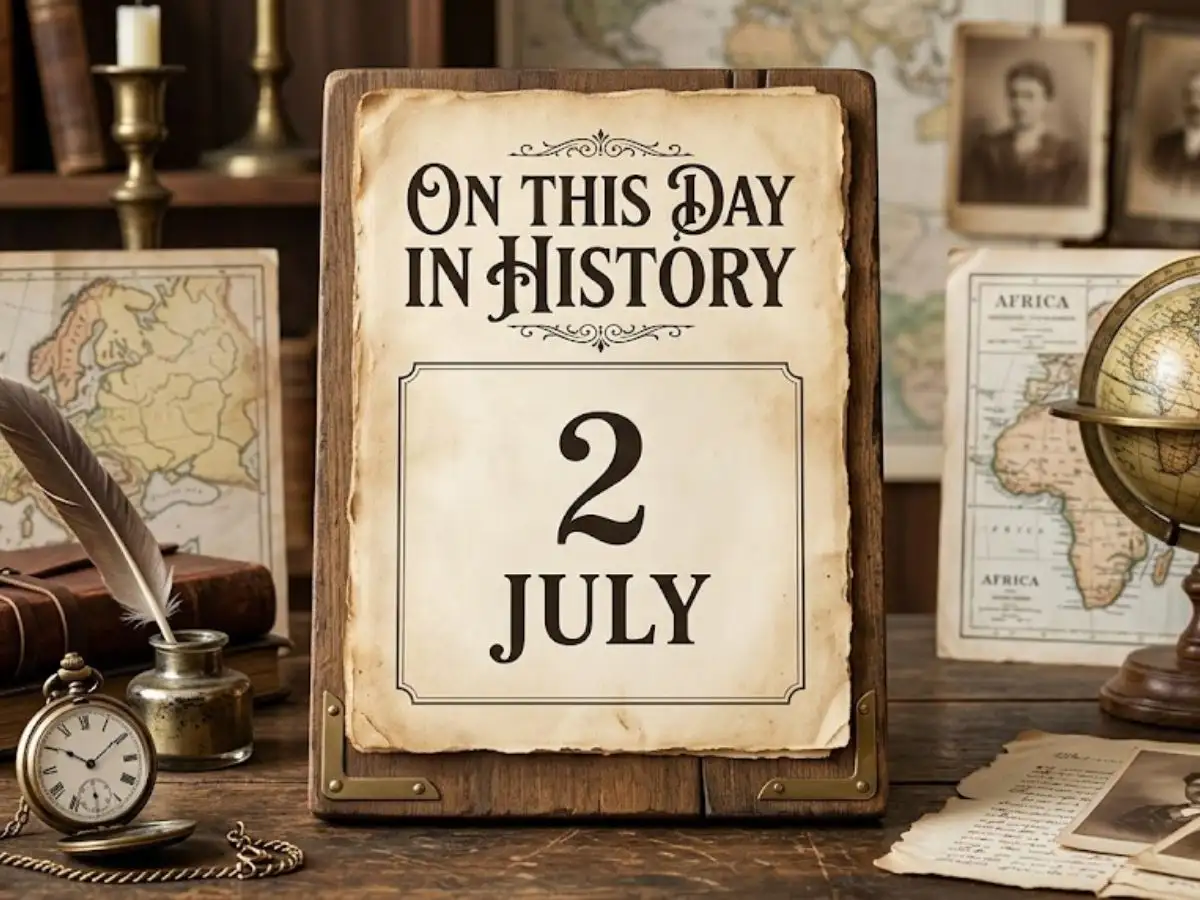
On this Day, July 2 has witnessed defining moments that shaped politics, civil rights, exploration and international relations across centuries. From the Continental Congress advancing American independence and the signing of the landmark Civil Rights Act in the United States to the mysterious disappearance of Amelia Earhart and the Simla Agreement between India and Pakistan, the date reflects turning points in history. It also marks important developments in literature, science, aviation and military affairs. Together, these events illustrate how July 2 has repeatedly been associated with decisions, discoveries and milestones that left a lasting impact on nations and societies around the world.
1266: Treaty of Perth
Norway recognised Scottish sovereignty over the Hebrides and the Isle of Man through the Treaty of Perth. The agreement resolved territorial claims between the two kingdoms and marked an important political settlement. It reshaped regional control and established Scotland's authority over the islands.
1505: Martin Luther vows to become a monk
After surviving a violent thunderstorm, Martin Luther declared that he would become a monk. The personal decision proved to be a defining moment in his life. It set him on a path that would later influence religious history.
1570: Ottoman Empire invades Cyprus
The Ottoman Empire invaded Venetian-controlled Cyprus and laid siege to its cities. The military campaign eventually resulted in Ottoman control of the island in August 1571. The invasion significantly altered control over the strategically important Mediterranean territory.
1679: Europeans reach Minnesota
An expedition led by Daniel Greysolon de Du Luth became the first group of Europeans to visit Minnesota and see the headwaters of the Mississippi River. The journey expanded European geographical knowledge of North America and marked an important exploratory achievement.
1776: John Dickinson abstains on independence vote
At the Continental Congress, John Dickinson abstained from voting on the resolution declaring independence. His decision reflected differing opinions among colonial leaders during a defining political moment. The vote nevertheless moved the colonies closer to independence.
1776: Continental Congress declares the colonies free
The Continental Congress resolved that the colonies "are, and of right ought to be Free and Independent States." The declaration marked a historic step toward independence from Britain. It laid the political foundation for the creation of a new nation.
1776: New Jersey expands voting rights
New Jersey granted voting rights to adults who could demonstrate a net worth of 50 pounds. The measure broadened electoral participation under the qualifications established at the time. It represented a notable development in voting policy.
1814: Mansfield Park published
Jane Austen's novel Mansfield Park was published in the United Kingdom by Thomas Egerton. The release added another major work to the author's literary legacy. The novel became an important part of English literature.
1843: Alligator falls during thunderstorm
An alligator reportedly fell from the sky during a thunderstorm in Charleston, South Carolina. The unusual incident became one of the more remarkable weather-related accounts associated with the date.
1847: First US 10-cent stamp envelope used
An envelope bearing the first US 10-cent postage stamps was used. The historic envelope has survived and remains an important postal artefact. The event marked an early milestone in American postal history.
1849: Garibaldi begins hunger strike
Giuseppe Garibaldi began a hunger strike in Rome. The action became part of the revolutionary leader's political struggle during a turbulent period in Italian history.
1862: Lincoln approves land grant for colleges
US President Abraham Lincoln signed legislation granting land for state agricultural colleges. The measure supported higher education by providing land for educational institutions. It became a significant step in expanding agricultural and technical education.
1863: Second day of the Battle of Gettysburg
The Battle of Gettysburg entered its second day during the US Civil War. Fighting continued between Union and Confederate forces in one of the conflict's most significant engagements. The battle became a defining moment in the war.
1865: The Salvation Army founded
William Booth and Catherine Booth established the East London Christian Mission, later known as The Salvation Army. The organisation began its work with a religious mission that would continue under its new identity in later years.
1867: First US elevated railroad begins service
The first elevated railroad in the United States began operating in New York City. The new transportation system introduced an innovative way to move passengers above crowded streets. It marked an important development in urban public transport.
1881: President James A. Garfield shot
US President James A. Garfield was shot on this day. Although he initially survived, he later died from his injuries on September 19. The assassination became one of the major political tragedies in American history.
1900: Zeppelin makes its first flight
The first successful flight of a zeppelin took place after the airship departed a floating hangar on Lake Constance near Friedrichshafen, Germany. The achievement marked a major milestone in aviation and demonstrated the potential of rigid airships.
1901: Butch Cassidy and the Sundance Kid rob train
Butch Cassidy and the Sundance Kid carried out a train robbery in Wagner, Montana, stealing $40,000. The robbery became one of the best-known exploits associated with the legendary outlaw duo.
1911: Ty Cobb extends hitting streak
Detroit Tigers star Ty Cobb recorded a hit in his 40th consecutive game during a 14-6 victory over Cleveland. The remarkable streak ended in the following game, but it remained one of the standout achievements of his career.
1915: Bomb explodes in US Senate reception room
Erich Muenter, an instructor in German at Cornell University, detonated a bomb in the reception room of the US Senate. The explosion became a notable security incident in Washington.
1916: Battle of Erzincan begins
Russian forces launched the Battle of Erzincan against the Ottoman Empire. The offensive formed part of the wider military campaign during World War I.
1916: Lenin submits manuscript on imperialism
Vladimir Lenin sent his manuscript arguing that imperialism was caused by capitalism to his publisher. The work later became one of his most influential political writings.
1921: Dempsey wins boxing's first million-dollar gate
World heavyweight champion Jack Dempsey knocked out Georges Carpentier in the fourth round before a crowd of 91,000. The bout generated boxing's first million-dollar gate and became a landmark event in the sport.
1940: Churchill meets Montgomery
British Prime Minister Winston Churchill met Major General Bernard Montgomery during World War II. The meeting brought together two key figures in Britain's wartime leadership.
1940: Subhas Chandra Bose arrested
Indian independence leader Subhas Chandra Bose was arrested and detained in Calcutta. The arrest came during India's struggle for independence and marked another significant episode in Bose's political journey.
1941: Joe DiMaggio breaks hitting streak record
Joe DiMaggio hit a three-run home run to surpass Willie Keeler's record by recording a hit in his 45th consecutive game. The achievement became one of baseball's most celebrated milestones.
1947: Soviet Union rejects Marshall Plan
The Soviet Union rejected assistance offered under the Marshall Plan. The decision marked a significant development in the post-World War II political landscape and reflected growing divisions between East and West.
1949: State of Vietnam recognised
The State of Vietnam received international recognition as the governing authority over the southern half of Vietnam, with Bảo Đại serving as chief of state. The recognition marked an important political development in the region.
1956: US conducts nuclear test
The United States carried out an atmospheric nuclear test at Enewetak Atoll. The detonation formed part of the country's ongoing nuclear weapons testing programme.
1957: Guided missile submarine launched
The USS Grayback, the first submarine designed to fire guided missiles, was launched. The vessel represented an important advance in naval military technology.
1962: First Walmart opens
American businessman Sam Walton opened the first Walmart store, then known as Wal-Mart, in Rogers, Arkansas. The business later grew into the largest retail sales chain in the United States.
1964: Civil Rights Act signed
US President Lyndon B. Johnson signed the Civil Rights Act into law. Widely regarded as the most significant American civil rights legislation since Reconstruction, the law became a defining achievement of the civil rights movement and transformed legal protections against discrimination.
1966: First French nuclear test
France carried out its first nuclear test on Mururoa Atoll. The event marked the beginning of the country's independent nuclear testing programme.
1968: El Al aircraft hijacked
An El Al Israeli airliner was hijacked and diverted to Algeria by three armed members of the Popular Front for the Liberation of Palestine. The incident became one of the notable aircraft hijackings of the era.
1971: USSR conducts underground nuclear test
The Soviet Union carried out an underground nuclear test at Komi, Russia, continuing its nuclear weapons programme during the Cold War.
1972: India and Pakistan sign Simla Agreement
India and Pakistan signed the Simla Agreement, a peace accord aimed at improving relations following conflict. The agreement became an important diplomatic milestone between the two neighbouring countries.
1977: "Gonna Fly Now" tops US charts
The theme song from Rocky , "Gonna Fly Now", reached the number one position on the US pop charts. The song became closely associated with the film and remains one of the most recognisable movie themes.
1989: Tiananmen student leader arrested
Tiananmen Square student leader Wang Dan was arrested and imprisoned on charges of spreading counterrevolutionary propaganda and incitement. His trial did not take place until 1991. The arrest became one of the notable developments following the protests.
1990: Mecca tunnel tragedy
A panic inside a tunnel in Mecca, Saudi Arabia, led to a stampede in which 1,426 pilgrims were killed. The tragedy became one of the deadliest incidents involving pilgrims.
1997: "Men in Black" premieres
Men in Black premiered in theatres. The science fiction comedy became one of the year's major film releases and introduced audiences to the franchise.
1998: "Harry Potter and the Chamber of Secrets" published
J. K. Rowling's Harry Potter and the Chamber of Secrets , the second book in the series, was published in the United Kingdom by Bloomsbury. The release continued the rapid growth of the bestselling fantasy series.
2016: Elie Wiesel dies
Romanian-born Jewish writer Elie Wiesel died at the age of 87. Awarded the 1986 Nobel Peace Prize, he was recognised for works that offered a powerful account of the near extermination of European Jews by Nazi Germany.
2019: First women nominated for top EU posts
Germany's Ursula von der Leyen became the first woman nominated to lead the European Commission, while France's Christine Lagarde became the first woman nominated to head the European Central Bank. The nominations marked a significant moment in European leadership.
2021: US withdraws from Bagram Air Force Base
The United States withdrew from Bagram Air Force Base in Afghanistan. The move marked a major step in ending the US military presence in the country.
People born on July 2
1937: Amelia Earhart disappears
American aviator Amelia Earhart disappeared over the central Pacific Ocean while attempting to fly around the world. Her fate remains one of aviation's greatest mysteries, and her disappearance continues to attract global interest.
1962: Sam Walton opens first Walmart
American businessman Sam Walton opened the first Walmart store in Rogers, Arkansas. The business grew into the largest retail sales chain in the United States, transforming the retail industry.
Days celebrated on July 2
Made In The USA Day
Made In The USA Day recognises products manufactured in the United States and encourages support for domestic industries. The observance highlights American production, craftsmanship and businesses while promoting awareness of goods made within the country.
World UFO Day
World UFO Day encourages people to learn about unidentified flying objects and discuss reported sightings. The observance also invites interest in space-related mysteries and theories while promoting conversations about the possibility of extraterrestrial life.
National I Forgot Day
National I Forgot Day offers people an opportunity to make up for forgotten tasks, appointments or promises. The observance encourages individuals to complete overdue responsibilities and reconnect with things they may have unintentionally overlooked.
Freedom From Fear of Speaking Day
Freedom From Fear of Speaking Day raises awareness about public speaking anxiety. It encourages people to build confidence, overcome communication fears and develop stronger speaking skills in personal and professional settings.
National Disco Day
National Disco Day celebrates disco music and its cultural influence. The observance honours the genre's energetic rhythms, memorable dance culture and lasting impact on music and entertainment.
Special Recreation for the Disabled Day
Special Recreation for the Disabled Day highlights the importance of inclusive recreational opportunities for people with disabilities. The observance promotes accessible programmes that encourage participation, enjoyment and community involvement for everyone.