
It was already an unbearably uncomfortable day in Melbourne – then a freak event took the city by storm. There was something even worse on the horizon.
By 2.30pm on this day in 1983, temperatures had reached a top of 43.2 degrees Celsius.
Half an hour later, Melburnians were plunged into darkness.
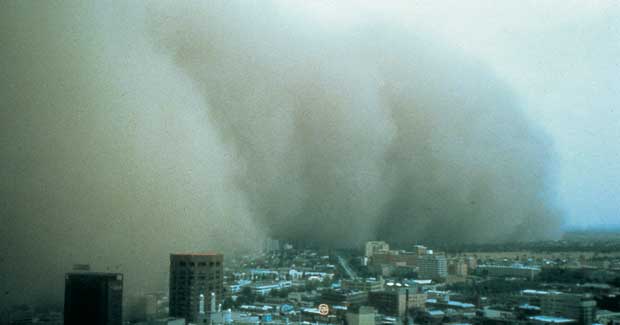
Like a doomsday scene from the apocalypse, a giant wave of dust began sweeping over the city, turning day into night.

Trees and power lines came crashing down, with more than 150,000 people losing power.
Trains stopped running, boats were ripped from moorings and the city’s three airports at Tullamarine, Essendon and Moorabbin closed.
Most people couldn’t see further than 100 metres in front of them, their eyes stinging and dust coating their hair and ears.
But the impact wasn’t restricted to the CBD.
Winds of up to 140km/hr were reported at Point Lonsdale. At Mornington, gusts reached 100km/hr.
To this day, the extreme weather event remains Melbourne’s worst dust storm in history, dumping an estimated 100,000 tonnes of soil onto the city.
So what happened?
It turned out the dust cloud was a layer of dry topsoil from the Western Districts of Victoria that had been scooped up and whipped into a frenzy by strong northerly winds.
The storm was one of the most dramatic consequences of the 1982-83 drought, which was the worst in Australian history at the time.

In hindsight, the dust cloud was viewed as a precursor to the Ash Wednesday bushfires eight days later.
That emergency devastated Victoria and South Australia by wiping out 3700 buildings and killing 75 people.
Dust had also enveloped Adelaide on the day the fires started.