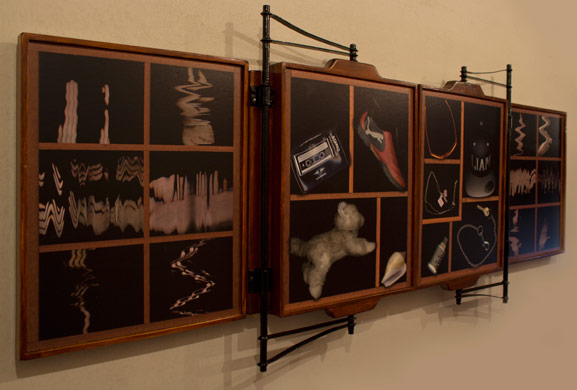
This piece was initially inspired by train and transport lost property departments. The work includes objects special to the artists, plus actual mislaid possessions from the school's lost property box, capturing a record of items important to young people in 2013.
Artist: Damien Robinson with year eight students from Treetops School, Grays. Cabinet maker: Walter Reid
Research and workshops for the exhibition took place over four months at participating schools and included field trips to regional and national heritage sites. Pupils studied events dating back to the early settlements of 1086 at Shoebury and Thurrock, along with the use of the Thames for transport, defence and as a source of food Photograph: Metal
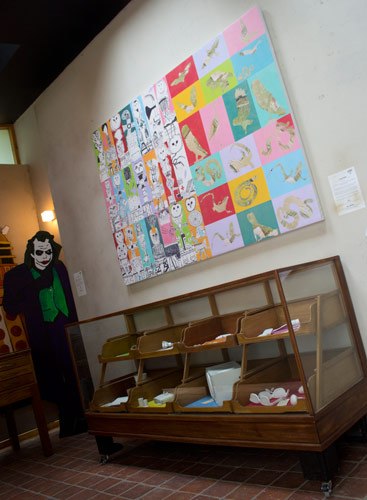
Museum of the Ordinary (below)
Mucking was once one of Europe's biggest landfill sites – and one of the UK's largest archaeological digs – but is now a nature reserve. The artist and students considered the multiple identities of Mucking to create icons representing it. Meanwhile, for Museum of the Ordinary, pupils concentrated on the concept of identities being 'fossilised' through discarded objects, providing insight into human life.
Artist: Heidi Wigmore with year nine students from Hassenbrook Academy, Stanford-le-Hope
Screen Tilbury (back)
Tilbury has been used as a location for many film and TV productions. The artist and students created lifesize depictions of iconic characters and took them out into Tilbury, visiting film locations and creating their own videos.
Artist: Rob Smith with Year 12 and 13 students from The Gateway Academy Photograph: Metal
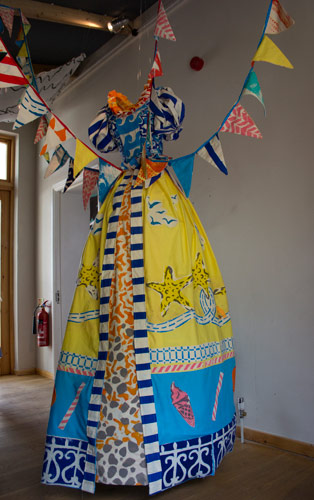
The work was the effort of 104 pupils – the entire reception year of Chalkwell Hall Infants. Each class created a piece of textile art, brought together in a hanging costume. Groups explored themes of the natural coastline, seaside holidays, travel and commuting, and Victorian Southend. Workshops focused on designing the costume with a Victoria silhouette and hand printing and painting all the fabric for it.
Artist: Lesley Ford with reception students from Chalkwell Hall Infant School Photograph: Metal
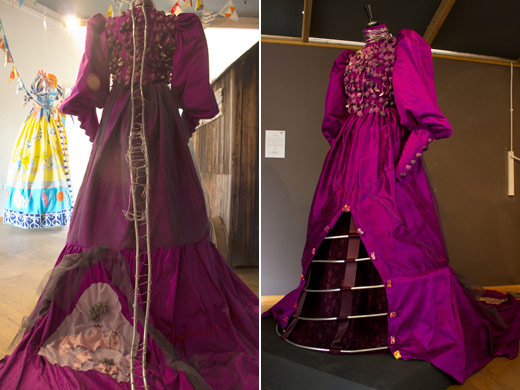
A sculptural costume interpretation of the London, Tilbury and Southend train line, inspired by the railways developed in Essex during the latter half of the Victorian era. The artist and students together researched Victorian costume, historical photographic documentation of trains and promotional tourism posters for the south coast dating from the mid-1920s to the mid-60s. The backbone tracks give the core strength and structure to the sculpture, reflecting the way the train line made tourism and trade possible.
Artist: Holly Murray with year one to six students from Fairways Primary School Photograph: Metal
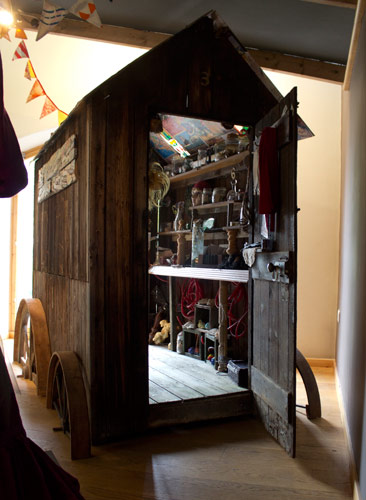
The artist and students studied the Victorians' desire for invention and progress. The arrival of the railway in Southend transformed the town from a rural, fishing and farming community into a popular seaside resort. Sea bathing became fashionable, giving rise to yet another invention: the bathing machine, to protect the modesty of female tourists. The second theme for this work was the Victorians' enthusiasm for travel and for bringing back curios – stocking whole rooms with specimens, taxidermy and objects of interest. The groups combined the two threads to build their own curiosity cabinet filled with handmade and collected ornaments.
Artist: Sally Chinea with year seven and year 13 students from Chase High School Photograph: Metal
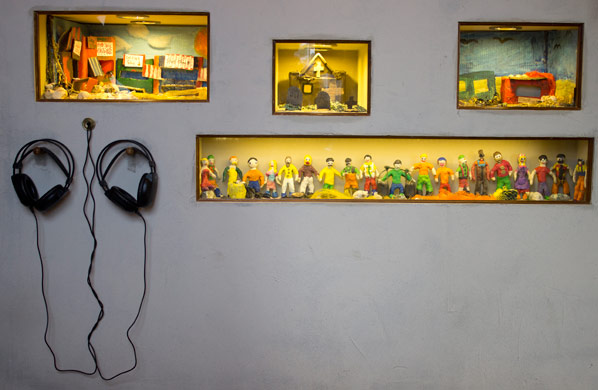
Leigh North Street Junior School has close connections with the fishing community. Using stop-motion modelled characters and drawings, the artist and 90 pupils created a film describing the history of the area's fishing industry in a series of stories. The models and sets incorporate objects found during a trip down to Old Leigh and the cockle sheds where the fishermen work. Groups also recorded local sounds, interviewed fishermen and created a sea shanty especially for the film.
Artist: Josie Moore with year four students from Leigh North Street Junior School Photograph: Metal
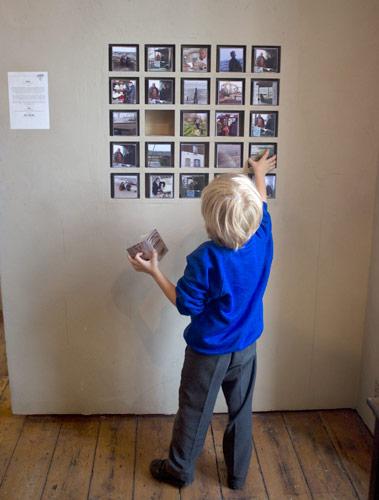
This 3D collage of photography consists of 25 cubes, each with six different images representing the area through the themes of portrait, architecture, transport, water, tourism and nature. Visitors are encouraged to rearrange the cubes to create their own depiction of Southend. Each cube represent one student's work and their individual interpretation of themes within their town.
Artist: Chloe Dewe Mathews with years seven, eight and nine students from St Bernard’s High School Photograph: Metal
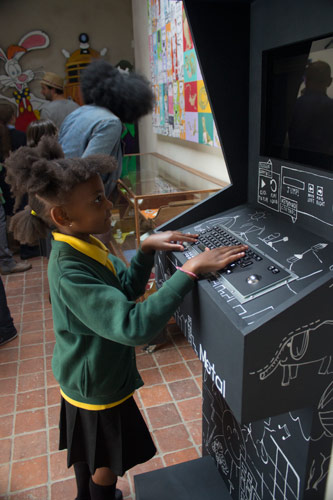
Students at Westcliff High School for Girls designed and built an online platform computer game called Play Southend. The game uses drawings created by the students who also created the game's rules and storylines. Make more sunshine for Southend’s seafront and Adventure Island. Collect lightning bolts or risk an apocalyptic flood! And while you’re at it, why not clean up the air in Southend High Street? The game created for On the Line with Nastassja Simensky is part of a larger, ongoing project by artists Ruth Catlow and Mary Flanagan. The full game, which includes hundreds more drawings and levels, will be launched at the Village Green festival on Saturday 13 July 2013. See www.playsouthend.co.uk for more details.
Artist: Nastassja Simensky with year nine students from Westcliff High School for Girls Photograph: Metal
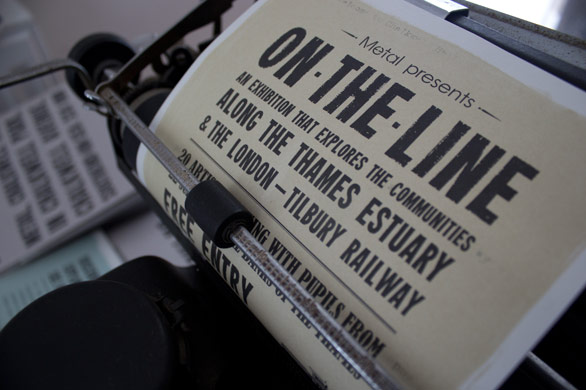
The exhibition runs until Friday 26 July 2013 at Chalkwell Hall. More details at www.metalculture.com Photograph: Metal