An increasing number of companies have banned employees from smoking during their work hours, aiming to resolve low productivity caused by their "smoking breaks" as well as to improve their health, which would help companies ease such social-security burdens as medical expenses.
In light of growing public criticism of smoking, the number of companies banning smoking on duty is likely to further increase.
In June, Taiyo Life Insurance Co. abolished all smoking areas set in its headquarters as well as in about 150 branches and offices nationwide. About 3,000 people, or about 30 percent of all employees, were smokers, but all of them quit smoking in the offices, according to the insurance company.
"As I stopped smoking during work hours, I can work efficiently and have become more health conscious," said Kazuyuki Hitomi, the company's field administration division.
Shimadzu Corp. has banned its employees from smoking for about one-hour before and after their lunch breaks since October and will eventually expand this to all business hours from spring 2020.
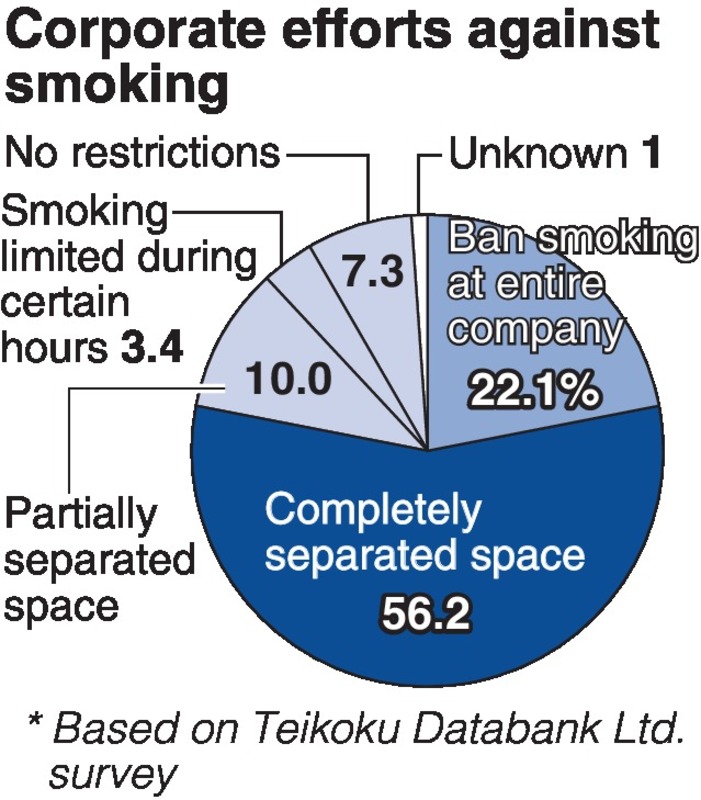
According to a Teikoku Databank Ltd. survey in September last year conducted on about 10,000 companies nationwide, 22.1 percent of the respondents said they had banned smoking entirely in their workplaces.
The revised Industrial Safety and Health Law, which took effect in 2015, requires companies to take measures against passive smoking at workplaces, prompting them to work on banning smoking.
Smoking breaks are often pointed to as lowering productivity as they disrupt smokers' work activities. According to a survey by the U.S. Institute for Health and Productivity Management, so-called hours of productivity loss -- working hours when employees are not active -- are about 76 hours a year among smokers, 1.8 times higher than the figure among nonsmokers.
In April this year, a male employee of Osaka prefectural government in his 40s was punished as his smoking break was seen as problematic, and the case drew public attention.
The prefectural government has banned its employees from smoking during work hours since 2008, but this employee had left the office to smoke outside for more than 100 hours in total without permission.
Criticism is aroused among nonsmokers as it is unfair to allow smoking breaks in terms of labor time. Piala Inc., a Tokyo-based information technology start-up, launched a system to allow its nonsmoking employees to have six extra paid holidays a year. The system was designed to fill "a gap of working hours between nonsmokers and smokers who have smoking breaks," according to the spokesperson, and also to encourage its employees to quit smoking voluntarily.
According to another Teikoku Databank survey (with multiple answers allowed), 11.5 percent of the respondents said abstaining from smoking in the workplace "helped improve business operation and promoted streamlining," and 5.2 percent said, "Productivity per hour has improved."
University of Occupational and Environmental Health, Japan Prof. Hiroshi Yamato said: "[Banning smoking] will help improve productivity and is beneficial to the business side. The number of companies following suit will increase in the future."
Read more from The Japan News at https://japannews.yomiuri.co.jp/