Are we naturally selfish? Or do we have an innate sense of empathy for our fellow living things? The radio journalist Herbert Morrison watched the Hindenberg come down and announced, “Oh! The humanity!” And once I stood outside a pub on the canal in Camden and watched a crowd of drunken men laughing and cheering as five seagulls pecked a fluffy baby duckling to death. I said nothing. But I suddenly understood why Mock the Week was so popular.
Perhaps there is hope for our species, despite the popularity of TV comedy panel shows. On Friday I witnessed at close hand the first flowering of the spontaneous collective act of compassion that has since dominated celebrity social media feeds all weekend, reaching critical mass at around 2pm Saturday, when the sheer density of tweets caused Danny Dyer’s nut to freak out, and saw Ricky Gervais append the heartwarming story to a breakdown of Netflix viewing figures for Derek.
Soon after breakfast on Friday morning I had crossed the Scottish border, driving north between standup shows, from the St Cuthbert’s Players Playhouse in Alnwick up to the Kate Middleton Memorial theatre in St Andrews, where the young Prince William’s eye first fell upon his future bride’s Scaramouche in a performance of Ben Elton’s We Will Rock You.
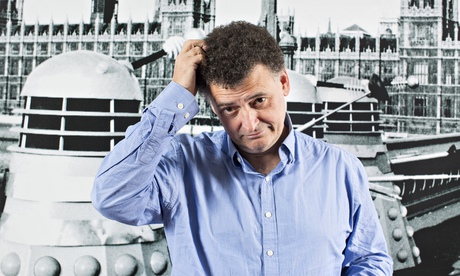
Gradually, on the southbound side of the A1, an enormous convoy of vastly varied Scottish vehicles appeared to take shape, streaming endlessly towards England, honking in celebration as they passed. But why? Not having a car radio, eschewing the iPhone, and unable to buy a copy of Friday’s Guardian that far north, I wasn’t able to make sense of the incoherent events. I pulled off the road to watch at Ayton, by the sign for Q’s Cat Motel, which was where I ran into Steven Moffat.
I had met the Scottish Doctor Who writer-producer once before, at a BBC thinktank. I had suggested a new long-running drama series about a little old man whose face and body stay the same for millions of years, but whose buttocks are played by the buttocks of a succession of currently fashionable character actors, as the decades progress, of all races and genders. Needless to say my idea was rejected by the fearful “suits”, concerned, doubtless, about appearing too “politically correct”, and in terror of losing the licence fee under a Tory government.
And now here was this Moffat again, by chance, at a cat motel off the A1 in Berwickshire, checking in his prize Persian, Erato, in anticipation of a long journey south. Perhaps Moffat could explain to me what on earth was going on. “Ian Rankin direct-messaged me and told me that Wattie from the Exploited was on Twitter encouraging all Scots to form a relief convoy,” Moffat explained, “and then Miss Barbara Dickson phoned me up in tears saying we had to mobilise the Scottish public. I asked myself, ‘What would Doctor Who do?’ Doctor Who would help. I know that better than anyone.”
In the sudden and unexpected political shift of the green island we all call home, the liberal left south of the border had been marooned, abandoned without hope. The Scottish celebrities’ heartstrings had been twanged and, overnight, their fans and followers had used social media to spring into action. I ran to the road and watched the first of the flotilla of little vehicles beginning the return journey north, their available space crammed with escapees.
All Scottish life was there, taking to their highland home those with nothing left to lose. A tweed-clad Loch Lomond laird in a spluttering vintage car turned his head toward the backseat to laugh with a gaggle of London schoolkids, avoiding academy status and the dead hand of Gove; half a dozen turbaned Scottish Sikhs, in a mobile festival catering wagon, partied with northbound Brighton lesbians, fearful of life under an equality minister who voted against gay marriage; and a whisky-nipping gillie at the wheel of a Land Rover softly stroked a young Yorkshire vixen and her sleeping cubs, escaping the repeal of the hunting ban.
I repositioned myself on the central reservation to continue to observe the convoy. Edinburgh Muslims, chefs from the Mosque Kitchen, drove a delivery van usually laden with cash and carry rice, and planned their pause for Friday prayers with the family of left-leaning north London Jewish academics they were taking with them, thinkers and readers for whom life in England was about to become intellectually intolerable; Heriot-Watt students, dressed as vampires, had rerouted the Haunted Auld Reekie Tours bus they worked on at weekends on an unscheduled excursion, and now swapped alcopops with southern arts and humanities graduates, finally accepting that they had no future in a culture that saw the outpourings of the human heart as nothing more than missed opportunities for monetisation. And farm trucks from the far north, thick with the ground-in dung of prize highland cattle, trundled towards the tartan utopia, their fenced flatbeds now thronged with teachers, poets, artists, dreamers, the poor and the unprofitable.
And then, as I crossed back to my car, there came the most moving sight of all. Celtic fans and Rangers fans, working together, taking turns to steer a hastily commandeered ambulance north, nursing the brows of dying old folk, bed-blockers from beneath the border, soon to be set adrift by the ongoing privatisation of their home visits, their tragic plight dissolving age-old sectarian differences. And all these noble Scots, it would transpire, had set their ancient grudges aside to assist those condemned to suffer by the unwieldy splitting of the democratic deck. I got back in the car and followed the convoy north.
As the makeshift convoy stopped at Dunbar for the night, the practical limitations of Wattie from the Exploited’s vision became apparent. The volunteers’ vehicles discharged their human cargo into a succession of hastily commandeered campsites, Dunbar Camping and Caravanning at the golf course, and Belhaven Bay by the reservoir, which were soon overwhelmed. “Is this what you wanted?” I asked Wattie, who was using a stolen golf club to direct the traffic. Wattie looked weary, his red mohican wilting a little. “I’m no genius,” he said, “but I looked at those poor people and I knew we had to do something. I don’t have a plan. I don’t even know what we’re going to do tomorrow. But at least we did something. You know what they’re calling this? The Miracle of Dunbar. Not bad, eh?”
Stewart Lee’s A Room With a Stew plays the Edinburgh festival fringe in August; see stewartlee.co.uk