Hanif Kureishi, CBE, was born in Bromley, south London, in 1954 to British-Pakistani parents, and studied philosophy at King’s College London. In the 1970s, he wrote pornography under various pseudonyms, before turning to playwriting for Hampstead theatre and the Royal Court. In 1985, he wrote the Academy Award-nominated screenplay for My Beautiful Laundrette, directed by Stephen Frears. In 1990 he published the semi-autobiographical The Buddha of Suburbia, which won the Whitbread best first novel prize; he adapted it for TV in 1993. A collection of short fiction and essays Love + Hate, is out now from Faber & Faber.
1 | Place
The Freud Museum, London
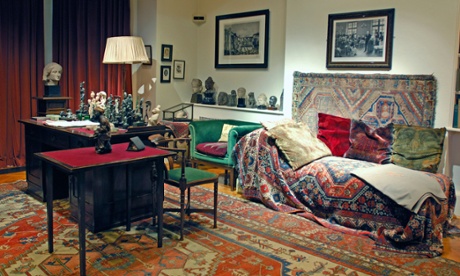
This is in the house in Hampstead where Sigmund Freud lived and died after he came to London. It is a fascinating place. As well as significant objects from his life, including his couch, it has a great library and a lovely garden. They have fantastic talks given by all sorts of people, not only psychoanalysts, but artists, sculptors, writers, on a huge range of subjects. Like most artists, from James Joyce to Hitchcock, I have an abiding interest in the unconscious and the Freud Museum is a reminder that so much of the language we use to talk about ourselves – both words and concepts such as neuroses, phobias, fears, excitements, authority figures – derives from him and his work.
2 | Theatre
The Young Vic, London
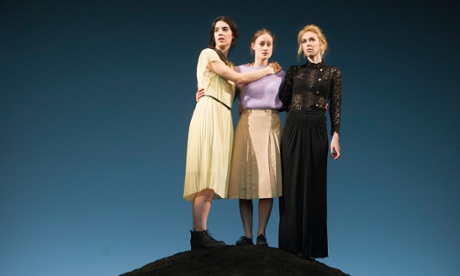
One of the main reasons I like the Young Vic is that the audience is fantastically diverse, nothing like the Jurassic lot you get at most London opera and theatre productions. There are always a lot of young people there and a mix of races and backgrounds. They invariably produce top work from some of the best actors and playwrights in the world. Highlights for me have been a wonderful version of Three Sisters directed by Benedict Andrew in 2012 and Chiwetel Ejiofor in a stunning production of A Season in the Congo two summers ago. I love the way the auditorium looks different for every production because they make use of every possible part of the building.
3 | Book
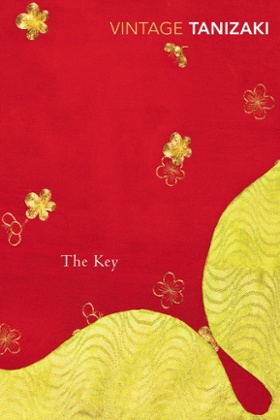
The Key by Jun’ichiro Tanizaki
This is a wonderful novel written in 1956. It’s a classic of world literature, about a middle-aged couple, with a daughter, who have been married for a long time. The wife is very inhibited but she begins drinking and when she drinks she falls into a dead faint. The husband starts to take photographs of her drunk and naked and to have sexual relations with her while she’s in that state. He shows the photographs to a friend of his daughter who develops them and also becomes sexually obsessed with the wife and begins a sexual relationship with her. It’s a novel of perversion, not least because the husband is obsessed with his wife’s feet, and it is also about inhibition and the inability of a couple to really speak to each other. I first discovered it about 10 years and I’ve been re-reading it recently because it is so cleverly constructed. It is all written through their diaries, so there’s no authorial voice, which makes it feel very contemporary.
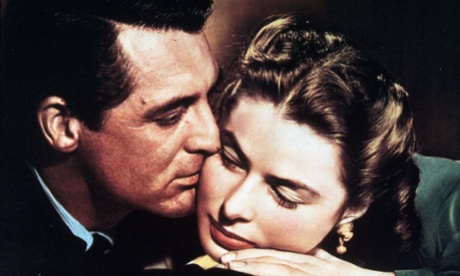
4 | Film
Notorious (Alfred Hitchcock, 1946)
This is a film made by Hitchcock in 1946, starring Ingrid Bergman and Cary Grant, partly set in Rio. Grant plays a British agent who is in love with Bergman. Due to a series of misunderstandings, she begins a relationship with and marries a man who is a suspect in Grant’s secret investigation into an organisation of Nazis who have moved to Brazil after the second world war. I’ve recently started watching Hitchcock again because I’m very interested in how it was possible for somebody to be a major artist, as he undoubtedly was, but also to be a popular artist, making thrillers for mass audiences. And because I am a teacher of creative writing I am very interested in structure and I am very interested in anxiety. One of the things Hitchcock was unmatched at was creating anxiety in the audience. By the time you’re three quarters of the way through the film, you’re extremely anxious about the outcome. You really want to know what’s going to happen. How did he do that? It’s a fascinating accomplishment.

5 | Music
Creation by Keith Jarrett
This is Jarrett’s first solo album for a few years, and I think it’s great. I have been a fan of his since he played with Miles Davis in the 1960s. The Köln Concert is one of my favourite records of all time. I listen to a lot of jazz when I am writing, reasonably quiet jazz like Jarrett’s. He’s 70 now and he is a man who has remained creative his whole life. Unlike most of us, his work is always surprising and new and refreshed. And he does these amazing improvisations. He sits down and makes this stuff up in front of you. It’s very exciting to think that this man is pulling something off live in front of you and he has no idea where it is going to go next. I’m very interested in that in the context of writing because in a sense all writing, at least at the beginning, is a form of improvisation. You start with nothing and by the end of the day there is a story that you have told almost by mistake, or at an angle from yourself, that you didn’t know before.

6 | Cafe
Café Rouge, Shepherd’s Bush, London
The Café Rouge is, of course, a chain and not known for the delicacy of its food or the number of Michelin stars it has won (or not). But it is my local and my theory about this – I guess because I grew up in the 1960s when everyone went to pubs – is that you need a local. You need a local to go to at the end of the day to gossip with your mates. I meet my friends at the Café Rouge three or four times a week. I try to avoid the food but I’ll have a beer or a coffee and we talk. We talk about politics, the EU, about our friends, our sex lives, who’s getting divorced, who’s getting married, the state of the world, how terrible things are, about our health, who’s dying, who’s still alive, who’s having an operation. This form of gossip, both high and low, is essential for a person’s healthy state of mind and relationship with the world. It’s especially important for me because writing is so solitary. I sit in a room all day scribbling away by myself. By 5pm I need to get out and away from the horror of my own imagination.