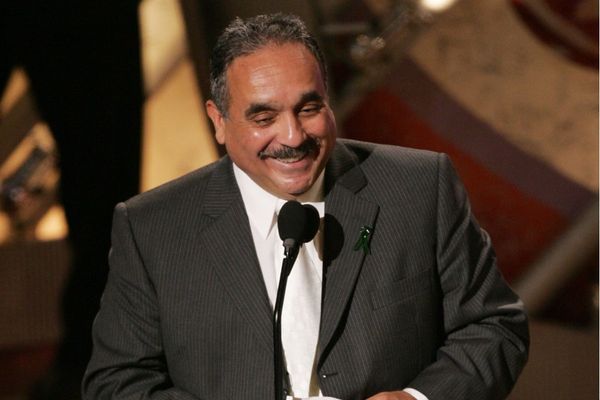
Writer, journalist and broadcaster Jonathan Meades was born in Salisbury in 1947 and was educated at Rada. His prolific TV work includes Abroad in Britain (1991), Victoria Died in 1901 and Is Still Alive Today (2001) and The Joy of Essex (2013). He was the Times’s restaurant critic from 1986 to 2001 and won best food journalist at the 1999 Glenfiddich awards. He has also published a number of fiction and nonfiction books, including Pompey (1993), The Fowler Family Business (2002) and An Encyclopaedia of Myself (2014). Jonathan Meades’s first art exhibition, Ape Forgets Medication, is on show at the Londonewcastle Project Space, London E2, until 27 April.
1 | Fiction
Transparent Things by Vladimir Nabokov

It’s many years ago that I first read this novella, and I keep on reading it – I must have read it 15 times – because it’s extraordinarily mysterious. It’s like picking up a piece of mercury. There’s something weirdly ethereal about it: you don’t know who is narrating, it repeats certain leitmotifs over and over again. The fairly unlovely protagonist strangles his wife while maybe sleepwalking, one doesn’t really know. It has some glorious comic moments, where for instance his father dies trying on an extremely tight‑fitting pair of trousers. For a long time it was out of print, but it’s back in print now. My only real newish enthusiasm is for a French writer called Régis Jauffret: he’s tremendous.
2 | Film
Judex by Georges Franju

This was a remake of a silent film. It’s kind of proof that surrealism is something that is always there, it has nothing to do with the surrealist movement, which was rather dictatorial. It stars an American magician called Channing Pollock – a very handsome and strange-looking guy. It’s about a crime in a country house, but it breaks every rule of British thrillers. There’s a magnificent scene of a masked ball, where people walk into this room wearing vulture heads and so on, and there’s a scene at a railway station where a nun stabs a man in the shoulder with a six-inch syringe. It’s absolutely terrifying, and also quite magical.
3 | Painting
Self-Portrait (Selbstbildnis mit Modell) (1927) by Christian Schad

Schad was of the major Weimar artists and the one who I found most appealing. He was misanthropic, funny, pretty brutal and a meticulous technician. The portrait in question has him looking expressionless, wearing a bizarre green diaphanous blouse, and behind is a woman who is wearing virtually nothing. She has a scar – like the scars 19th century gangsters in Naples used to inflict to say ‘this is my woman’. The relationship of the man to the woman is imponderable: they might be lovers, she might be a prostitute, they might be married, they might just be an artist and a model.
4 | Place
Environs of Euston Station

I live in France now, but I lived in London most of my adult life and loved going to obscure bits of it: the dinosaurs in Crystal Palace park, Upper Norwood. Euston on the other hand is more central. When I was at Rada, which is off Gower Street, I used to walk aimlessly – it’s cheap to walk aimlessly. Within 100 metres of Euston station there are four absolutely remarkable buildings: St Pancras New Church, the Euston Road fire station, the Elizabeth Garrett Anderson hospital, and a really odd building called Grafton Chambers. It’s amazing, the four buildings are so totally different from each other, but they give you some idea of how strange London is and that there is no consensus about building.
5 | Comedy
Marty Feldman

He was simply the funniest man. He died young in the early 80s; I don’t think he made 50. He was extraordinary looking – he had hyperthyroid eyes [Graves’ disease], and just to look at him was rather joyful. He was on At Last the 1948 Show, which was the precursor to Monty Python and had John Cleese and Graham Chapman. There’s a wonderful sketch in which Feldman, wearing a mitre and a bishop’s garb, and holding a pint of beer and a joint, comes into a railway carriage and says, ‘I’m a bishop’, then behaves in the most un-bishoplike way. I watch it over and over again.
6 | Television
The Gorge and Hearts and Flowers by Peter Nichols

I think Peter Nichols is a kind of genius. His stage work is quite theatrical, borrowing from panto and so on, whereas his TV work [Anthony Hopkins in Hearts and Flowers, above] was meticulously naturalistic. There wasn’t any crossover between them, it was as if two people were writing. These two TV plays, from 1968 and 1970, were about petty bourgeois Bristol – it was almost as if they were about my family in Southampton – done with this incredibly sharp and unsparing eye. He’s an incredibly funny writer. Wonderful incidents occur where you think ‘Oh my God! That is how people behave!’. Unlike a lot of TV today, Nichols’s stuff had a pithiness and a tightness that you get from writing a script of 80 or 90 minutes.
7 | Poem
The Ruined Maid by Thomas Hardy

I came very late to Hardy’s poetry. It’s a social satire, the maid of the title. In a nutshell, a farm woman runs into someone else who used to work in the farm, now dressed in finery. She’s a kept woman who speaks one line in every verse about her ruination. Ruination is rather preferable – the Victorians were odd about this, in some ways very frank and in others very covered. She has made something of herself by going away and admittedly compromising herself in a way that her friend hasn’t, but at least she isn’t still digging up turnips. There are no easy answers – it’s a terrific bit of work.