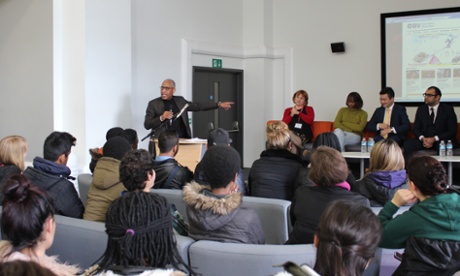
The students dragging their feet into the common room at Waltham Forest College seem less than thrilled by the prospect of discussing politics. “Why are we here?” says one. Looking down at their phones, engrossed in Snapchat and speculating about who the strange people were perched on stage, it seems only a great feat will engage this crowd of mainly black and minority ethnic (BME) teenagers.
Waltham Forest, in north-east London, is one of the most ethnically diverse areas in the country. In the last census in 2011, 36% of people described themselves as white British, 17.4% black, and 10.2% Pakistani. It is the 15th most deprived borough in the UK.
All this explains why a bright orange bus, emblazoned with the image of the US civil rights activist Rosa Parks, is paying a visit to one of the area’s biggest colleges. The vehicle is the OBV eXpress – the flagship of Operation Black Vote, which has been campaigning for greater political participation and representation of BME communities for almost 20 years, launching the political careers of former Conservative party chair Lady Warsi and the first black female Tory MP, Helen Grant.
OBV’s co-founder and director Simon Woolley takes the mic to address the scores of students in the common room of Waltham Forest College. “I often believe the political status quo depends on you not voting. If you don’t vote, they’re not going to listen,” he tells them.
The status quo to which Woolley refers is the 50% rise in unemployment among young BME people since the coalition government came to power in 2010, the growing attainment gaps in education and the prevalence of police stop and search. Change is unlikely, he says, if low voting registration persists among BME people in Britain – 28% of black Africans were not registered to vote at the last election compared with 7% of white British, according to the Ethnic Minority British Election study (EMBES).
This is where the OBV eXpress comes in. Alongside Parks are images of a woman in a wheelchair and Sikh soldiers – referencing the Sikh regiments that fought for Britain in two world wars. Inside are 12 laptops open on the government’s voting registration website.
OBV hopes to register more than one million new voters, many in marginal seats such Croydon Central, south London. The organisation has identified more than 160 seats where the estimated number of BME voters is bigger than the majority of the winning party in 2010.
Sitting on the bus’s sofa, Woolley says: “Many people feel powerless and that nothing is going to change. We’re saying to people: register to vote and demand greater social and racial equality.”
Back at the college Woolley asks the parliamentary candidates for Walthamstow, the local constituency, to explain to the students why they should vote.
Tory candidate Molly Samuel-Leport takes the stage: “Your vote is important regardless of which party you believe in. I happen to believe in the Conservatives.”
At this point one audience member boos, but Samuel-Leport – a black mother at 14 from a tough housing estate who fought to become seven-times world karate champion – battles on to drive home her message. “Get out and there and vote, don’t waste it,” she says.
Bilal Mahmood, Labour candidate for nearby Chingford and Woodford Green, and standing in for Walthamstow’s incumbent MP, Stella Creasy, tells them: “The best way to invoke change is to get down there on that bus after that meeting to register to vote and then vote.”
Woolley then invites questions from the students; no one appears to be brave enough to ask a question. But after prodding by his friends, 18-year-old Ayo Abiodun from Gants Hill puts his hand up.
“You’re all talking and were listening but the thing is when you actually get in power are you actually going to keep your promises?” says Abiodun, who arrived in London from Nigeria aged seven. His question triggers rounds of applause and cheers.
Woolley responds: “We need to reclaim democracy and to make sure politicians are more accountable. That if they’re not doing their job we get rid of them halfway through parliament.” He ends the session by telling the packed audience: “Let’s today make history that will change our society. Are you with me?”
The steady stream of enthusiastic students registering to vote at the bus seemed to answer that question. Among them is Abiodun, whom the Guardian spots emerging from the bus after registering. “I feel like we all have a say in the government and if we don’t act fast our voice won’t be heard and we won’t get what we deserve,” he says.
Also in the crowd is business student Bruna Silva, 18, from Walthamstow. Silva works alongside her course to support herself. “I’m cleaning and cooking for long hours and I’m getting £20 for the whole day,” she says. She hopes her vote will help her improve her prospects.
Another first-time voter is Phil Bunyan. The 24-year-old is learning his trade as butcher on a Morrison’s apprentice scheme. From a white, working-class background in Dorset, he says: “Before I never really felt I would have benefited by voting. But now I’d like to think my vote counts for something.”
Eleven weeks into taking over Waltham Forest College, the principal, Penny Wycherley, is determined to get her students to engage in politics.
“When we first started this I wondered what sort of turnout we would have, but today I’ve seen enthusiasm,” she tells me, adding that her students face language barriers, poverty and stereotyped views about what they can achieve.
Maria Sobolewska is a political scientist at the University of Manchester and has studied BME voting. Though her work on the EMBES she found that many citizens of Commonwealth countries did not think they were eligible to vote and so did not register.
Unlike Woolley, Sobolewska is not so optimistic the registration rate among BME people will increase. In an attempt to make voting more secure the Electoral Registration and Administration Act 2013 introduced individual registration, instead of one person in a household supplying the details of all the people living at that address. The Labour leader, Ed Miliband, has claimed that a million people, many of them students and young people, have dropped off the electoral roll as a result.
Sobolewska says: “I think it will have a particularly negative impact on the minority community, because usually the head of household – who is economically active and perhaps speaks the best English – would register the entire family. In patriarchal communities and with newer immigrants, we think a lot of people will drop off the register.”
She plays down OBV’s suggestion the BME vote could decide 160 seats at the election: “Because the British minorities are more likely to vote Labour, only in the ultra marginal seats they can have an impact, like Croydon Central.” At the last election 68% of BME voted Labour compared with 16% Conservative. The large margin is put down to Labour’s history of passing legislation benefiting minorities.
OBV has created an app to make it easier to register to vote. Woolley envisions more political engagement and, eventually, being able to vote via a smartphone. “It is the way forward and it is the way of talking to these young people who politicians rarely speak to,” he says.
And it is the conversation that Woolley is interested in. He touched on Trevor Phillips’s recent comments in a Channel 4 documentary. Phillips, a former chair of the Equality and Human Rights Commission, argued that gagging people from expressing prejudiced ideas may not be the best way to stop them thinking them and has stopped politicians dealing with ethnic social problems for fear of being labelled racist.
Woolley says Phillips is wrong. “The vast majority of racial discourse is nasty and offensive. I think people should check their offensiveness toward minorities.
“We don’t really care if you call us coloured or black. We’re not bothered by this pseudo-debate. We need to talk about tackling persistent race inequality, unemployment and stop and search. That’s the debate about race I want to have.”