Boris Johnson has announced there will be no further social restrictions imposed in England before Christmas to tackle the Omicron variant of Covid9 while efusing to make similar guarantees for the New Year period.
England could still see a circuit-breaker lockdown enforced next week, with the government’s scientific advisers continuing to call for new restrictions to stop the spread, a stance opposed by some senior cabinet ministers who object to further constraints on public freedom and say they are unconvinced by the current (limited) data on Omicron.
Professor Stephen Reicher, a member of the government’s Scientific Advisory Group for Emergencies (Sage), for one, has warned that Omicron is “coming at us like an express train” and insisted that Mr Johnson must give the public a “good, clear message” about how “serious the crisis is”.
The UK recorded 106,000 new Covid cases on Wednesday — another new record, but some experts have speculated that the pernicious influence of Omicron may have peaked already.
Professor Paul Hunter, an infectious diseases expert from the University of East Anglia, said as much on Wednesday when he told The Daily Mail that cases “look like they’ve peaked”, justifying the prime minister’s decision not to take further preventative measures before Christmas.
“It’s not all doom and gloom, it does look like Omicron has stopped growing. The numbers over the last few days seem to have plateaued and maybe even be falling,” he told the newspaper.
Tempering that stance somewhat, he continued: “It’s a bit too soon to be absolutely sure about that, but if it is the case Boris Johnson will breathe a sigh of relief. We have to be a little bit careful because it’s only a few days.
“And because we’re getting closer to Christmas there is nervousness that people may not come forward for testing because they don’t want to test positive and miss out on meeting relatives.
“Omicron overtook the other variants around 14 December so most of any changes from there on would be down to Omicron. So if it was still doubling every two days that would have shown and we should have been at 200,000 cases yesterday and certainly more than 200,000 cases today.
“But the fact it has been around 91,000 raises the point that it might actually have peaked. But it will probably take until at least Wednesday to get an idea of a day that is not affected by the weekend. But I am more optimistic than I was a few days ago.”
Professor Carl Heneghan of Oxford University, a specialist in evidence-based medicine, was also upbeat, telling The Daily Telegraph: “I think cases will go up again, but this number looks like it has stabilised. We should have a better idea by Thursday.”
One reason for their optimism is the fact that, nationally, just 1.95 per cent of people who test positive for Covid right now end up in hospital.
The lowest that figure has been since the onset of the pandemic last spring was 1.8 per cent in mid-July this year, around the time Mr Johnson cast off the final round of social restrictions.
This time last year, it was 12 per cent.
The number of people in hospital in England on Monday was 6,688, which compares favourably with the 16,633 on the same date precisely a year ago and 34,336 at the peak of the Alpha wave in January.
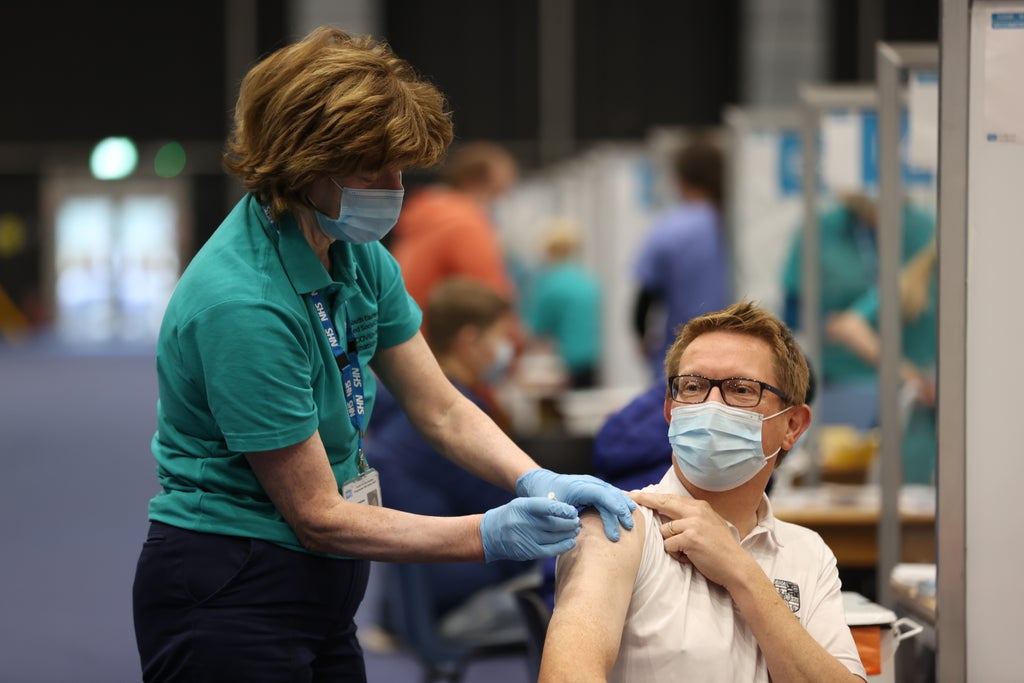
The difference between now and our situation last year is, of course, the vaccines, with 89.6 per cent of British adults having had a first jab, 81.9 per cent having had their second and 52 per cent a booster, according to the official figures.
The failure of the soaring infection rate to translate into a significant rise in hospitalisations and deaths (so far) is further testament to the success of the vaccine rollout this calendar year and supports the observation of intensive care consultant Rupert Pearse, who told BBC Radio 4’s Today programme on Tuesday that unjabbed people accounted for between 80 and 90 per cent of patients he had seen at Queen Mary’s University Hospital in London.
The data also reports a clear correlation between vaccines and infections regionally, with those areas that have 30 per cent or more of the population unvaccinated - like Acre Lane in Lambeth, south London - suffering a case rate of 921 per 100,000, compared to 603 per 100,000 where less than 10 per cent of the locals have not had their jabs.
While it is certainly true that the infection rate appears to have stabilised in recent days, that the feared increase in hospitalisations and deaths has yet to materialise and that the vaccines appear to be helping keep Omicron at bay, as always with this pandemic so much remains unknown and it is too soon to make any definitive judgements or rest on our laurels.
We still do not have enough clinical data to be certain about the properties of the new strain and, as UCL’s Professor Christina Pagel has warned, the increased amount of intergenerational indoor social mixing about to take place over Christmas could yet drive cases spiralling north again.
Unquestionably one of the biggest threats at present is public complacency towards observing restrictions, with many determined to have a pleasant Christmas whatever the cost and patience already sorely tested and trust undeniably damaged by the run of recent revelations about illicit Westminster parties last year.
Messaging obviously remains key at this pivotal moment and Professor James Naismith, director of the Rosalind Franklin Institute, has said Mr Johnson’s government should “emphasise the uncertainty alongside the risk of acting too late” in its communications with the public in the interests of transparency.