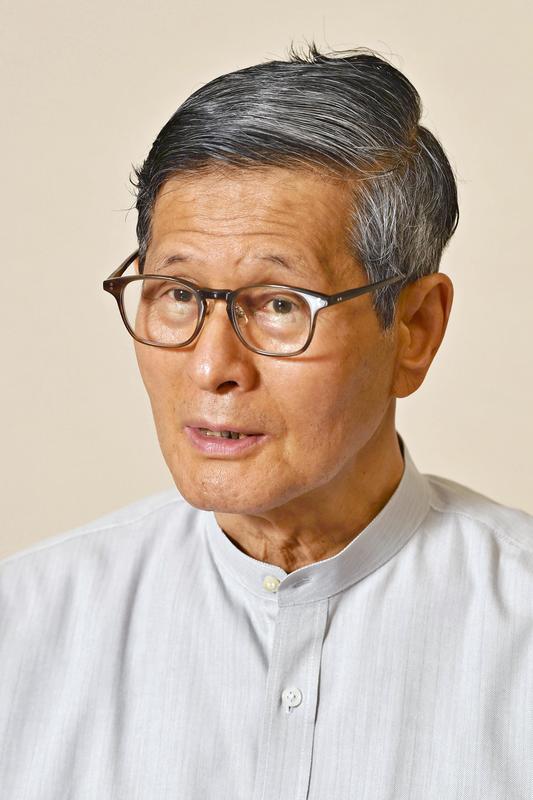
A government panel of experts that has made a number of recommendations to prevent the spread of the new coronavirus will be reorganized into a meeting body with the participation of a wide range of experts. Shigeru Omi, former director of the World Health Organization's (WHO) Western Pacific regional office, who served as vice chair of the panel, recently sat down with The Yomiuri Shimbun to discuss his views on the events up to now and the outlook for the future.
Unusual proposal
The Yomiuri Shimbun: You have recalled that starting in mid-February, the expert panel became "obtrusive." Why was that?
Omi: Cases were emerging in several areas with unknown routes of infection. We were getting information from China that the virus can be transmitted by asymptomatic people as well, and that it's a difficult virus to contain. So we knew all that. [We thought] the infection may be spreading under the radar in this country as well. We had to do something to get the word out to society in time. We all had a sense of crisis and a sense of responsibility, having lived our lives as experts in infectious disease control.
The members of the expert panel stayed up late every night exchanging information and having heated debates. On Feb. 24, when we announced our view that "we are on the brink in the coming week or two," there was a sense that we had crossed the Rubicon River. In a normal council meeting, experts express their opinions on the government's proposals, and it was unusual to present their own countermeasures.
Q: The state of emergency was declared on April 7.
A: The number of infected people was increasing rapidly, filling hospitals with the seriously ill, and the medical community was saying, "It's like a nightmare." It was declared just in the nick of time.
Q: New cases began to decline before it was declared, leading some to question the effectiveness of the declaration.
A: We saw that in retrospect because there is a delay between infection and reporting. Looking at the situation overseas, we had no other choice at that point. In fact, after the state of emergency was declared, the effective reproduction number, which indicates the average number of people infected by one person, decreased even more. The state of emergency was extended into May as well, but we had to keep the number low enough or we would have problems later. I can't judge at this point if [the declaration] was too much or not, but I'm pretty sure it had a certain effect.
Decision for the best
Q: What's the outlook for the future?
A: It's concerning that we're once again seeing cases in rural areas with unknown sources of infection. It is very important to understand the circumstances under which infections occur. We need to improve our research.
On the other hand, there have been technological innovations such as testing and contact verification apps. The health-care delivery system has changed as well. There are some things you can do as an individual, such as avoiding the 3Cs -- closed spaces, crowded places and close-contact settings. An analysis also showed that if we reduce contact in places where clusters are likely to occur, rather than in society as a whole, the spread of the disease will be contained. There is a possibility that, with some ingenuity, we won't have to "reduce contact by 80%" again.
We've been sprinting for four months, but the advisory body has to change. Essentially, the infectious disease experts do a quick technical analysis and report back to the government, and the government has to take a variety of political steps. It's the best form of decision making.
Infectious disease control is a social science that always considers the impact on society. I completely understand the importance of maintaining economic activity. It is natural that if your position is different, you will have different opinions. I think it would be great if the knowledge of various fields could be brought together to create a system for advising the government.
Read more from The Japan News at https://japannews.yomiuri.co.jp/