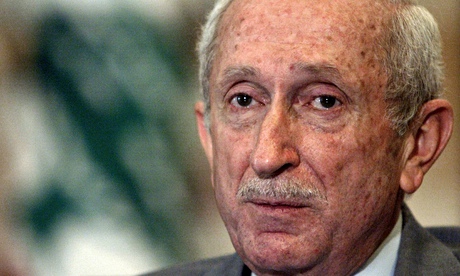
Any successes that Omar Karami, who has died aged 80, achieved during his two terms as prime minister of Lebanon were eclipsed by the ignominy of his fall from power during the “cedar revolution” of 2005. A million Lebanese people (around a third of the population) took to the streets of the capital, Beirut, to protest at the 29-year-long presence of Syrian troops on their soil. Karami, seen as Syria’s placeman, could not secure a cabinet and was forced to resign.
His political career had begun almost accidentally, in 1987, when a bomb planted on board a helicopter killed his elder brother, Rashid, who was then prime minister. Omar entered polititcs himself and in 1989 became Lebanon’s education minister.
Lebanon’s 15-year-long civil war ended in October 1990, thanks largely to Syrian force. Two months later, the president, Elias Hrawi, named Karami prime minister and on Christmas Eve he unveiled a 30-member government of national reconciliation that included several rival militia chieftains. Christians fumed over their loss of status and railed against the friendship treaty signed between Lebanon and Syria in 1991. Crippled by currency crises and economic malaise, labour protests and food riots, Karami stood down in 1992.
He was 70 when he returned as premier in 2004. The incumbent, Rafik Hariri, had resigned when Syria unconstitutionally extended the tenure of the Lebanese president, Émile Lahoud. Karami, by contrast, rejected criticism of Syrian interference in Lebanon, and particularly opposed UN resolution 1559, an American and French-inspired initiative that aimed to disarm the Shia Hezbollah militia and force Syria’s army out of Lebanon.
Karami brought two women into his 2004 cabinet, a first for Lebanon, but he lacked Hariri’s international business connections, and failed to reduce the national debt. Increasingly, dissidents disputed Syria’s pretext for remaining in Lebanon.
Matters came to a head in February 2005, when a roadside bomb in Beirut killed Hariri. Druze, Sunni and Christian protesters immediately blamed Syria, and, by extension, Karami too. Never before had Damascus faced such open defiance. A fortnight later, Karami resigned. He was reinstated after 10 days, only to leave office permanently that April amid renewed public ire.
Karami was born in An Nouri, near the northern port of Tripoli, into a leading Sunni Muslim dynasty. For 400 years Karamis had provided Tripoli, Lebanon’s second largest city, with its muftis (religious leaders) and zuama (traditional oligarchs). Their local authority often extended to the national arena: one in four Lebanese is a Sunni and the national pact negotiated at independence in 1943 vouchsafed for the Sunni community the office of prime minister.
Karami’s father, Abdul Hamid Karami, served briefly as prime minister in 1945, and his brother, Rashid, began the first of eight stints as premier in 1955. Karami studied law at Cairo University and the American University of Beirut. After 1956 he worked as a lawyer and local enforcer for his brother. From 1991 he represented Tripoli in parliament, and was re-elected in 1992, 1996 and 2000.
Detractors felt Karami epitomised Lebanon’s antediluvian sectarian system. American officials derided his 2004 cabinet as “Made in Syria”. Yet sometimes he revealed an independent spirit and flashes of wickedly sarcastic humour.
He highlighted corruption where other politicians shunned the issue. Gamely (if unsuccessfully) he introduced austerity measures in 1991-92 and reopened the port of Beirut. He disputed certain Syrian edicts and attacked successive presidents for wielding excessive power. He recreated a cross-sectarian national army, and pursued the delicate negotiations that ultimately saw all western hostages released by June 1992. Perhaps his greatest triumph was the disarming of Lebanon’s militias – with the exception of Hezbollah and the South Lebanon Army.
After Karami’s resignation in April 2005, he was replaced by Najib Mikati, a young Sunni rival from his Tripoli stronghold. Syria’s remaining troops finally left Lebanon later that month.
Karami is survived by his wife, Mariam, and their two sons and two daughters.
• Omar Abdul Hamid Karami, politician, born 7 September 1934; died 1 January 2015