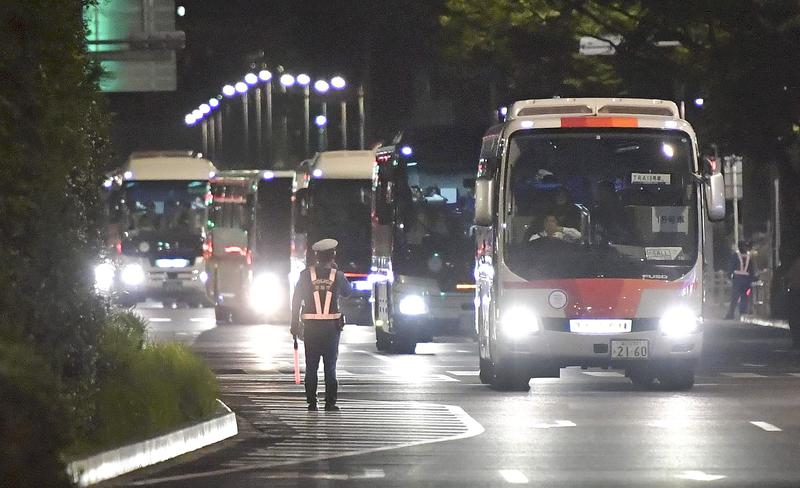
The 2020 Tokyo Olympic and Paralympic organizing committee plans to manage a total of about 5,500 buses and passenger cars to transport athletes and others under a special operation system.
The system will provide instructions on optimal routes for each vehicle based on road information collected by a "transport operation center," which will be newly created.
It is the first such attempt in Olympic history, and it is now being discussed that the system may be used at the 2024 Paris Games.
Compared with past Olympics where the main competition venues were close to each other, such as the 2012 London Games and the 2016 Rio de Janeiro Games, venues for the Tokyo Games are dispersed in different locations because many existing facilities will be used as venues. To transport officials concerned, about 2,000 large buses and about 3,500 passenger cars will be used, and multiple routes connecting between the Olympic Village, accommodation facilities and venues will be set up.
During the Olympic and Paralympic period, 10 million visitors are expected from within and outside Japan, and there is a concern over heavy traffic jams. To manage the Olympics and Paralympics smoothly, the organizing committee set a goal of reducing traffic by 30% on the Shuto Expressway network and by 10% on ordinary roads. It will ask companies and others to refrain from using cars and will conduct large-scale traffic control during the period.
According to sources related to the Tokyo Games, the organizing committee is developing a new system to manage all vehicles with cooperation from Toyota Motor Corp., with an aim to efficiently operate relevant vehicles. All the vehicles will be equipped with the global positioning system (GPS) so that their locations can be tracked, and driving routes and other instructions will be provided via special terminal devices.
During the Games, a "transport operation center" will be created by the Tokyo metropolitan government, the police and road administrators. It will collect information on traffic jams and accidents and transmit the information to the system. When traffic congestion is expected, detour routes will be sent to vehicles as needed.
The organizing committee will gather bus drivers from across the nation. For that reason, many drivers will be unfamiliar with roads in Tokyo, and the new system is expected to prevent such drivers from taking the wrong route. As for the timing of refueling and taking breaks, it is possible to give drivers appropriate instructions while confirming the operation situations of all vehicles.
If the new system can help operate buses on schedule and show the number of passengers for each vehicle during the Tokyo Olympics and Paralympics, such data can be used for transportation plans of future Olympic Games to be held in other large cities. The organizing committee is considering accumulating traffic-related data and offering the data and the envisaged system for the Paris Games.
"Smoothly transporting athletes and Olympic-related officials is the most important issue for the Tokyo 2020. If we can successfully reduce traffic and use the new system, it will become a legacy for future Olympic and Paralympic Games after the Tokyo Games," an organizing committee official in charge of the matter said.
Lessons from Pyeongchang
At the 2018 Pyeongchang Winter Olympics and Paralympics in South Korea, main venues were set up in two locations, and measures to avoid traffic congestion were taken, such as preparing special driving lanes exclusively for vehicles related to the Games on expressways. However, there was a series of glitches, such as delays in arrivals and departures of buses and route mistakes.
According to officials close to the Games, additional buses were needed to compensate for changes in the times and durations of Olympic programs, and bus departure and arrival times were changed from their initial schedules.
Organizers sometimes could not respond to such sudden changes, while some drivers dispatched from other regions took the wrong routes.
Also, there were buses that ended up transporting very few passengers, which prompted some people to point out the operational inefficiency, according to relevant officials.
An official in charge of transportation matters during the Games said: " We had a system to track the current locations of vehicles concerned, but we did not have a system to give instructions in a flexible manner. There are many difficulties in [managing] transportation for an Olympics, which draws many visitors, and it is difficult to deal with such trouble."
Read more from The Japan News at https://japannews.yomiuri.co.jp/