The cities, towns and villages that will host foreign athletes for training camps before the Tokyo Olympics and Paralympics, known as "host towns," are busily preparing efforts to continue exchanges between local people and athletes now that the Games have been postponed until next year due to the coronavirus outbreak.
Those involved in Japan have expressed their wish to further deepen the relationship with their foreign counterparts over the next year, taking the postponement as a chance to do so.
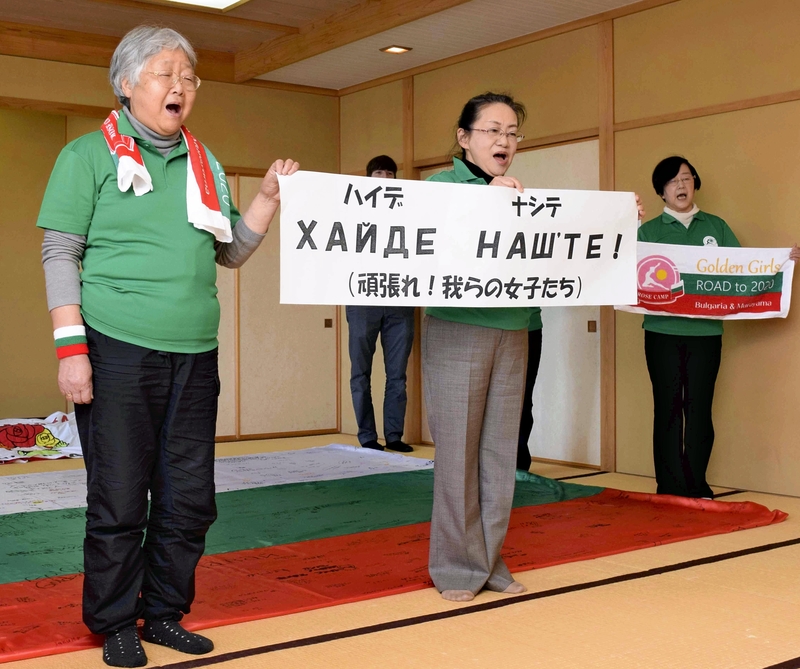
Some citizen volunteers in Murayama, Yamagata Prefecture -- a city that will host the Bulgarian national team for the Games -- recorded a video to cheer on the Bulgarian rhythmic gymnastics team on March 31, the day following the postponement announcement. In the video, the citizens cheered while holding a Bulgarian flag and a banner that read, "Do your best, girls!" and the video was sent to the team via email on April 3.
In 2017, the city became the first in the nation to become a host town for the Games by hosting training camps for the Bulgarian gymnasts. This relationship began partly because the rose -- the national flower of Bulgaria -- was also designated the official flower of Murayama. Training camps have been held every year since and a fan club for the team has been established.
Although the team's training camp was originally scheduled for July and a trip to watch the team's performance at the Games had also been scheduled, all were canceled.
Despite the Games being postponed, the city government has not removed the board counting down to the Games and has instead added a piece of paper saying "plus about a year" to it, sending a message that the city is determined to continue their relationship with the Bulgarian team. Once the virus outbreak subsides, the city hopes to host a training camp for the team as early as by the end of this year.
"We've got another year to cheer the team on. We want to encourage the athletes to do their best," said a 69-year-old fan club representative.
Meanwhile, Maebashi has been hosting a group of five track-and-field athletes from war-torn South Sudan since November of last year. It was the first nation to send athletes to Japan for the Olympics, due to the difficulty of securing training facilities in South Sudan.
The Maebashi municipal government is considering the option of continuing to host the athletes, extending the period until the Games take place next July. It has allowed the athletes the use of a sports ground with 400-meter tracks for training, while accommodation and food costs are covered by roughly 16 million yen in donations through the furusato nozei system, a tax-deductible donation program to support local governments. A group of local companies has also supported the athletes.
"If [their stay] is to be extended, we'd like to seek more donations," said Maebashi Mayor Ryu Yamamoto.
In mid-March, the Paralympic Thai boccia team sent a video to the city office of Odate, Akita Prefecture, where the team was scheduled to hold a training camp. In the video, athletes said, "We feel the same as you." Amid the spread of coronavirus infections in Japan, the athletes spoke in Japanese about their hopes to maintain their relationship with citizens of the city. Recruitment of volunteers to host the team next year has already begun.
On March 25, the Brazilian Olympic committee sent an email to the Sagamihara municipal government, saying that they are willing to continue the partnership and hold a training camp before the Games.
The municipal governments of Misawa, Aomori Prefecture; Ogata, Akita Prefecture; and Numazu, Shizuoka Prefecture were among those that received similar messages from the countries they were to host for the Games.
"Host towns are important. We'd like to ask each area to provide constructive efforts," said an official of the organizing committee of the Games.
Read more from The Japan News at https://japannews.yomiuri.co.jp/