It's not easy for an Aussie to fit into a Kiwi team. But Queensland-born Grace O'Hanlon has become the Black Sticks' Olympic goalkeeper, thanks in large part to the bond she's made with fellow keeper, Georgia Barnett.
Their story begins in a bar on Topless Thursday.
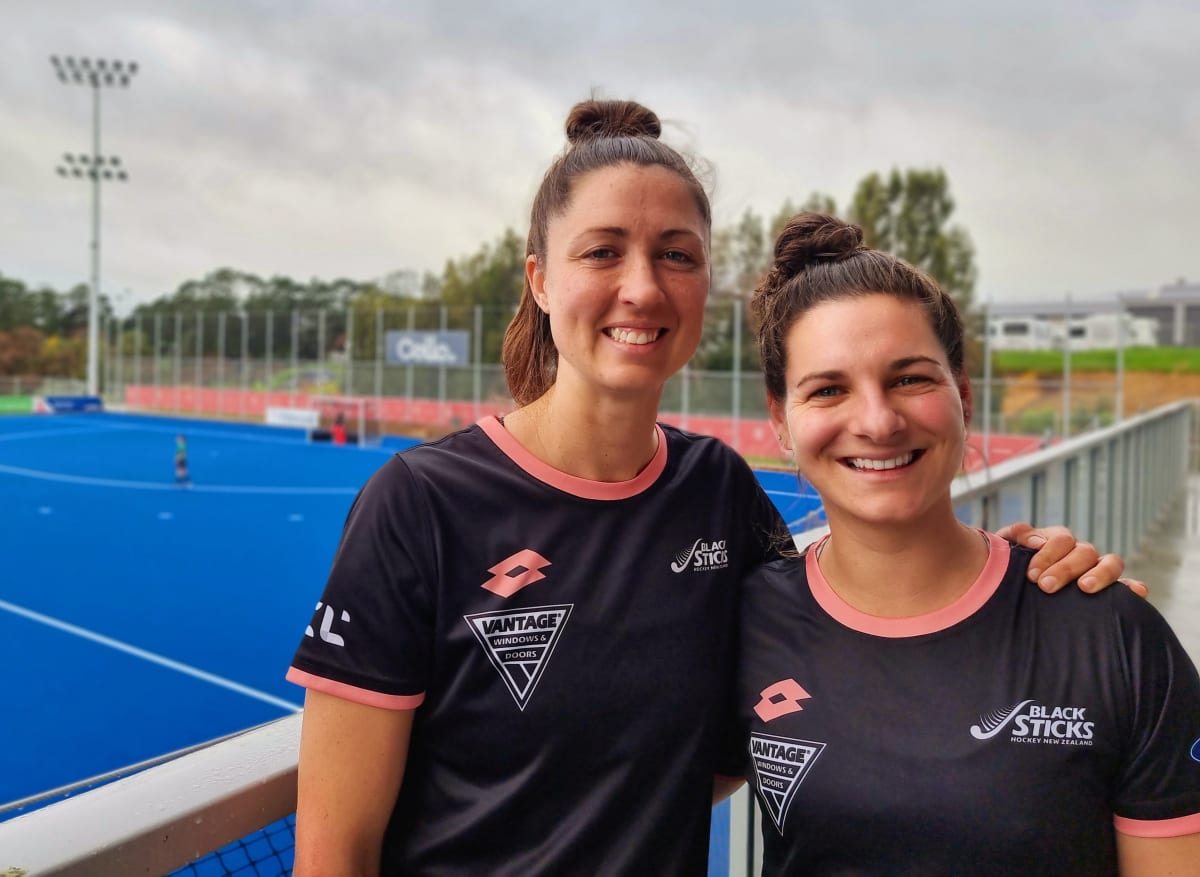
Black Sticks goalkeepers Grace O’Hanlon and Georgia Barnett can’t help themselves laughing about the first time they met as players at the end of 2019.
Barnett, who made her Black Sticks debut in 2012, had taken a break from hockey after missing out on the team for the 2016 Rio Olympics. For three years, she focused on finishing her marketing degree and working for the family business, OBO, which makes goalkeeping gear.
“But I always felt I had a bit more to give,” she says.
O’Hanlon, an Australian who became an overnight Kiwi hero as the super sub in the 2018 Commonwealth Games dramatic semifinal penalty shootout, knew Barnett professionally.
“G was my actually my sponsor,” O’Hanlon says. “We weren’t really friends. We didn’t text.”
But as soon as Barnett returned to the Black Sticks fold and moved from her hometown of Palmerston North to Auckland, O’Hanlon reached out a gloved hand and suggested they go out for a beer.
“I was thinking ‘This is my kind of gal’,” Barnett says. “This is starting on a really good foot - our first hockey interaction wasn’t out on the turf.”
What started out as one beer stretched to three or four hours chewing the fat. “It was a Thursday afternoon at a tradie bar. And the girls serving the beers got more and more naked to a point where we realised it was ‘Topless Thursday’,” O’Hanlon says.

“I thought Grace had stitched me up,” Barnett laughs. O’Hanlon still claims ignorance. “But it turned out to be a pretty good icebreaker.”
Something clicked with the pair. And over the next two years, they’d become friends rather than rivals, who’d help each other immensely on the road to the Tokyo Olympics. Even when it meant only one of them would make the Black Sticks team.
'Keepers are different'
Sitting in the lounge of the National Hockey Centre in Albany, O’Hanlon and Barnett have an hour before their afternoon Black Sticks training session. It’s a few days before they fly to Perth to play Australia in two Pro League matches delayed by Covid-19, before heading to Tokyo.
But only one of them will walk out on the turf.
The 16-strong side for the Olympics includes only one goalkeeper, and O’Hanlon made the cut.
Barnett will still go to Tokyo, but as the travelling reserve. And she sees her role as making O’Hanlon as razor-sharp and fired up as she can be, which is crucial to the Black Sticks’ success.
“As a second goalie, having a role to play when you aren’t on the turf is actually really important. I don’t see it as a weight,” Barnett, 26, says.
“In a sense, Grace and I only have each other. When you sign to be a goalkeeper, not only do you look physically different to all the other players on your team, but you have to be there 10 minutes earlier to get all your gear on, then you have to warm up differently. Every way you look at it, keepers are different.
“Only goalkeepers know what it’s like to be a goalkeeper. So we understand that if I want to play my best, I need Grace on my side… If we want the team to do well, we need to be on each other’s side.
“If we compete against each other, it’s only to make each other better; not to stamp each other down. If Grace makes a wicked save, I’m like ‘Shit that was good, now I need to make a bloody good save too’.”
O’Hanlon, 28, says she’s playing “100 percent better” since Barnett returned to international hockey.
“In other training partnerships I’ve had in other teams, there’s been a lot more friction. But to me, that’s counterintuitive,” she says.
“Having the environment and the confidence to do well, because we’re supportive of each other and building each other up all the time, has been psychologically freeing.”

At no point in the last two years has O’Hanlon felt she and Barnett were fiercely competing to stand in goal.
“It’s quite a stressful time of your life and when you have to spend all that time with another individual, man you’re lucky when it’s not someone who’s secretly hoping you fail,” O’Hanlon says.
“At the end of day, you can’t begrudge someone for having exactly the same dream as you, someone who wants to achieve the same as you.”
Although both keepers admit going to an Olympics to play hockey wasn’t always a dream for either of them.
Becoming a Black Stick
Barnett grew up playing football and dreamed of a college scholarship in the United States, and maybe playing for the Football Ferns at a World Cup. But in 2009, still at Palmerston North Girls High, she ruptured her ACL. During her rehab, the school’s hockey 2nd XI needed a goalkeeper, so she padded up.
She had the foot-eye co-ordination – and the gear.
Meanwhile, O’Hanlon was growing up in Queensland, and although she had posters of Australia’s Hockeyroos on her wall, she never pictured herself as an Olympian.
“It was one of those things your crazy aunty might say: ‘Oh, you might go to the Olympics’,” she says. “Even when I ended up in the Australian hockey programme, it still wasn’t on my radar. I was just delaying getting a fulltime job.”
But by the end of 2016, when her path was blocked by more senior Australian goalkeepers, she decided to further her hockey career by crossing the Tasman. Her dad, Greg, was born and raised in west Auckland, so she trialled for the Black Sticks and made the grade.
Starting on a new path mid-career, though, scared O’Hanlon.
“All the girls I grew up with are wearing an Australian dress now. I left that part of my journey to start again in the middle of someone else’s,” she says.
“It was quite an isolating moment - you feel like an outsider, trying to fit into what is quite a well-established culture. All of the [Black Sticks] players have known each other since they were teeny tiny. So, it was really important to try to put down roots here.”
She sealed her place in the team who won gold at the 2018 Gold Coast Commonwealth Games – substituted on for the deciding shootout against England in the semifinals and saving four of the five English penalties.

“When you’re in the washing machine cycle of it, it’s not till you’ve settled down and reflect back on it, that you think ‘Oh wow, go you, good on you for making it through’,” she says.
Barnett appreciates how much O’Hanlon, a qualified chemical engineer, gave up moving to New Zealand.
“All that sacrifice she made, her personal life and her career put on hold to follow this dream. I think it’s so cool, and I have a real sense of pride that she’s been able to do that,” Barnett says.
“I’m just stubborn,” O’Hanlon insists.
Unorthodox vs Textbook
There’s very little between the two Black Sticks goalkeepers in terms of skill.
“I don’t see any difference in our ability. Period,” says O’Hanlon, who’s played 65 tests for New Zealand. “Either one of us could have stood there and it would have been exactly the same for the team.
“I think the only reason I was selected is because I have a nose more experience. I’ve been playing more international hockey in this Olympic cycle and that’s all.”
But they play differently. Where Barnett is a “textbook” keeper, O’Hanlon by her own admission is “unorthodox - I don’t have the limbs for technical,” she says. “Same result, very different pathways."
Barnett, who has 37 caps, agrees, but reckons there’s one area where O’Hanlon has the upper hand.
“I do think she’s better at shoot-outs,” they both laugh. “We’ll give her that one.”
Barnett admits the Olympic selection was tough. “We both knew it would only be one of us – but that didn’t change anything between us,” she says.
As the reserve keeper in Tokyo, Barnett can be called into the team right up until the day of the final if O’Hanlon is injured and can’t keep playing in the competition. But she doubts that will happen.
“Because everyone uses such good gear these days, Grace isn’t going to get injured,” Barnett explains.
“The only niggly part,” O’Hanlon chips in, “is if there’s a catastrophic injury to the goalie during the game, then one of the girls [who play in the field] has to put the kit on.” No-one has put their hand up yet.
What happens after Tokyo, neither keeper has decided.
They know they will continue to spend “quite stupid amounts of time” talking on the phone. “I will call with one question and it will be an hour and a half later, and then ‘Anyway, I better go to work’,” O’Hanlon says. “We always have schemes and plots running, trying to solve the world’s problems.
“So don’t retire and block my calls,” she orders Barnett.
“Last year, as weird as it was, probably stripped back our hockey friendship, because we weren’t playing hockey,” says Barnett, who at the first lockdown went home to Palmerston North to her marketing coordinator job at OBO and her partner.
“Grace and I talked about life and our common interest in the business world. I see it as being indicative of what our relationship will be post-hockey. It was special.”
O’Hanlon now calls Auckland home. “My partner has moved over and has fallen madly in love with New Zealand, so it looks like we’re staying. But I have no plans after Tokyo,” she says.
“I worked at a stockbroking firm for the last year and loved it - it’s competitive and fast-paced. And I got to wear all my blazers. Corporate life is a novelty when you spend all the rest of your time on the pitch.
“I think these Olympic Games will be a decider in a big way – whether I’m hitting my straps, or whether I’m over the hill. I’ll let that decision make itself.”
“Whatever happens post Olympics, we’ll cross that bridge when we come to it. But it’s not over for either of us as a partnership,” adds Barnett. “What I want to portray to Grace is that we’ve come this far together, and we need to keep going together as well.”