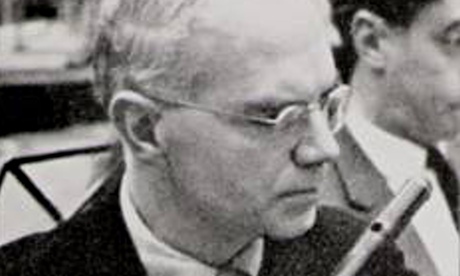
In 1943 the conductor John Barbirolli was recruiting new players for the Hallé orchestra, which had greatly diminished in size during the second world war. Auditioning one evening in a gloomy Manchester church hall, Barbirolli called for the final applicant and was startled to see a boy come into the room. It was the flautist Oliver Bannister, who has died aged 88; at the time of this first opportunity, he was 17. As soon as Barbirolli heard him play there was no doubt as to his outstanding musicianship. Bannister was immediately appointed second flute and became principal in 1945.
Although not a soloist by nature, while with the Hallé he gave performances of Jacques Ibert’s Flute Concerto, Frank Martin’s Ballade and Domenico Cimarosa’s Concerto for Two Flutes, with Bill Barlow. He also gave several performances of Bach’s Suite in B minor for flute and strings, one of which was conducted by the composer and musical all-rounder Paul Hindemith. The orchestra’s leader, Martin Milner, maintained that Bannister’s brilliant technique and musicianship were “of such good quality that the other woodwind all played to him – intonation, phrasing, everything”.
When an invitation came from the Covent Garden Opera orchestra in London, Bannister accepted but stayed on with the Hallé until he had completed his full 20 years. At a gala concert in September 1963, Barbirolli presented gold medals to the four members he had recruited in 1943. Bannister then played at the Royal Opera House for the next 23 years, retiring in 1986.
Throughout his career he played on a wooden Rudall Carte instrument. The flutemaker and writer Robert Bigio recalled: “When I was young I thought wooden flutes were only worth converting into lamp stands. My mind was changed instantly the first time I went to the Royal Opera House, where I heard the most glorious flute sound I had ever experienced. I remember craning my neck to see who was responsible, and there in the first flute’s chair was a white-haired man playing a wooden flute. This was the wonderful Oliver Bannister. I went to Covent Garden as often as I could afford to, just to hear him play.”
Bannister was born in Welshpool, Powys, the son of Arthur, a postman, and his wife Edwardinah (neé Richards). Prematurely white hair was a family trait. In the services in the first world war, a commanding officer had pointed to his father and told another man: “Run! Run! Look at that old man over there – he’s running faster than you!” His father was 23 at the time.
Oliver attended Manchester Central high school for boys. He first studied the flute with Henry Wilson, of the Carl Rosa Opera Company, and later with Joseph Lingard at the Royal Manchester (now the Royal Northern) College of Music.
A supremely modest man, Bannister would respond to any compliment with “Hmm. By the skin of my teeth.” He was reluctant to teach as he did not think analytically about playing; he said it confused him to think that way – like the centipede that was asked which leg it started with, and was then unable to move.
A Covent Garden colleague, the oboist David Theodore, remembered him as “a quiet man, self-effacing, but with steely determination. His shoes were always highly polished, he always wore a tie. I was impressed that after rubbing out a mark in the music he always wrapped up his eraser carefully before putting it away.”
Another fellow musician at Covent Garden, the flautist William Morton, said that he had heard of Bannister being angry only once, when finding in a performance of Ravel’s Daphnis and Chloë with the Hallé that his part was missing. He played it from memory, then went to see the librarian.
Barbirolli said simply: “Every time he plays the sun comes out.”
Bannister’s first marriage ended in divorce. Then he married Mary (nee McBride), a librarian, in 1970. After retirement, he and Mary played an active part in the cultural life of Lewes, East Sussex.
Mary died in 1994. He is survived by two nieces and two nephews.
• Oliver Bannister, flautist, born 20 March 1926; died 4 November 2014
• Oliver Bannister in The Aviary from Saint-Saëns’ Carnival of the Animals
• This article was amended on 1 May 2015. The original stated that Oliver Bannister was survived by a niece and two nephews.