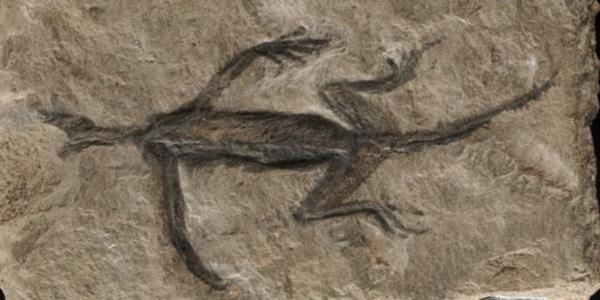
One of the oldest animal fossils ever found has been intriguing scientists for decades. Discovered in 1931 in the Italian Alps, the fossil, known as Tridentinosaurus antiquus, dates back 280 million years and is believed to be one of the earliest pieces of evidence of lizards on Earth. What makes this fossil particularly fascinating is its exceptional state of preservation.
The Tridentinosaurus fossil has a dark imprint of the animal's body engraved on the inside, creating a visually stunning record. Paleontologists have long believed that this imprint was a preserved section of the animal's skin. However, new research has revealed that it is something quite different – black paint.
Valentina Rossi, a paleobiologist from University College Cork, made this remarkable discovery during her study of the fossil. Initially, she found the fossil to be peculiar-looking, as did her colleagues. The body outline, which appeared to be skin, puzzled them.
Through further investigation and the analysis of microsamples, Rossi realized that the fossil was not carbonized soft tissue, but rather black paint. Molecular analyses confirmed her findings, shattering the misconception that had persisted for most of the 20th century.
Preserving soft tissue is a rarity in paleontology because it typically decomposes before the fossilization process can begin. Scientists had simply overlooked the possibility that the supposed preserved skin might not be organic matter at all.
The Tridentinosaurus fossil still holds significant value despite this unexpected revelation. Its overall authenticity remains intact, raising questions about why someone decided to cover it with paint. Unfortunately, that mystery may never be solved.
Rossi expressed mixed feelings about the discovery, describing initial shock and sadness. Nonetheless, she acknowledged the significance of this insight, highlighting the progress that has been made in paleontological research. With the development of advanced techniques, such as the ability to study fossils at the molecular level, scientists are uncovering insights that were unimaginable just a decade ago.
While the revelation about the black paint may disappoint some, it serves as a window into the history of paleontology. This unexpected finding underscores the importance of embracing new technologies and constantly reevaluating our understanding of ancient artifacts.
The Tridentinosaurus fossil exemplifies the ever-evolving nature of scientific research and reminds us that there is always more to discover. As scientists continue to explore the mysteries of our planet's ancient past, we can only speculate on what other surprises may lie waiting to be unearthed.