In a 1971 interview, Harold Pinter spoke about his recently completed Old Times, a love triangle that is less a problem of geometry than metaphysics. “I’ll tell you one thing,” he said. “It happens. It all happens.”
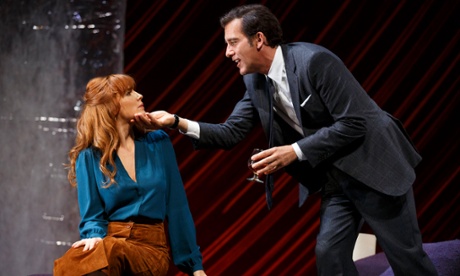
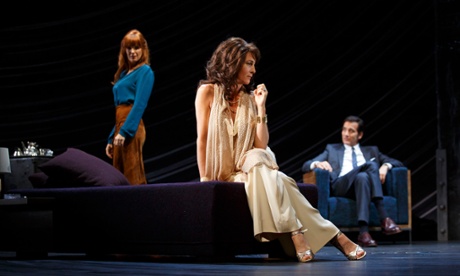
It is now happening on Broadway, in a faintly compelling revival, directed by Douglas Hodge and starring Clive Owen, Eve Best and Kelly Reilly. It is happening on an extravagant set, perhaps somewhat far from Pinter’s call for “a converted farmhouse.” (His request for two sofas and an armchair have been honoured more literally.)
Christine Jones’s set, wonderfully ambitious if sometimes unhelpful, dwarfs the characters. It features a back wall that resembles an abstract expressionist hurricane and a window that looks like a monstrous ice cube. It’s amazing no one thinks to chip away a chunk for cocktails. Or to stave off climate change.
The occasion for the play is a visit by Anna (Best), the former flatmate that Kate (Reilly), who now lives with her film-maker husband Deeley (Owen), hasn’t seen in 20 years. In the first scene Deeley and Kate talk about Anna as though she isn’t there, but she can be seen lingering near the ice cube. (The ice cube later doubles as a shower, which suggests unusual versatility.) Later Anna joins them and they reminisce.
This is a problem. The reminiscences abrade and conflict. Did Kate see a movie with Anna or with Deeley? Who went home with whom after a party? And whose knickers was she wearing? Is Anna dead? Is Kate dead? Are all of them dead? Is this Purgatory on Ice?
This is a guessing game with no real solution, a memory play as mystery play. But a coherent answer isn’t the point. As Anna says, seemingly articulating the governing theme, “There are some things one remembers even though they may never have happened. There are things I remember which may never have happened but as I recall them so they take place.” As in other Pinter plays, one primary concern is the instability of observable reality. Another is the violence that can be done – social, psychological, spiritual – without a fist ever being raised.
A big set, a big stage and big incidental music (composed by Thom Yorke) mean big performances. Under Hodge’s direction, Owen, who looks predictably good in his suit, is surprisingly loose and engaged. Best, a stage veteran tucked into a white jumpsuit, is often commanding. Together they join in a nicely awkward medley of Frank Sinatra favorites. While Reilly is lithe and focused, Kate’s is a less extroverted, less performative role. Reilly sometimes seems lost in the decor. Or maybe the play suggests that we are all diminished by forces and furnishings beyond our control.
Either that or something of the play has been lost, too. It is possible to be coolly entranced in its shifting power dynamics without ever being roused emotionally. Deeley ends the play in tears, but it’s doubtful that other eyes were wet. What should feel haunting, upsetting, frightening and menacing never quite does. This Old Times feels smaller than its set would suggest. Even in the first scene Kate suggests, “Anyway, none of this matters.” It should matter more.