OSAKA -- Sappa Boiler Co.'s small factory in Osaka's Kita Ward maintains steam locomotives that play a leading role in attracting tourists.
Domestic railway companies do not have the know-how to maintain and repair boilers, the steam locomotive's heart, which generate power with steam. For that reason, most of the active boilers are carried into the factory by the railway companies that count on Sappa Boiler's high technology. The factory is much on the mind of the railway industry as well as railway enthusiasts.
All manually

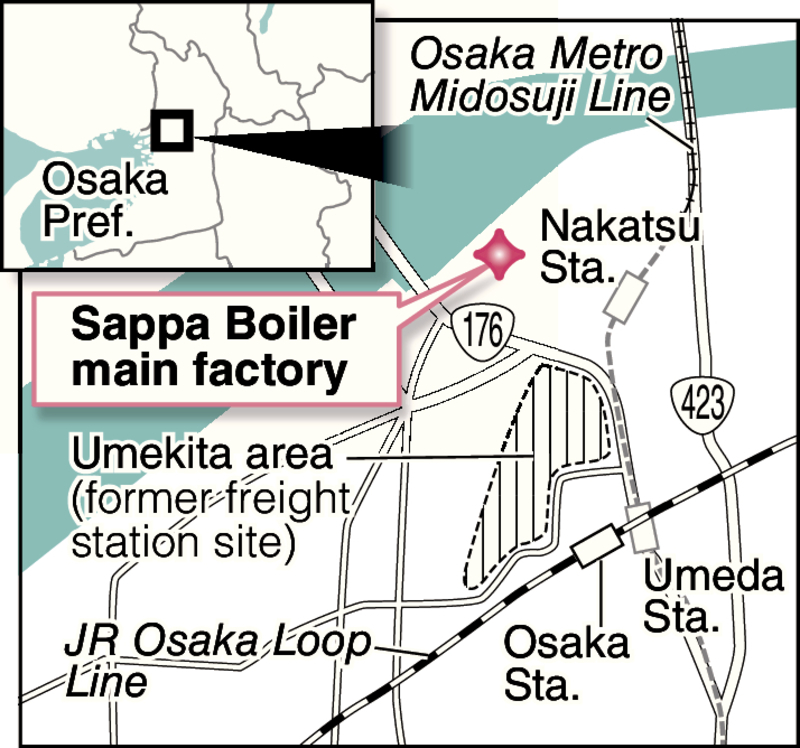
A five-minute walk west of Nakatsu Station on the Osaka Metro Midosuji Line leads me to an old factory in a residential area along the Yodogawa river. Looking inside from the opened door, I could see sparks flying when a giant round iron structure was being welded.
If you do not know at all what the factory is, you could not imagine that it was repair work for boilers as the main body of a steam locomotive.
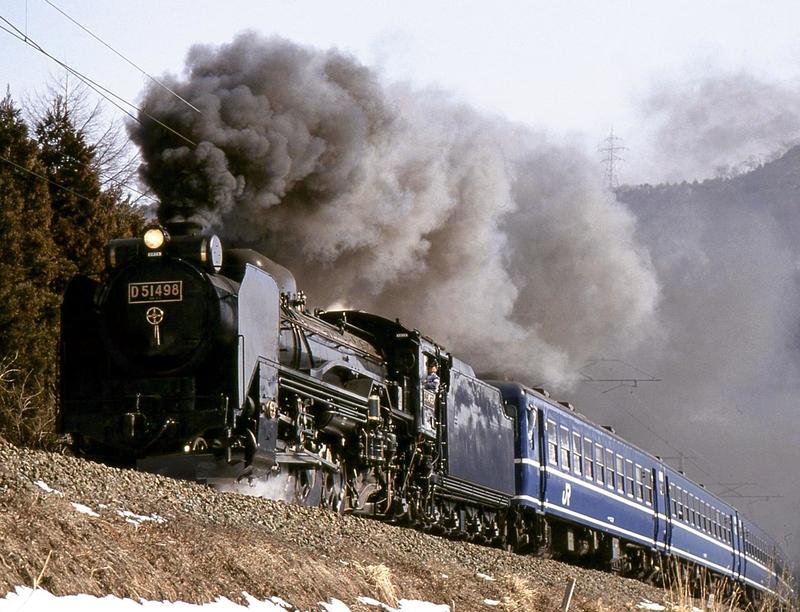
There are about 15 steam locomotives currently in operation in various parts of the country. Their boilers, whose black exteriors and wheels were removed, are brought into the factory for repairs every six to eight years. The day I visited, the factory was working on a "D51 498" boiler used in Gunma Prefecture by East Japan Railway Co. (JR East).
Boiler structure is largely made up of a fire chamber to burn coal, and a boiler component that contains water. When coal is burned in the fire chamber, hot combustion gas boils the surrounding water through the boiler component's pipes, and the generated steam is converted into power to move the train. Wear and tear on parts that can withstand high temperature and pressure is severe.
Built in 1940 at a former railway ministry's factory in Kobe, the D51 498 steam locomotive reached a maximum speed of 85 kph. This train was in service until 1972, and after a long storage period, the boiler was restored in 1988 by Sappa Boiler.
The factory head, Takatomo Sappa, 46, marveled at the then-high technological know-how.
"If you look at the drawings drawn by hand at that time, you can see that, by trial and error, [the engineers] tried to increase the speed capacity as much as possible by improving combustion gas transmission, among others. It's a very elaborate design," he said.
For repairs, the water is drained from the boiler component and more than 100 pipes are removed one by one.
Rivets used to join the iron plates and corroded pipes are replaced with new ones, and the severely damaged parts of the iron plates are reinforced. Repairs carry on by hand until mid-December.
Sappa Boiler's main business is production of industrial boilers, and it started repairing steam locomotive boilers in 1987. Chichibu Railway Co. based in Kumagaya, Saitama Prefecture, was searching for a steam locomotive repair service and asked Sappa Boiler to repair its steam locomotives after hearing about its know-how through JR East.
"This led to an increase in orders from railway companies and the accumulation of technology," said company president Ikuko Sappa, 58.
The factory has repaired more than 50 steam locomotives. Besides the D51 498, it is repairing Tobu Railway Co.'s "C 11" and "8630" steam locomotives of West Japan Railway Co. (JR West)
Preserving the railway culture
More than 40 years have passed since the former Japanese National Railways retired its last steam locomotive in 1975. It is said that many nearby residents do not know what is going on at the factory. However, it is known among railway fans as one that preserves technology that was once on the verge of disappearing and maintains the smooth running of steam locomotives in various places. The railway industry also relies on the factory.
Junichi Yoneyama, 67, secretary general of the Railway Preservation Society of Japan, said: "Without maintenance, steam locomotive operations cannot be continued. I'd like the transfer of technology to be made to protect railway culture and support regional vitalization."
-- Sappa Boiler
Founded in 1918 as an iron factory and manufactured small steam locomotives used in mines for some time during the prewar period. The factory does not accept visitors, but some railway fans watch operations from outside. It is also close to Osaka Station, which opened in 1874, and the Umekita district, a redevelopment area of the former freight station site.
-- Extend your trip
Popular SLs
The number of steam locomotives that can carry passengers is increasing in several regions. In the Kansai region, JR West runs "SL Kita Biwako" about 22 kilometers between Maibara and Kinomoto stations in Shiga Prefecture from March to November. "SL Yamaguchi," operated by JR West mainly in Yamaguchi Prefecture, celebrated its 40th anniversary in August.
Steam locomotives are so popular that you often have to buy a ticket in advance to ride them. Because the service is irregular, it is necessary to check the schedule in advance.
Read more from The Japan News at https://japannews.yomiuri.co.jp/