Dozens of Iranian children were beginning their school week inside a two-story building in Minab when what appears to be a U.S.-fired missile struck the building.
The deadly attack in the first few hours of the U.S.-Israel war against Iran — as families were racing back to the school to bring their children to safety — killed at least 175 people, most of them young children, according to Iran’s ambassador to the United Nations.
The school was reportedly on a target list and mistakenly identified as a military site, though it remains unclear whether officials had reviewed outdated intelligence prior to launching the attack, and whether AI played a role in the decision-making.
The Department of Defense is expected to publish a report from its investigation, but preliminary findings appear to have confirmed that the U.S. was responsible — raising critical questions about human accountability in a military era defined by rapidly advancing technology.
“Potentially using targeting data that is a decade-plus old and not updating it and not going in and verifying what’s happening on the ground right now — Is this still actually a military target? Are there civilians in it, even if it is? And how are we going to address that? — none of that happened,” according to Ret. Master Sgt. Wes J. Bryant, a former senior policy analyst and adviser on precision warfare at the Pentagon’s Civilian Protection Center of Excellence.
How US targets are created
Minab’s Shajarah Tayyiba elementary school for girls is roughly 15 miles inland from the Strait of Hormuz in southern Iran’s Hormozgan province, which faces the northernmost point of Oman directly across from the strait.
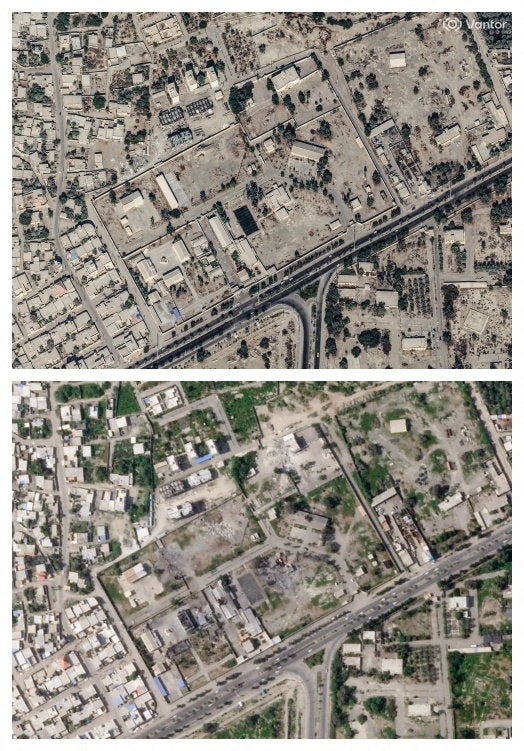
Satellite images show that the school and nearby buildings were once part of an adjoining Iran Revolutionary Guard Corps military compound, but the school was separated from the base by a wall between 2013 and 2016.
A nearby clinic was also walled off between 2022 and 2024, images show, and an outdoor play area can be seen on Google Earth as early as 2017.
Iranian authorities reported initial strikes in the area at roughly 10:45 a.m. Saturday, February 28, at the start of the Iranian workweek.
There were at least six precise strikes inside a nearby naval compound, and a seventh appears to have directly struck the school — adjacent to the northwest corner of that navy base, according to satellite images.

According to CNN, U.S. Central Command created the target coordinates for the strike using outdated information provided by the Department of Defense.
The U.S. Defense Intelligence Agency is responsible for maintaining a database of potential targets.
Each of those targets is assigned a “basic encyclopedia” number, and military agencies and commands are responsible for maintaining the intelligence for the corresponding “BE” number associated with each entry.
Central Command — which covers the Middle East, Central Asia and parts of South Asia — employs several intelligence analysts to support its operations, though the overwhelming number of potential targets and data to support them may have been too much to handle, according to The Washington Post.
There are reams of intelligence for each target, some of which dates back several years, and hundreds of new locations were reportedly added to potential target lists in the weeks before the attack, vastly expanding a database to be reviewed.
It is unclear whether the school was on that list, but officials have also been developing potential targets for Iran over several years, fueling speculation that the school’s location was previously identified as a target when it was part of the adjoining military complex.
AI-generated errors?
The targets for Operation Epic Fury were identified with the aid of the National Geospatial-Intelligence Agency’s Maven Smart System, which folds in data from surveillance and intelligence, among other data points, and can lay out the information on a dashboard to support officials in their decision-making.
Maven, created by Palantir, has been coupled with Anthropic’s Claude, a large language model that can vastly speed up that processing.
That AI tool does not explicitly create targets but works within Maven to identify potential points of interest for military intelligence.


Central Command’s Adm. Brad Cooper said the U.S. military is “leveraging a variety of advanced AI tools” to conduct the strikes.
“These systems help us sift through vast amounts of data in seconds, so our leaders can cut through the noise and make smarter decisions faster than the enemy can react,” he said on March 11. “Humans will always make final decisions on what to shoot and what not to shoot, and when to shoot. ... But advanced AI tools can turn processes that used to take hours and sometimes even days into seconds.”
Anthropic, meanwhile, has demanded that the Pentagon not use its products to support mass surveillance efforts or autonomous weapons, and Donald Trump’s administration has argued in response that the company poses a “supply chain risk” and seeks to replace Claude with rival AI tools in its networks.
Anthropic then sued the Pentagon, noting that the U.S military “reportedly ‘launched a major air attack in Iran with the help of [the] very same tools’ that are ‘made by’ Anthropic and are the subject of the Challenged Actions.”

Seth Lazar, who leads the Machine Intelligence and Normative Theory Lab at Australian National University, said the use of Claude to select military targets “should send chills down the spine of anyone who's been spending the last few months vibe-coding, vibe-researching, vibe-engineering.”
“You can’t do test-driven development when the test is firing a precision-guided missile,” he wrote.
Sarah Shoker — senior research scholar in AI at the Berkeley Risk and Security Lab at the University of California, Berkeley, and the former geopolitics lead at OpenAI — has also disputed the use of model evaluations in place of robust testing in a military context, noting that there are “scarcely any” military-specific evaluations for large language models.
Pentagon guts program to reduce civilian harm
Last year, Bryant — the now-former Civilian Protection Center of Excellence specialist — was forced out of a program aimed at reducing civilian harm during military operations.
Civilian Harm Mitigation and Response was formalized in 2022, encompassing 200 personnel, including roughly 30 at Bryant’s Civilian Protection Center of Excellence.
That mission has largely been cut down to nothing and exists mostly on paper, Bryant told ProPublica.
At Central Command, where a 10-person team was cut to one, only a handful of positions were brought back to backfill roles during operations in Iran.
Without that oversight explicitly designed to prevent civilian harm, Central Command essentially scrapped what could have been months of work to prevent a tragedy like the one in Minab.

A senior military official testifying to members of Congress on March 12 delivered what appear to be the first extensive public remarks from the Pentagon in response to questions about the attack.
“When tragedies like this happen, it causes us all to reflect and try to improve our processes,” said Air Force Gen. Alexus Gregory Grynkewich, commander of the U.S. European Command.
“We do have a number of safeguards in the system,” he added. “Every single time at a tactical level if I was releasing a weapon on a target, I was personally making an assessment as to whether there was any chance of civilian harm, and if there was, was that proportional to the military necessity of striking a target.
There are “robust standards” involved with the targeting processing, including reviewing images to “update our understanding of the target and refresh the intelligence on a recurring basis to determine the chances of civilian harm and to address any collateral concerns that might be there,” according to Grynkewich.
Asked by Democratic Sen. Kirsten Gillibrand how the U.S. “could have gotten this wrong,” Grynkewich said an investigation should play out to determine what happened.
“I would hesitate to speculate,” he said. “There’s usually a chain of errors and mistakes that happen ... I would say we need to let the investigation play out and find all those factors.”