OKAYAMA -- "Be the eyes of hope that won't be afraid of sunken rocks. Step into the world from here, step into the future from here."
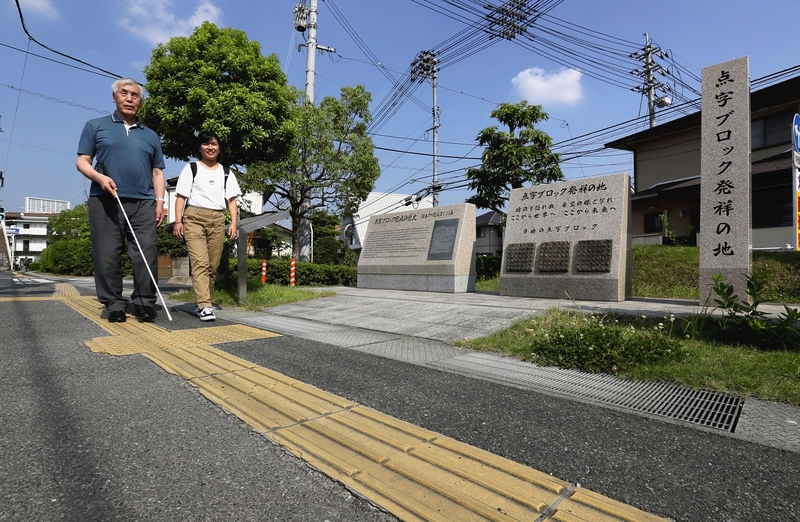
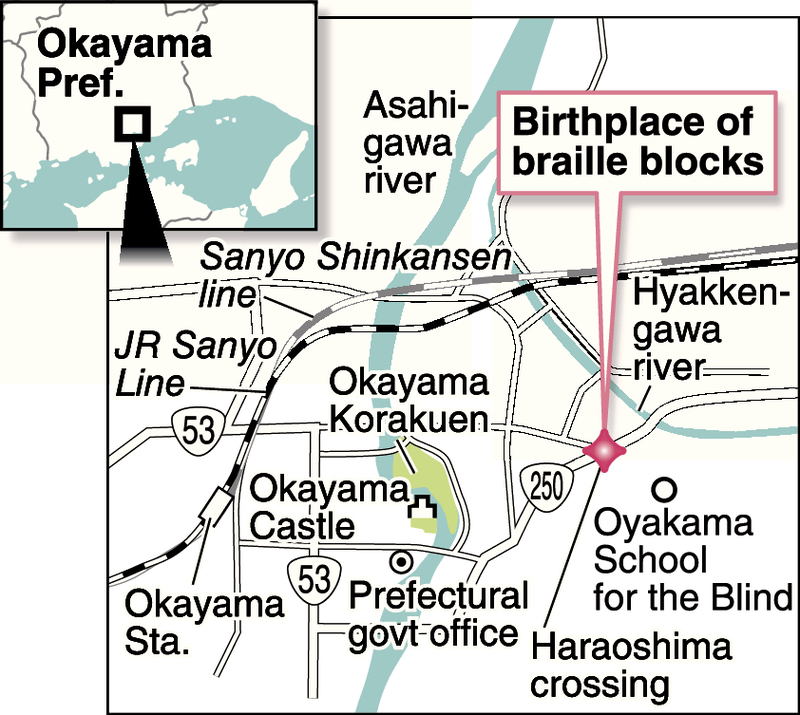
These words are engraved on one of the monuments standing near a crossing on a busy arterial road in Naka Ward, Okayama. Fifty years ago, the world's first "braille blocks" -- textured sections of pavement that provide guidance for the visually impaired -- were installed in this very place.
People living in the area have preserved this spot as one of the first examples of support for the blind, and it continues to draw visitors from afar.
Inspiration struck
"I can tell by the soles of my feet." This casual comment by a friend who was losing his sight is said to have been a significant hint to Seiichi Miyake (1926-1982) in his invention of braille blocks in Okayama in the early 1960s.
Miyake was busy developing items useful for daily life while running a ryokan inn. He had witnessed dangerous scenes of cars passing near pedestrians who were trying to cross the road with a white cane. Since then, Miyake had been pondering ways to help blind people walk safely.
After trial and error, he created braille blocks, and established Traffic Safety Research Center, Inc. in Okayama in 1965 with his younger brother Saburo, 78, hoping to spread the use of the blocks. In 1967, the first 230 blocks were laid out at the crossing in the Haraoshima area in the city, and a ceremony to walk on them was held on March 18 in the year.
Miyake's desire for his invention to be of use to visually impaired people nationwide inspired him to invest his own money to donate braille blocks to local governments, and tout their usefulness. However, he did not receive any orders.
The tide turned in 1970. The blocks were installed in roads and stations in big cities that had undergone urban development, like Tokyo and Osaka. The blocks spread gradually nationwide, but Miyake fell into poor health in 1976 and died six years later.
Braille block day
It was Masahiko Takeuchi, a gold medalist in table tennis at the 1964 Tokyo Paralympics, who suggested erecting monuments to honor Miyake's achievement.
Takeuchi shared this desire with the people around him after he retired, including those at the Oyakama School for the Blind where he used to study and also served as an assistant principal. Takeuchi, 74, now is the chairman of Okayama Lighthouse, a braille publishing house.
Residents and companies in the community agreed with Takeuchi that everybody must get involved to achieve such an important task. He collected 6.5 million yen to erect the monuments in 2010, and an unveiling ceremony was held on March 18, the same day that the event was held to lay down the first braille blocks 43 years before. Since then, March 18 has become "braille block day."
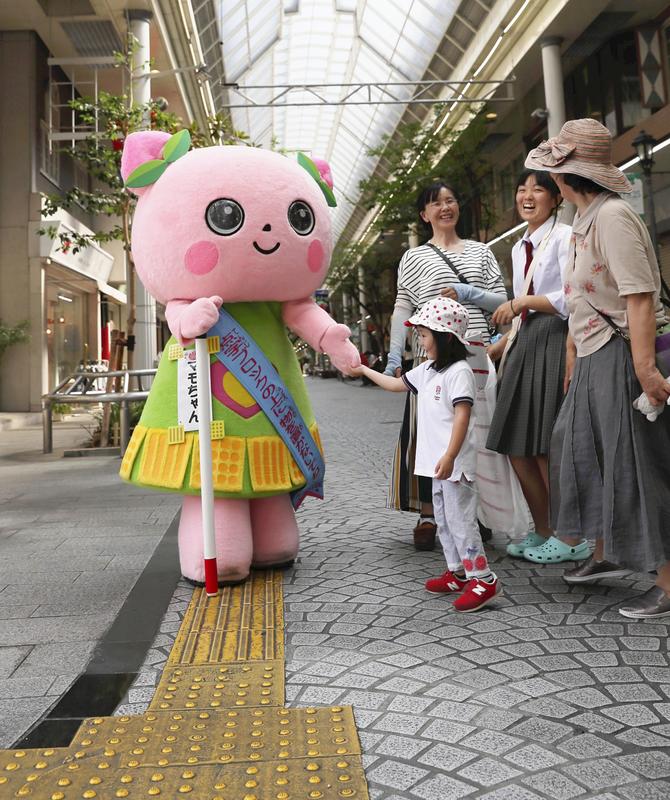
Sympathy and support have spread. A Chinese restaurant owner Kengo Tei, 53, in the city created a mascot in 2015 called Mamo-chan, based on the prefecture's specialty of peaches. He created the mascot to help children become familiar with braille blocks and launched a campaign to encourage people not to put things on top of the blocks.
Once a week, a local radio station airs a program featuring topics related to the blind. It is also broadcast nationwide via a smartphone app, and mail has been received from listeners nationwide.
Seiwa Industry Co. a trading company based in Osaka, sympathized with the activity and became a sponsor to cooperate with Okayama Lighthouse. The company developed braille mats that are relatively easy to install, hoping to further spread the product.
Spread to 75 nations
"Check this out! We're on Google," a braille block supporter yelled in the middle of a promotional activity in front of JR Okayama Station on March 18. Google's top page featured an illustration of braille blocks and letters to honor Miyake, translated into various languages.
"The blocks have reached the world for real," Takeuchi said.
Braille blocks are now used in more than 75 countries, including the United States, China and Britain. The line on the monument, "Step into the world from here, step into the future from here," has become reality.
-- Crossing at Naka Ward, Okayama
The birthplace of braille blocks is located about three kilometers east from JR Okayama Station, on the National Highway Route 250. It is called the Haraoshima crossing, and is about 10 to 15 minutes from the station by car. One of the three monuments there relates the history of braille blocks. Students at junior high schools nearby and the Oyakama School for the Blind regularly come to clean them.
Read more from The Japan News at https://japannews.yomiuri.co.jp/