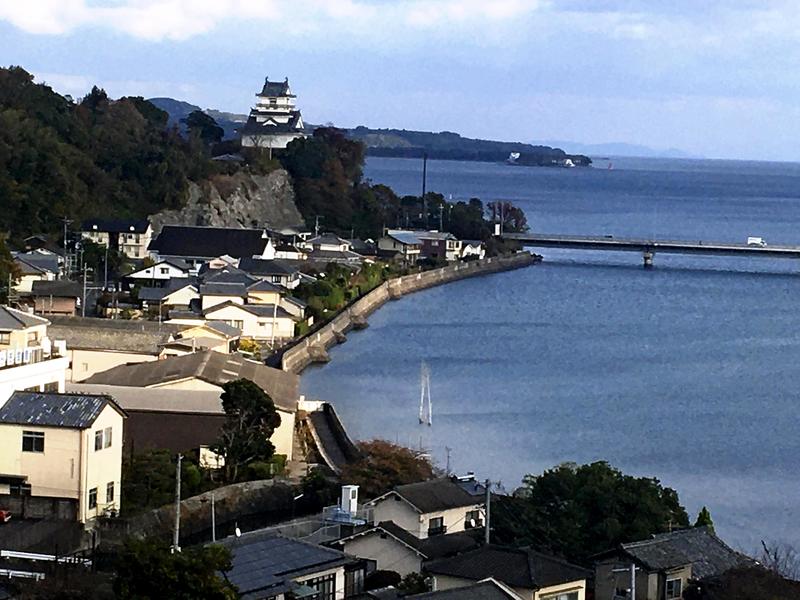
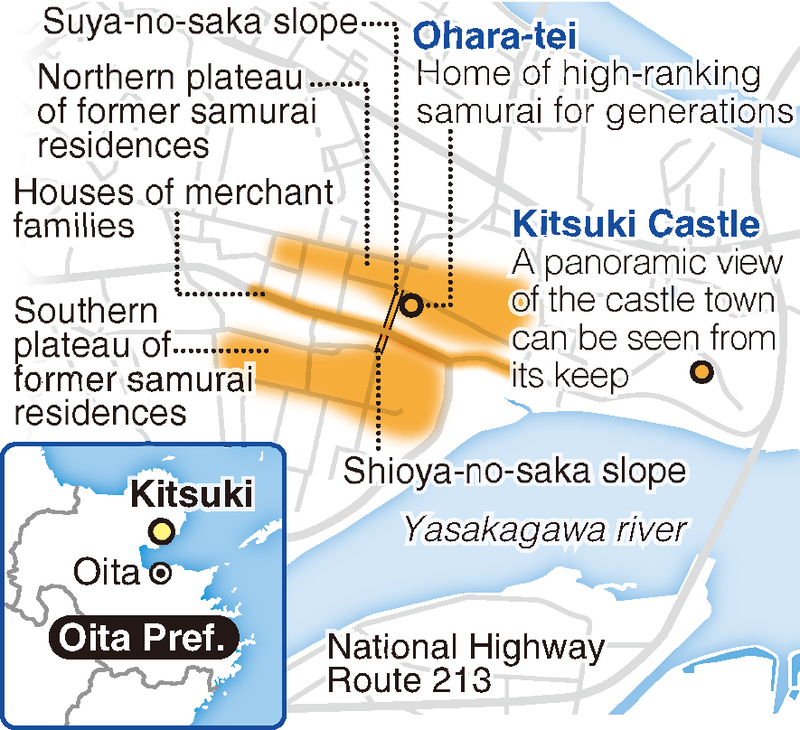
There is a castle town, or jokamachi, in Kitsuki, Oita Prefecture, known as the sandoicchi-gata jokamachi (sandwich-style castle town). This surprising nickname made perfect sense on my recent visit to the town, on the southern edge of the Kunisaki Peninsula. There, I saw that the old houses of merchant families occupy a low area sandwiched between bukeyashiki, former samurai residences, on the southern and northern plateaus.
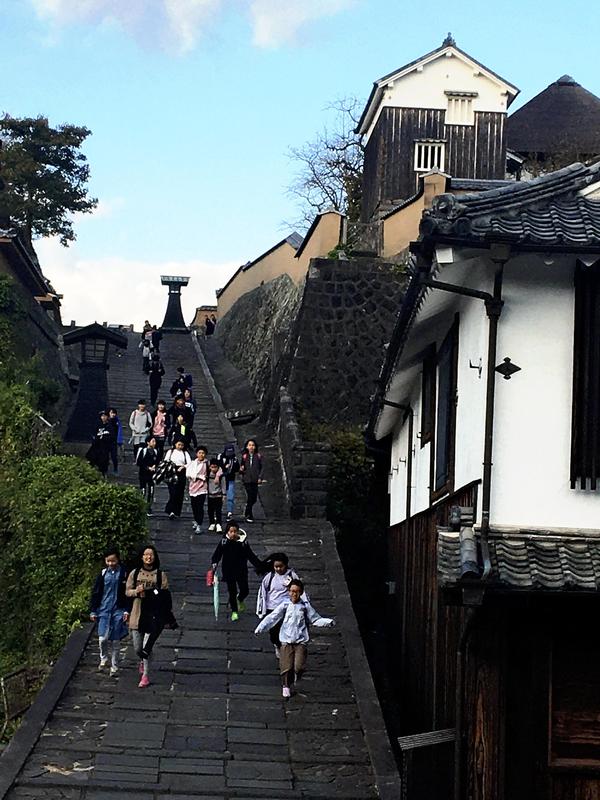
As I walked east through the merchants' area, I saw that there are many slopes that only serve as routes linking the northern and southern former samurai residence areas.
The routes include Tomisaka slope, once lined with the houses of wealthy merchants; Hitotsuya-no-saka slope, on which only one house stands; Ameya-no-saka slope with a beautiful dogleg curve; and Shioya-no-saka and Suya-no-saka slopes, which face each other.
Shioya-no-saka means "salt shop slope," and Suya-no-saka means "vinegar shop slope." Sure enough, there was a salt shop below one slope, and there used to be a vinegar shop below the other.
The vinegar shop has since been converted into a miso store. As I stood in front of it, I heard a high-pitched "Hello!" from off to one side. It was one of a number of elementary school students heading home via the vinegar slope with hard-sided school backpacks on their backs. Others soon followed suit, and I felt a bit embarrassed by all the attention as they continued to cheerfully greet me.
I soon began to climb the steep slope myself, but was awkwardly heavy-footed. As I looked back, I saw a group of older elementary schoolchildren, who had just made it down the vinegar slope, running up the salt slope across the street at full speed. I didn't think my physical strength was that different from theirs.
Slopes and samurai residences are not the only faces of the castle town. There's also Wakaeya, a fancy ryotei restaurant that was the only establishment of its kind in the area, and was frequented by Kitsuki domain lords. It survived the Meiji Restoration, and has been running for more than 300 years. Their signature dish is tai chazuke, a dish in which hot green tea is poured over sliced sea bream on rice.
"The heads of Wakaeya managed the restaurant, armed with wisdom and innovative ideas, and the tai chazuke became our signature dish. I hope tasting it will motivate people to learn more about Kitsuki as a sightseeing destination," said Gentaro Goto, 45, the 16th family head of Wakaeya.
The hot green tea and rice nicely balance the flavor of sesame sauce in the dish, which might have been too rich otherwise. The flavor of the sea bream itself adds to the feeling that you could just go on eating and eating.
"Sesame isn't the only thing used in this sauce, is it?" I asked.
"We use things we've found here and there for the sauce, but the exact ingredients are a secret. It is a recipe that has been handed down for generations in the family," Goto said.
If you get to the top of the Suya-no-saka vinegar slope and turn right, you will find Ohara-tei, formerly the residence of a high-ranking samurai family. An old gate standing past Ohara-tei is a remnant of Gakushukan, an Edo period (1603-1867) school that was established by the domain to educate the children of samurai families. Interestingly, the gate is now used as that of an elementary school.
The end of the road lined with samurai residences is also a slope. You can see Kitsuki Castle's main tower far from the top of that slope. The present school routes for children are the roads used by past retainers of the Kitsuki domain when they were going to the castle.
Pack your kimono
The city of Kitsuki encourages people to walk around the town in kimono. Admission to public tourism facilities is free for those wearing them. Discounts and special services are also available for the kimono-clad at various stores throughout the city. I first thought the services were meant for foreign tourists, but, according to the Kitsuki Tourism Organization, "Surprisingly, many Oita Prefecture residents enjoy the services, too." I hope the city will provide a service somehow making it easier to walk the slopes in kimono, so more people will want to walk around in the traditional Japanese clothing.
'Hamo' and egg
Fifteen restaurants in Kitsuki compete to serve the best tasting dishes prepared with local products by creating their original Kitsuki Donto-don or Kitsuki rice bowl dishes. Among them is Kitsuki Ryosaikan's Ryoshidon (fisherman's bowl), which attracts many people.
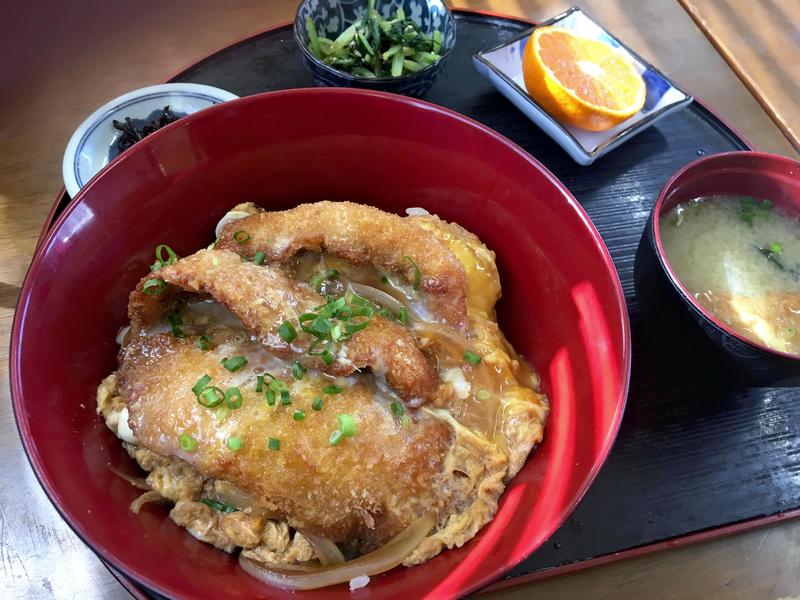
But Kitsuki Ryosaikan's popular proprietress Hamako Manabe, known as Hama-chan, said, "The fisherman's bowl is always good, but I recommend this to you!" The unrefusable offer was Hamokatsudon, or rice bowl with fried hamo pike conger cutlet.
It's similar to katsudon, or fried pork cutlet on rice, but high-quality hamo is used for the dish instead of pork. Deep-frying expensive hamo seemed like a waste, but -- in another Kitsuki surprise -- the scrambled egg yolk mixes well with the thick fried hamo. It is so tasty that you may once again feel like you don't want to stop eating.
"We use a lot of hamo, so we make sure that the local fishing cooperative keeps a year's worth of hamo catch for us. We serve hamokatsu curry, too."
An expensive food is turned into a lunch item that everybody can enjoy. I was astonished at the unexpected combination.
Access
Roughly a 1 hour 45 minute flight from Haneda Airport to Oita Airport, then about a 30-minute bus ride to Kitsuki Bus Terminal.
For more information, call the Kitsuki Tourism Organization at (0978) 63-0100.
Read more from The Japan News at https://japannews.yomiuri.co.jp/