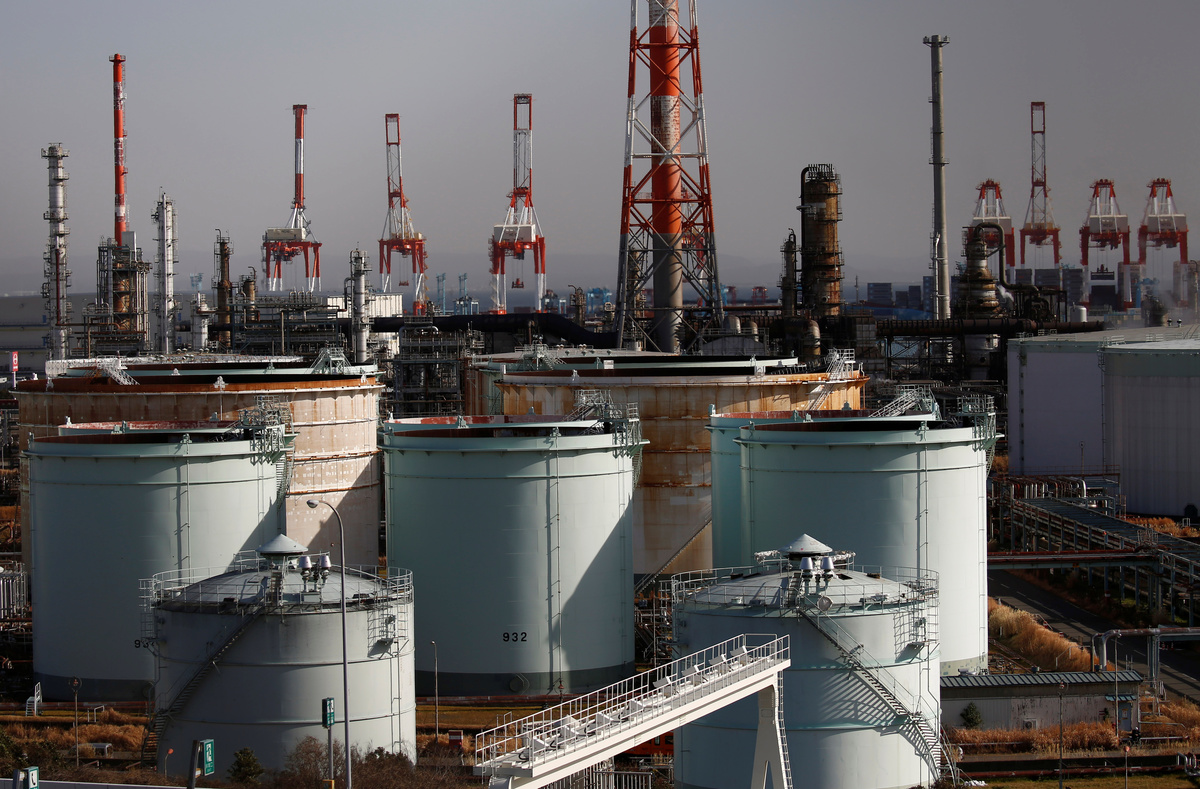
NEW YORK (Reuters) - Oil prices fell on Monday after more poor Chinese economic figures fanned fears of slowed worldwide oil demand.
Losses were limited, however, from worries about supply and increased tensions in the Middle East following last week's attacks on two oil tankers in the Gulf of Oman. The United States blamed the attacks on Iran but Tehran denied involvement.
Brent crude futures for August delivery fell 58 cents to $61.43 a barrel by 1:05 p.m. EDT (1705 GMT). U.S. West Texas Intermediate (WTI) crude futures fell 26 cents to $52.25 a barrel.
Prices have fallen around 20% since a 2019 high reached in April, in part due to concerns about the U.S.-China trade war and disappointing economic data.
China's industrial output growth unexpectedly slowed to a more than 17-year low, data from the National Bureau of Statistics showed on Friday. It grew 5.0% in May from a year earlier, missing analysts' expectations of 5.5% and well below April's 5.4%.
U.S. President Donald Trump and China's President Xi Jinping could meet at the G20 summit in Japan later this month. Trump has said he would meet with Xi at the summit, although China has not confirmed the meeting.
Protectionism across the globe reached a record high last year due to new barriers designed to restrict trade into China and the United States, according to a report by the European Commission published on Monday.
Bank of America Merrill Lynch lowered its Brent price forecast to $63 per barrel from $68 a barrel for the second half of 2019 on faltering demand.
U.S. Secretary of State Mike Pompeo on Sunday said that Washington does not want to go to war with Iran but will take every action necessary, including diplomacy, to guarantee safe navigation in the Middle East.
Saudi Arabian Energy Minister Khalid al-Falih said on Monday that countries need to cooperate on keeping shipping lanes open for oil and other energy supplies to ensure stable supplies.
Market participants also await a meeting between the Organization of the Petroleum Exporting Countries and other producers including Russia, a group known as OPEC+, to decide whether to extend a production cut agreement that ends this month.
The group has been considering since last month moving the date of their policy meeting in Vienna to July 3-4 from June 25-26. After a meeting on Monday, Iran's oil minister said he told his Russian counterpart that he still disagreed with the early July dates but could attend if the dates were shifted to July 10-12, the Iranian oil ministry's news agency SHANA reported.
OPEC+ agreed to cut output by 1.2 million barrels per day from Jan. 1.
"The fact that aggressive OPEC production restraint so far this year has failed to sustain price strength offers strong testament to the quickly evolving trading theme of demand deterioration virtually around the globe," Jim Ritterbusch of Ritterbusch and Associates said in a note.
(Additional reporting by Noah Browning in London and Aaron Sheldrick in Tokyo; Editing by Marguerita Choy and Mark Potter)