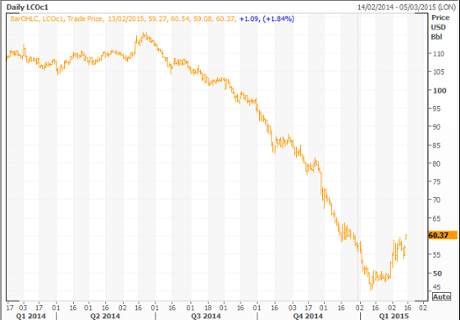
Oil prices have risen above $60 a barrel for the first time this year amid signs that industry spending cuts might curb supply.
Brent crude collapsed 60% from a high of $115 a barrel last summer to $45.19 in January, the lowest in almost six years, as a result of oversupply.
Despite the rise on Friday, oil is still down by almost 50% compared with the peak in June.
Analysts at Bank of America Merrill Lynch are predicting Brent average prices will range between $40 and $70 a barrel in the next 18 months.
“A continued build in storage will likely further exacerbate near-term price volatility and keep pressing companies to make capital expenditure reduction decisions that will have long-lasting effects on production,” they wrote in a note.
He said the steep fall in UK inflation – expected to turn negative in the spring – would boost consumer spending, and in turn economic growth.
“The combination of rising wages and falling energy and food prices will help household finances and boost the growth of real take-home pay this year to its fastest rate in a decade. This will support solid growth in consumer spending,” Carney said.
However, ratings agency Moody’s took the opposite view earlier in the week, arguing that lower oil prices will do little to boost global growth in the next two years as benefits will be offset by events in the eurozone, China and Russia.
Analysts at Moody’s said the big fall in the price of oil since the summer should, in theory, boost economic output by cutting costs for businesses and consumers. But in its global macro outlook report, Moody’s left its estimates for growth among G20 countries this year at less than 3% – broadly unchanged from last year’s rate and Moody’s earlier 2015 forecast in November.
Marie Diron, who wrote the report, said: “A range of factors will offset the windfall income gains from cheaper energy. In the euro area, the fall in oil prices takes place in an unfavourable economic climate, with high unemployment, low or negative inflation and resurgent political uncertainty in some countries.”
Moody’s based its estimates on Brent crude prices averaging $55 a barrel this year and $65 next year.
The rise to above $60 on Friday was supported by businesses in the sector cutting back on spending.
US shale oil producer Apache said on Thursday that output would be roughly flat in 2015 following the price collapse, as it cuts its rig count and capital spending.
Royal Dutch Shell also warned oil supply might not be able to keep up with demand as companies cut budgets.