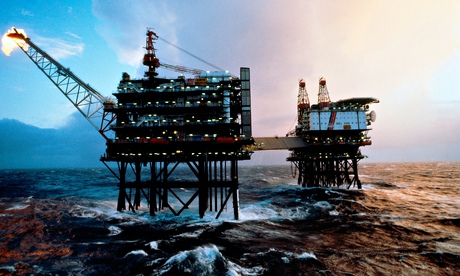
If there is one thing guaranteed to punch a hole in the Scottish economy it is a plunging oil price. Since the summer the wholesale value of Brent crude, the key North Sea price used as a global benchmark, has nearly halved from last year’s average of $109 a barrel. This month it fell below $60 for the first time in more than five years.
Many forecast a further decline to nearer $50, raising substantial challenges for the North Sea industry – the largest and most valuable industrial sector in the British economy, and pressuring the Treasury to lower the heavy tax burden on the sector.
Robin Allan of the independent oil explorers association Brindex said this week that the North Sea had been brought to the brink of collapse, burdened by high production costs and high taxes. Sir Ian Wood, oil engineering magnate and government adviser, says that is exaggerated, but even so warns that up to 37,500 people could lose their jobs – 10% of the industry.
Professor Alex Kemp, an Aberdeen University oil economist and an expert in this field, said prices were likely to fall into the mid-$50s early in 2015 and only recover to the $60s later in the year, and in the short term could go down “a bit moreThere’s nothing to stop it,”.he said.
North Sea tax revenues have plummeted to a fifth of their historic high only five years ago, due to heavy tax discounts for investment in new fields and infrastructure, as well as falling oil prices.
But the hardest questions are over the financial strength of an independent Scotland and the Scottish government’s case for far greater fiscal autonomy.
As the Scottish National party’s former leader Alex Salmond stressed in an Independent interview on Friday, he wants the SNP to hold the balance of power in London after the general election, and his price for helping prop up a minority Labour government would be devolving far more tax and welfare powers to Edinburgh. But low oil receipts make Scotland more reliant on UK taxpayer support, not less.
Salmond’s blueprint for independence, in the Scottish government’s white paper Scotland’s Future, was predicated on an oil price of $110 barrel or above. In 2008/09 the North Sea generated a record tax take of £12bn, helping pushing Scotland’s GDP into the top 10 of the OECD.
That £12bn was roughly 20% of total public spending in Scotland – a huge bonus when spending per head in Scotland is at least £1,300 higher than the UK average. Tax receipts at that level helped Scottish ministers to correctly argue during the independence referendum campaign that Scotland’s share of overall Treasury revenues was often higher than the UK average. It also allowed John Swinney, the finance secretary, to predict that saving surplus receipts in an oil fund was realistic.
But today’s oil price ruins that arithmetic. The Office of Budget Responsibility’s analysis of the autumn statement this month estimated the North Sea’s tax take would be £2.2bn next year, rising to £3.1bn by 2018-19. But that is based on a higher $70 oil price.
The Scotland Office estimated this week that if oil prices remained at $60 a barrel after 2016 – the date an independent Scotland could have been set up, an independent Scottish exchequer would be £15.5bn worse off in its first three years. For every dollar oil prices fall, a Scottish exchequer would be £100m a year poorer.
The key difference for Scotland is that oil income plays a huge role in its tax take and its economy: at UK level, oil revenues are less than 2% of total tax take. And while far lower forecourt prices for fuel stimulates the wider economy, Scotland is home to half the North Sea’s 375,000-strong workforce.
Losing up to 18,000 very high value oil jobs cuts income tax receipts and increases welfare payments, just as Scotland gets control over income tax rates. It means oil companies will cut their overheads, cutting jobs and paying contractors less, said Kemp. And contractors will cut payments to their suppliers. More jobs will be lost.
Kemp said the slumping oil price proved the case for treating North Sea oil receipts as a source of extra income to top up the onshore economy and not as a source of core funding for public spending.
“North Sea oil should be regarded as a bonanza, not as part of the normal business of government or public finances. There’s no doubt about it, [a lower oil price] would make a big difference,” he said.
Swinney insists that oil taxes are treated as an additional source of income – a “bonus, not the basis of Scotland’s economy.” And many analysts, including the oil producers organisation OPEC, predict the price will double up to $110 for the rest of the decade.
But for Scotland to rely on just non-North Sea oil tax receipts would require tax rises, spending cuts or borrowing levels far beyond the rates his government has ever dared to contemplate. Scotland raised £47.5bn from its onshore economy in 2012-13. It spent £65bn. There is an even deeper black hole there without oil.