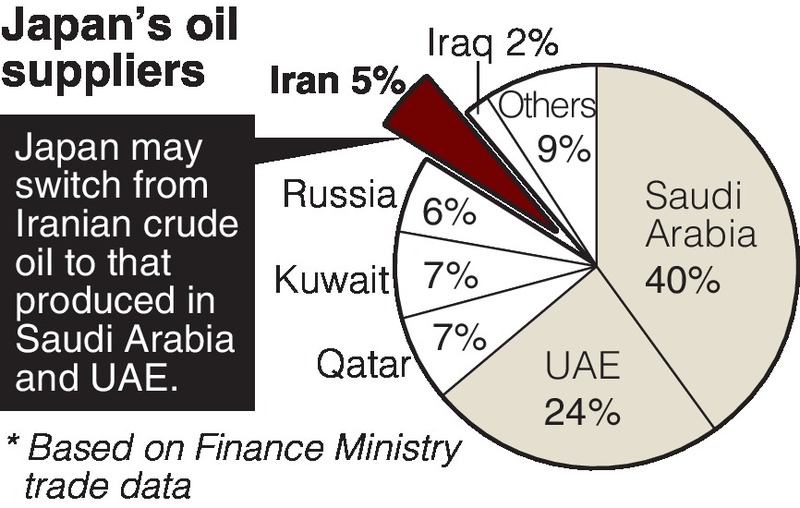
Japanese oil distributors are seeking alternative crude oil suppliers to replace Iran as the resumption of U.S. sanctions against Tehran looms.
The administration of U.S. President Donald Trump has indicated it will resume sanctions against Iran, following Washington's announcement of its withdrawal from the multinational nuclear deal signed with Iran.
Crude oil produced in Iran accounts for about 5 percent of Japan's imports, making the country a key crude oil supplier for Japan's energy strategy.
Petroleum Association of Japan President Takashi Tsukioka said at a press conference on Thursday, "If sanctions are implemented, we'll have to halt oil imports [from Iran] in early October."
The Trump administration plans to resume the sanctions against Tehran in early November. If Japan continues to purchase crude oil from Iran, it is feared that it could face sanctions as well, which could ban Japanese companies from conducting business in the United States.
It takes a certain amount of time to transport crude oil from Iran to Japan and to settle payments for transactions.
Taking this into consideration, Tsukioka, who is also the chairman of Idemitsu Kosan Co., said, "We'll have to finish the process of loading oil [in Iran] by mid-September."
The Foreign Ministry and the Economy, Trade and Industry Ministry, among other entities, have strongly urged the United States to remove Japan from the list of countries that Washington would ban from importing Iranian oil.
The Trump administration has hinted that it may exclude some countries from the ban, but a Japanese government source said, "The situation is quite unpredictable."
As a major, resource-rich country, Iran is ranked fourth in the world in crude oil reserves and second in natural gas reserves. Historically, Japan has cultivated a friendly relationship with Iran.
If the United States resumes the sanctions against Iran and implements a complete ban on importing oil from that country, oil distributors will likely have to procure oil from such countries as Saudi Arabia and the United Arab Emirates instead.
The United States, one of the world's leading oil producers, has been increasing its shale oil production. Therefore, even if crude oil imports from Iran are banned, "It's unlikely that crude oil prices will rise sharply," an oil industry source said.
However, crude oil produced in Iran contains a high percentage of heavy oil and other elements and relatively small amounts of gasoline components, making its transaction price low compared with that of other oil producing nations.
Some Japanese oil distributors have introduced special equipment at their refineries to extract as much gasoline as possible from Iranian crude oil. Under such circumstances, it is not easy for them to switch to different oil production areas. It seems there will be a significant impact on the industry.
Inpex won't bid for Iran field
Inpex Corp. President Takayuki Ueda said the company will not take part in the bidding for the Azadegan oil field in southwestern Iran.
"Considering the current international circumstances, realistically, there's no chance that our company will take part in the bidding," Ueda said of the previously planned bid for one of the largest fields in the world, in a recent interview with The Yomiuri Shimbun.
Read more from The Japan News at https://japannews.yomiuri.co.jp/