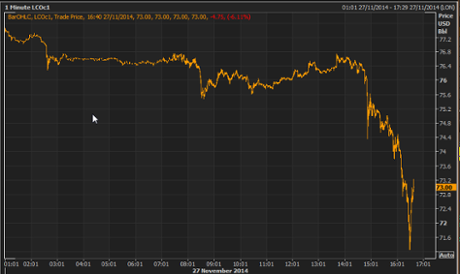
I’m going to pause now, as the oil price seems to have stabilised after both main benchmarks tumbled 6.3% to new four-year lows.
Brent crude is hovering around $72.80, down $5 today. And US crude has marked Thanksgiving by losing $4.60 to $69.05.
My earlier summary has the story of how Opec triggered the rout, and unleashed a price war on the shale industry.
And I’ll try to pop back in tonight if anything develops.... Thanks. GW
Updated
Late news from Vienna -- Venezuela’s foreign minister had told Latin American TV station Telesur that a fair oil price would be $100/barrel.
Rafael Ramirez (who stormed out of the Opec meeting) added that lower oil prices will hurt the fracking industry too.
Updated
Crude oil falls below $68 after OPEC meeting. pic.twitter.com/ws2GfT5fwf http://t.co/M1CLNxsY2b ~ via http://t.co/VS8RO1tb5N
— Day Trade Alerts (@AlertTrade) November 27, 2014
The slide in the oil price is bad news for Britain’s North Sea industry.
And with civil servants racing to finalise the details of next week’s Autumn Statement, energy companies are urging the Treasury to offer more tax breaks to help them.
Otherwise, they warn, extractors could abandon the North Sea for other areas.
More here: Plunging oil price piles pressure on George Osborne’s autumn statement
Citi, the Wall Street bank, has come up with four theories to explain Saudi Arabia’s reluctance to cut oil production.
One is that Saudi’s finances are quite strong today, so it can take the hit of lower revenues. Another is that the Kingdom’s top officials are focused on other matters, such as the health of the Royal Family.
Citi's theories on why Saudi Arabia didn't agree to an Opec cut. pic.twitter.com/gSxDe6cc0v
— Joseph Cotterill (@jsphctrl) November 27, 2014
Opec has effectively fired the starting gun on a new price war in the energy industry.
And the target is America’s shale industry, as Olivier Jakob from Petromatrix consultancy explains (via Reuters).
“We interpret this as Saudi Arabia selling the idea that oil prices in the short term need to go lower, with a floor set at $60 per barrel, in order to have more stability in years ahead at $80 plus.
“In other words, it should be in the interest of OPEC to live with lower prices for a little while in order to slow down development projects in the United States.”
Reuters also reports that Venezuela’s foreign minister, Rafael Ramirez, was “visibly angry” as he left the meeting. Venezuela had been pushing for an output cut.
Afternoon summary: Oil price routed after Opec decision
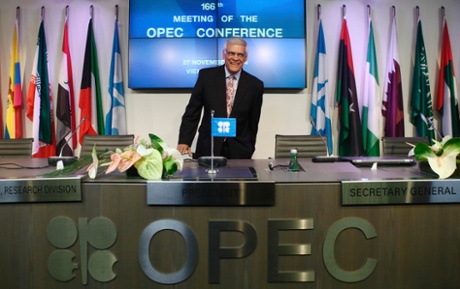
I think it might be helpful to recap.
The oil price has plunged this afternoon after the Organization of Petroleum Exporting Countries (Opec) decided not to cut production levels (see 3pm onwards for highlights).
At a five-hour meeting in Vienna, Opec resisted pressure from some members to lower their output, from the current target of 30 million barrels per day.
Analysts say that Opec members, led by Saudi Arabia, have decided to focus on protecting their market share rather than slashing production in an attempt to push the price back up.
Opec said the decision was not a reason for alarm. In a statement, it said:
....the Conference concurred that stable oil prices – at a level which did not affect global economic growth but which, at the same time, allowed producers to receive a decent income and to invest to meet future demand – were vital for world economic wellbeing.
Secretary general Abdalla El-Badri told reporters that:
“We’re going to produce 30m [million barrels per day] for the first half of the year
We have no target price, we are looking for a fair price.”
Sec Gen of OPEC Abdullah Al-Badry of Libya: "The price decline does not mean we should rush to do something...we dont want to panic."
— Terry Macalister (@TerryMac999) November 27, 2014
The news sent reverberations through the sector, even though Opec members such as Saudi Arabia, the UAE and Kuwait had hinted that production would not be cut.
- US crude oil is now changing hands at $67.75 per barrel, down from $73.69 last night.
-
And Brent crude is now down to $71.25 per barrel, down from $77.50 last night.
In the long term, the decision could help Opec fight back against the rise of the shale oil industry, as a lower oil price will probably rein in their output.
As Bill Farren-Price, head of Petroleum Policy Intelligence, put it to the FT this afternoon:
“Those [Opec] producers that have been hardest hit by the oil price drop have been persuaded that an output cut may have been ineffective and that the only way to counter the surge in US shale oil production is to allow lower prices to pare back supply over time.”
In the short-term, though, consumers can look forward to cheaper petrol prices. And global inflation is likely to be restrained too.
Oil had already fallen by around a third since the summer, as global growth has slowed and shale production has boosted supplies. This latest slump is going to make oil production more loss-making for some Opec members, and other producers such as Russia:
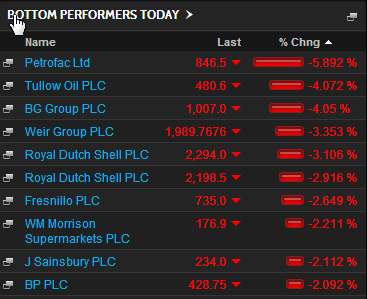
The news also sent the Russian ruble sliding, to 48 rubles to the US dollar. And it also hit the share prices of oil companies; in London, Tullow Oil fell 7%, BG Group lost almost 6%, and Royal Dutch Shell fell 4%.
New record low for the Ruble as oil price slides.
— Duncan Weldon (@DuncanWeldon) November 27, 2014
Updated
Today’s decision was (like much Opec policy) driven by the wishes of Saudi Arabia, explains Alistair McCaig of IG.
OPEC has decided to keep oil production unchanged and the spot oil markets have subsequently collapsed as the template of oversupply and weak demand keeps the pressure on energy prices. The sound bites that came out before this meeting all inferred that Saudi Arabia was happy to maintain its market share.
Historically, when it comes to altering supply levels, it has fallen on the Saudi’s shoulders to make the changes, and without their leadership few OPEC members were likely to go it alone.
Updated
“Opec just declared war on everyone-including itself”, says the Wall Street Journal’s Liam Denning.
Today’s decision not to cut production means oil will remain below $100/barrel for several years to come, he adds. More here (£)
Updated
Crumbs -- Brent crude has plunged even further, hitting $72.74 per barrel.
That means it has fallen by five dollars per barrel today, a massive slump for the oil price.
Updated
Hello Nymex. $69.39 #OPEC #oil @CNBC @CNBCWorld
— Louisa Bojesen (@louisabojesen) November 27, 2014
The oil price tumble is turning into a rout, with prices hitting fresh four-year lows as I type.
Brent crude has now fallen through the $74/barrel mark to just $73.41 after Opec’s decision.
And New York crude has just plunged through the $70/barrel mark, to $69.39.
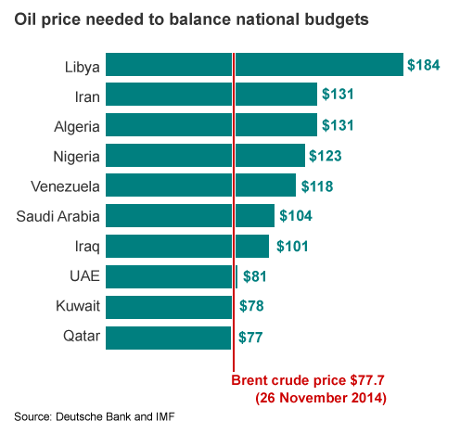
Most oil producers need the crude price to be rather higher to be in profit:
Oil producers hammered by $74 oil. Only UAE, Qatar, Kuwait breaking even. Most others in trouble, some serious: pic.twitter.com/ypfusbCSWO
— Jamie McGeever (@ReutersJamie) November 27, 2014
Updated
Some very experienced analysts at meeting say that OPEC and Saudi have decided the cure for oversupply is lower prices not prod cuts.
— Neil Hume (@humenm) November 27, 2014
Even Opec is pointing out that a lower oil price is good for consumers:
OPEC sec gen asks why we are all complaining about OPEC supply. Says it's cheaper for us to fill up car. Apparently that's good for hacks.
— Neil Hume (@humenm) November 27, 2014
Analyst Steve Baines makes a similar point:
Reminder: the oil price falling is not "a risk", it is a tax cut to everyone who isn't a Russian oligarch or Arab sheikh.
— Stephen Baines (@spbaines) November 27, 2014
It’s not *quite* as clear-cut as that, though. Venezuela, for example, was relying on a higher oil price to cover its public spending, so there could be serious consequences there.
The oil price is hitting new lows as Opec’s decision reverberates though the markets. Brent crude just hit $74.00 per barrel, the lowest since August 2010.
Many US oil traders are on holiday today, for Thanksgiving, so there could be more volatility tomorrow when they return to their desks.
Brent now at $74. Market not liking decision and that's with American closed for thanksgiving. Could be bloodbath tomorrow
— Neil Hume (@humenm) November 27, 2014
Opec's statement confirms no production cut
It’s doubly official now -- Opec has just published a statement, confirming that it will keep producing 30 million barrels of oil per day.
Opec says today’s meeting in Vienna agreed that it is “vital for world economic wellbeing” that the oil price is stable, at a level that allows producers to make a “decent income” without hurting global growth.
Accordingly, in the interest of restoring market equilibrium, the Conference decided to maintain the production level of 30.0 mb/d, as was agreed in December 2011. As always, in taking this decision, Member Countries confirmed their readiness to respond to developments which could have an adverse impact on the maintenance of an orderly and balanced oil market.
Opec added that it will remain “vigilant” to the uncertainties and risks in the world economy. The full statement is online here.
Updated
Opec: We just want a fair oil pricce
Our energy editor, Terry Macalister, is tweeting the key points from Opec’s press conference in Vienna now:
Secretary General of OPEC Abdullah Al-Badry of Libya: "We are not sending any signal to anyone. We just try to have a fair price (of oil)."
— Terry Macalister (@TerryMac999) November 27, 2014
Secretary General of OPEC, Abdullah Al-Badry of Libya: "We (OPEC) have no target price" for oil.
— Terry Macalister (@TerryMac999) November 27, 2014
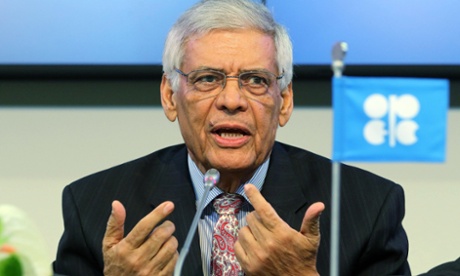
Abdalla Salem El-Badri, the secretary general of Opec, has insisted that today’s decision is no reason to “panic”.
I’ve taken this quote from fastFT:
[The recent price fall] doesn’t mean we have to rush and see where the market will settle; we want to see the market, how the market behaves.
Al-Badri also told reporters in Vienna that Opec has “no target price” for oil.
It appears Opec has decided to leave production levels alone for the next six months, according to Reuters:
This looks like being OPEC's oil output until mid-2015. OPEC delegate tells @Reuters its next meeting will be in June.
— Jamie McGeever (@ReutersJamie) November 27, 2014
Of course, an emergency meeting can’t be ruled out, and countries have been known not to stick to official targets.
But that does chim with Saudi Arabia’s desire to sit tight, maintain market share, and see if the oil price settles.
Opec: No production cut
It’s official! Opec’s spokesman has just read out a statement in Vienna, confirming that the oil group has decided to leave production targets at the current level of 30 million barrels of crude oil per day.
Share prices in oil producers are sliding too following these reports that Opec has left production levels unchanged.
They are dominating the list of biggest fallers on the FTSE 100:
Ruble in trouble
The Russian ruble has tumbled too, underlining that Russia is likely to suffer from Opec’s decision not to cut production levels.
It’s down by 1.5% to around 48 rubles to the US dollar.
Rouble tumbles 1.5% after Opec refrains from cutting production. It will be a tough few months for #Russia and other #oil producers
— Jack Farchy (@jfarchy) November 27, 2014
This slump in the oil price is a boost to households and many businesses; petrol stations should pass at least some of the saving on.
It will also push down headline inflation rates - and in the UK, that could mean the consumer prices index falls below 1%, from its current level of 1.3%.
That would force Bank of England governor to write a letter of explanation to the chancellor (the target is 2%).
UK CPI below 1% (and a letter from Carney explaining why) now looking rather likely.
— Duncan Weldon (@DuncanWeldon) November 27, 2014
And it is likely to intensify the deflationary pressures in the eurozone.
New York crude oil, the other measure of the oil price, has also fallen sharply in the last few minutes.
Nymex has shed almost 3% to $71.55 per barrel, the lowest since August 2010.
Nigeria confirms that Opec will continue to produce 30 million of barrels of crude per day:
NIGERIAN OIL MINISTER: OPEC TO MAINTAIN PRODUCTION LEVELS - MNI
— Fabrizio Goria (@FGoria) November 27, 2014
This chart shows how Brent crude tumbled to a fresh four-year low a few moments ago, as Opec’s meeting broke up without an agreement to cut production levels:
Brent intraday: pic.twitter.com/FpEZ0ZlHeP
— Michael McDonough (@M_McDonough) November 27, 2014
The Kuwaiti oil minister has confirmed that Opec resisted calls to cut production at today’s meeting in Vienna.
Ali Saleh al-Omair said “no change” to reporters as he left today’s meeting, Reuters and Dow Jones both report.
Ali Saleh al-Omair had earlier said that Kuwait would cope with the oil price, whether it was $60 per barrel or $80 per barrel.
OPEC Keeps #Oil Production Target Unchanged at 30 million Barrel per day.
— Holger Zschaepitz (@Schuldensuehner) November 27, 2014
Saudi: No Opec production cut
Another Reuters flash: Saudi oil minister Ali al-Naimi was asked whether Opec has decided not to cut, replied “that is right”.
And this is sending the Brent crude oil price falling sharply, hitting $74.75 per barrel. That’s a new four-year low.
#Brent #crude falls $1.50 on #OPEC announcement RO pic.twitter.com/vRVyC7KNrY
— IGSquawk (@IGSquawk) November 27, 2014
More newsflashes on Reuters... Saudi oil minister Ali al-Naimi has apparently said that Opec has taken a “great decision”, but hasn’t actually said what the deal is!
Newsflash on Reuters: the Brent crude price is weakening on reports that the Opec meeting has ended....
BRENT CRUDE OIL EXTENDS LOSSES TOWARDS $76 A BARREL AFTER REPORTS OPEC MEETING HAS ENDED, NO COMMENT FROM MINISTERS - RTRS
— Pauly@spz_trader (@spz_trader) November 27, 2014
Economics editor Larry Elliott has reached back into history to explain how Opec established such a grip on the oil market, and why the cartel is still influential:
Here’s his conclusion:
There are winners and losers from falling oil prices just as there are winners and losers from tumbling interest rates. Producing nations suffer while consuming nations benefit. The net effect, though, should be positive for growth since producers are more likely to save than consumers.
There are two provisos, however. The first is that lower prices stick. The second is that falling oil prices do not lead to a period of outright deflation from which countries find it difficult to escape.
Full piece: The Opec oil price still matters (just not as much as before)
The Economist has produced a neat chart, showing how Opec’s share of the energy market is expected to fall over the next six years:
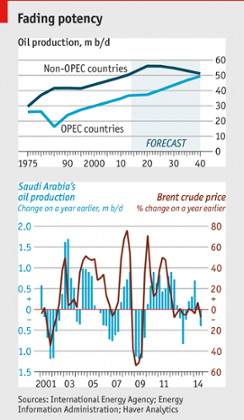
That adds to the OPEC dilemma:
OPEC’s poorer members, whose oil is generally costly to extract, want to cut output to prop up prices—now at four-year lows. Richer ones, who have lower costs, prefer to keep pumping and maintain their market share.
More here: Cartelists’ conundrum: OPEC meet
Still no news from Vienna, as Opec members continue to talk...
The wait goes on. Still no decision from OPEC meeting. pic.twitter.com/Y2p4lBw2lw
— Neil Hume (@humenm) November 27, 2014
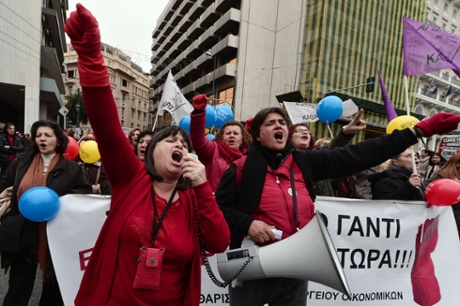
Today’s Greek anti-austerity protests are among the biggest “since the huge rallies back in 2011”, according to Odysseus Trivalas, president of the civil servants’ union ADEDY.
Unions are estimating that well over 100,000 state workers and private employees took to the streets.
Trivalas told our correspondent Helena Smith that:
“I think we sent a very strong message to the government and the Troika that the Greek people cannot make any more sacrifices, or tolerate any more behind-the-scenes exchanges of the kind they are now clearly preparing,”
Trivalas added that the turnout for the strike action had been “massive” with more than 90% of workers walking off the job, showing that people will not accept further austerity cuts.
Updated
The news of Germany’s falling inflation rate may have driven even more money into eurozone government bonds.
The price of French 10-year bonds just spiked, driving down the yield (interest rate) on the bonds to below 1% for the first time ever.
Traders may be calculating that lower German inflation raises the odds of the ECB launching the long-awaited sovereign bond-buying QE programme.
Updated
German inflation falls to lowest rate since early 2010

Back in the eurozone... Germany’s inflation rate has fallen to its lowest rate in almost five years, in the latest sign of deflationary pressures stalking the euro area.
The German Consumer Prices Index has risen by just 0.6% year-on-year, according to a flash estimate just released, down from 0.8% in October. Prices were flat month-on-month.
And on an EU-harmonised basis, annual German inflation fell to 0.5%, from 0.7% last month. That’s the lowest rate since February 2010, according to Reuters data.
#Japanification continues: German headline inflation continues to edge lower to 0.6% YoY in Nov, lowest since 2010. pic.twitter.com/xJ2v4pbHip
— Holger Zschaepitz (@Schuldensuehner) November 27, 2014
I think this raises the chances of the eurozone’s inflation rate, released tomorrow, falling to 0.3% from the 0.4% recorded last month.
German #inflation falls to 0.6% in November (0.8% in October), lowest level in nearly 5 years http://t.co/Yrm7kLYO5J
— Markit Economics (@MarkitEconomics) November 27, 2014
The fall in inflation has partly been driven by the fall in the oil price.
Carsten Brzeski, analyst at ING, points out that cheaper consumer goods and a drop in prices for vacation destinations and package tours also pushed inflation down.
He’s not worried though, saying:
As German employment just reached another record-high in October, this drop in inflation should be inflationary rather than deflationary.
Just think of Draghi’s famous words “with low inflation, you can buy more stuff”. At the current juncture, price expectations of both consumers and producers remain solidly anchored in Germany.
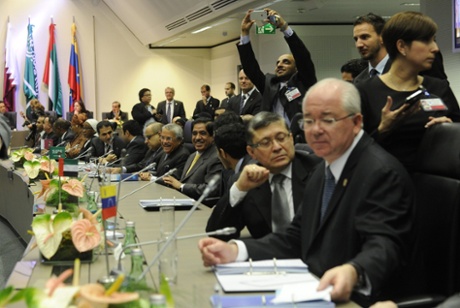
Another shot from Vienna this morning:
This chart explains how Opec’s muscle has been weakened by the rise of rival energy sources, such as shale:
#OPEC's dilemma, very nicely shown by Christoph Ruehl / ADIA #oil pic.twitter.com/7HUpSdYskE
— Cuneyt Kazokoglu (@ckazok) November 27, 2014
Lunchtime summary: Oil prices slides, Greeks strike
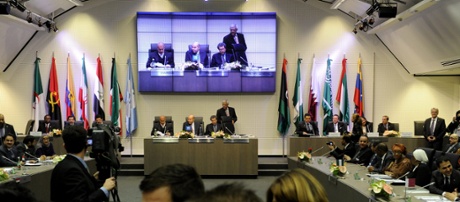
Time for a recap.
The oil price has fallen to new four-year lows today as members of the Opec cartel of producers hold a crunch meeting in Vienna.
Opec is expected to resist calls to cut production quotas in response to the 36% slump in the crude oil price since June.
As we wait for OPEC, a reminder how much and how quickly oil has fallen. -34% since June: pic.twitter.com/HcUxJ2sZSE
— Jamie McGeever (@ReutersJamie) November 27, 2014
That has wiped another 2% off Brent crude to around $76 per barrel, the lowest since September 2010.
Saudi Arabia, Kuwait, Qatar, and the United Arab Emirates have indicated that they will stick to existing production levels.
Saudi’s Ali bin Ibrahim Al-Naimi refused to give the press any titbits earlier, having already indicated that Opec will reach a “unified position”. The UAE’s representative has said there is no reason to panic.
Venezuela, though, is calling for Opec to lower its production goals. Its foreign minister Rafael Ramírez, told reporters that 2 million barrels of of excess oil are being produced each day, and it should be cut “out of the market.”
Ramírez also blamed the US shale industry for destabilising the market.
We should get Opec’s decision this afternoon (perhaps 3pm GMT....)
Barclays analyst Miswin Mahesh says that Opec’s refusal to cut production shows that its grip on the energy sector has weakened, and that Saudi Arabia is more concerned with market share than profits.
The oil price is likely to fall further if Opec stands pat today.
Will Hedden, Premium Client Manager at IG, says:
The sheer magnitude of the moves in oil recently have led many analysts to expect a cut to supply, as global growth concerns added to increased US production, and the rise of other hydrocarbons like shale gas pressurise the demand for traditional black gold.
Failure to cut supply today will lead to further downward pressure on Brent and Nymex.
Marc Ostwald of ADM Investor Services warned that another slide in the oil price will have serious consequences for counties such as Russia.
If OPEC fails to agree output cuts in oil, they will most likely see the price fall further: http://t.co/NFHNLNqpYB pic.twitter.com/176G0YgHoG
— Mitch Heiner (@mitchheiner) November 27, 2014
In other news....
Greece’s deputy PM has suggested its bailout exit might be delayed, after failing to reach agreement with the Troika yesterday.
Unions are holding a general strike in Greece now - these photos shows crowds of demonstrators, as transports links are hit.
Germany’s unemployment rate has hit a record low of 6.6%.
And inflation in Spain, and Saxony, has fallen more than expected.
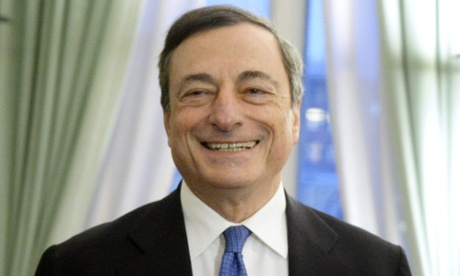
ECB chief Mario Draghi is now addressing students at the University of Helsinki.
Draghi is explaining that the eurozone needs two elements to ensure its success:
The first is that all euro area countries need to be able to thrive independently, the second is that euro area countries need to invest more in other mechanisms to share the cost of shocks.
He says there is a strong argument that sovereignty over relevant economic policies should be exercised jointly by Eurozone members.
Draghi also reminded his audience that three years ago, some experts believed the eurozone was about to collapse. They underestimated the political will to preserve the euro, he said, but warned that the single currency union needs to work for all its members.
Draghi: If there are parts of the euro area worse off inside the Union, doubts may grow about whether they might ultimately have to leave
— ECB (@ecb) November 27, 2014
The full speech is online here.
Photos: Greek general strike
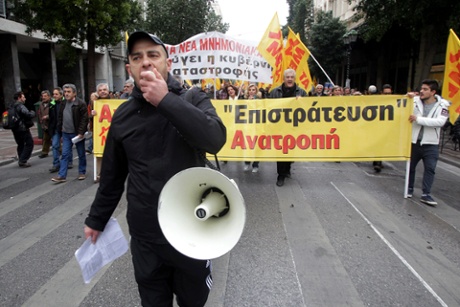
The deadlock over Greece’s bailout exit comes as unions hold a general strike in protest at the job cuts and other austerity measures demanded by its lenders.
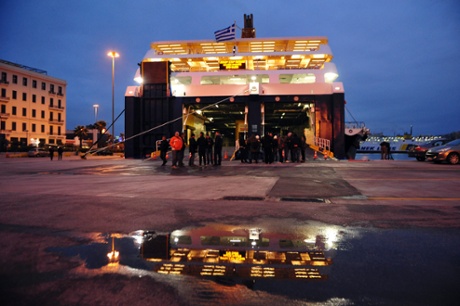
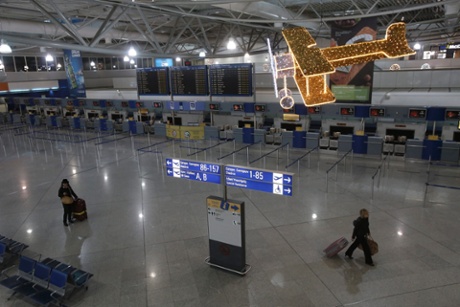
The walkout - the first general strike in months - has forced airlines to cancel hundreds of flights. Public offices have been shut, and local transport services badly hit.
Hospitals are being staffed by emergency workers, while tax and other local public offices are shut today.
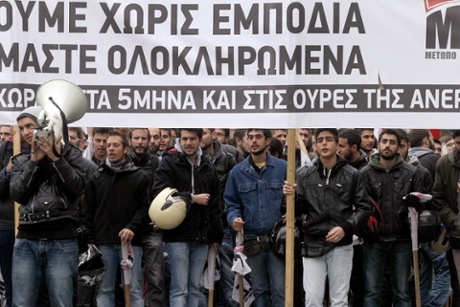
Members of the main unions are now marching through Athens, calling on the government to refuse to implement further layoffs and tax rises:
#Greece: Massive general strike protest #27ngr pic.twitter.com/NHFvJcscaS
— dromografos/Skar (@Skar_) November 27, 2014
No to extra taxes, unemployment, bailout agreements. Some of the messages being read on banners #27ngr #rbnews pic.twitter.com/qX4ArPz9f6
— Joanna P. (@Inflammatory_) November 27, 2014
#27ngr protesters start marching to Syntagma sq. I see unions, antiracist & left-wing groups #rbnews pic.twitter.com/8yRuAxmYHd
— Joanna P. (@Inflammatory_) November 27, 2014
The private sector GSEE union says austerity is creating a “humanitarian crisis” in Greece, adding:
“GSEE is resisting the dogmatic obsession of the government and the troika with austerity policies and tax hikes,”
Here’s more photos from Athens:
Updated
There is also speculation in Greece that next February’s elections to replace outgoing president, Karolos Papoulias, could be brought forward in an attempt to ease the political uncertainty gripping the country.
Former foreign minister Dora Baokoyannis told VIMA FM radio this morning that Greece was experiencing “a deep political, not economic crisis” that was now threatening to endanger any progress it had made.
She said:
“The picture of instability and uncertainty is at the expense of the Greek economy with every day that passes.
The process for the election of the president of the republic should start now, and parliament should not close for Christmas … we have a deep political crisis. Not an economic crisis.”
Greek deputy PM: Bailout could be extended
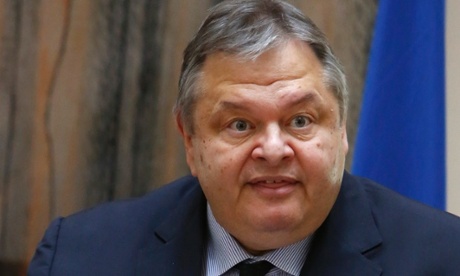
Just in, Greece’s deputy prime minister Evangelos Venizelos has told reporters that the country’s bailout programme could be extended by a few weeks.
This follows the failure to reach a deal with its creditors yesterday, Athens correspondent Helena Smith reports.
Venizelos told reporters gathered outside the prime minister’s office that:
“The European [side of the] programme expires on 31st December.
The aim is for the last installment [of aid] to have been released by the 31st. If for technical reasons some procedures have not been completed, there could be an extension but not a new memorandum [bailout accord].”
The delay could be “weeks or a few days”, he added.
He was speaking after talks with PM Antonis Samaras, on this week’s abortive negotiations with creditors in Paris (and as unions hold a general strike).
Venizelos added:
“A new programme means a new loan. That cannot happen.”
Government officials saying that negotiations with auditors will continue via email and teleconference calls.
Christos Protopappas who represented Venizelos’ Pasok socialist party at the Paris talks, confirmed this morning that the 21-hour negotiations had broken down primarily because the IMF had toughened its stance.
“The budget [for 2015] was the focus of great doubt,” he said adding that the troika wanted cuts in “major pensions” and further tax increases. “
We told them, these things cannot happen, and are not necessary. They are circulating scenarios about prolonging the memorandum [bailout accord].
We are saying no to a six-month extension.”
The deadlock is pushing up Greece’s borrowing costs, on nervousness that the Greek crisis is flaring up again....
#Greece 10-year bond yield climbs 17bps to 8.40%, following failed talks between the Greek gov't and the Troika. | #euro
— Yannis Koutsomitis (@YanniKouts) November 27, 2014
#Greece 10 year 8.48% pic.twitter.com/jTk3ByAiDJ
— Yiannis Mouzakis (@YiannisMouzakis) November 27, 2014
Updated
Barclays: Opec is losing its grip
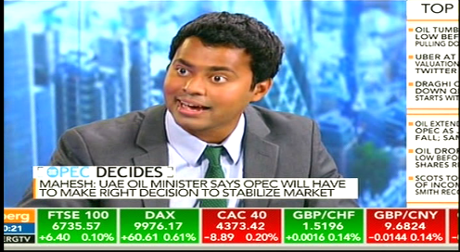
The reluctance of many Opec members to agree an output cut shows that the cartel’s grip on the industry has weakened, says Miswin Mahesh, oil analyst at Barclays.
Speaking on Bloomberg TV, Mahesh explains he doesn’t expect much from today’s meeting in Vienna.
If Opec don’t agree to limit production, he says, then they show they no longer have a grasp on the oil sector.
But if they were agree to cut production, say by one million barrels per day to 30m/day, it’s not clear they could implement it.
And Opec members also know that other suppliers, from outside the cartel, would fill the gap.
Mahesh reckons that Saudi Arabia’s strategy is to protect its market share by sitting tight, watching for the oil price to stabilise over the next few months, and then adjust to the situation.
Updated
Shares in oil producers have fallen this morning, tracking the selloff in crude (Brent is currently down 2.5% at $75.77 per barrel)
OPEC’s (likely) reluctance to cut output today has knocked 3.5% off Petrofac’s share price, 1.5% off BG Group and 1.3% off Royal Dutch Shell.
Elsewhere in the markets, the yield (or interest rate) on a flock of European government bonds is tumbling again to new record lows.
This flow of money into eurozone sovereign debt has driven the yield on French 10-year bonds down to just 1%.
It shows traders are anticipating an ECB QE programme, weak eurozone growth, and very low inflation (or worse).
Another day, another record-low 10Y yield in Germany, Austria, Belgium, France, Finland, Ireland, Italy, the Netherlands and Portugal
— Lucy Meakin (@lucy_meakin) November 27, 2014
Euro zone countries' bond yields below 1% Germany 0.71% Finland 0.79% Netherlands 0.83% Austria 0.86% Belgium 0.95% France 1% and falling
— Jamie McGeever (@ReutersJamie) November 27, 2014
Another photo of Saudi oil minister Ali al-Naimi (shaking hands, on the left) before the press pack were driven from the room.
Naimi looking relaxed at #opec pic.twitter.com/O1fUlrA8ak
— David Sheppard (@ReutersSheppard) November 27, 2014
Today’s Opec meeting has officially started, according to a newsflash from Reuters.
Venezuela hits out at shale
Venezuela’s foreign minister, Rafael Ramirez, took a swipe at America’s burgeoning shale industry as he arrived at the Opec meeting, suggesting it should be reined in.
Ramirez said (via Reuters):
“The U.S. is producing in a very, very bad manner. The shale oil, I mean it is a disaster from the point of view of climate change...”
Unlike the environmentally friendly oil industry?!
Venezuela is reportedly planning to propose an output cut today; the consensus, though, is that other countries led by Saudi Arabia will resist (see 8.02am onwards for the key quotes)
OPEC: Dow Jones - Venezuela has proposed OPEC cut similar to Oran 2008 decision when OPEC cut output ceiling by 2.2 million b/d
— Sri Jegarajah (@cnbcSri) November 27, 2014
Updated
Jonah Hull, Al Jazeera’s man at the OPEC briefing, shows that oil ministers have taken their seats in Vienna and are being interrogated by the press....
The #OPEC game of grab-an-oil-minister is underway in Vienna. No comment from the Saudis. pic.twitter.com/47rdUeIOnx
— Jonah Hull (@jonahhull) November 27, 2014
#OPEC breakfast. This is what you get when the oil price falls below $80. pic.twitter.com/4rhmCBIUJd
— Jonah Hull (@jonahhull) November 27, 2014
Back in Vienna, Saudi oil minister Ali bin Ibrahim Al-Naimi wasn’t keen to engage with the press as the OPEC meeting started.
“I’ve made enough comments”, he said, according to this video clip from CNBC’s Rose Michelson:
Saudi oil min Ali Al-Naimi refuses to answer any questions ahead of #OPEC meeting https://t.co/b9u9SqIrfT
— Rose Michelson (@roseleah) November 27, 2014
Day over? *DRAGHI SAYS HE 'WON'T ELABORATE ON POSSIBLE UPCOMING MEASURES'
— Frederik Ducrozet (@fwred) November 27, 2014
The text of ECB chief Mario Draghi’s speech to the Helsinki parliament has been released.
No show-stoppers; Draghi will tell students that monetary policy can’t do all the “heavy lifting” on its own, and repeated his call for a “comprehensive strategy” to put the eurozone economy back on track.
Updated
Italian business confidence has taken another hit this month, as the country’s recession hurts the sector.
The monthly index of corporate morale has fallen to 87.7 this month, from 89.1 in October (100 is the long-term average). There is one encouraging sign - manufacturers are slightly less gloomy.
German unemployment rate hits fresh low

Just in: Germany’s unemployment total had fallen again as its labour market shrugs off the economy’s slowdown.
The number of people out of work in Germany fell by 14,000 this month (on a seasonally adjusted basis), to 2.872m. That means Germany’s unemployment rate is just 6.6%, a record low according to reports.
October’s figures have also been revised, to show the rate hit 6.6% last month too, not 6.7% as first reported.
Germany’s economy skirted recession last quarter, with growth of just 0.1%. But its workforce does not appear to be suffering.
German unemployment down 14k in November. Jobless rate steady at new record low of 6.6% (Oct rev from 6.7% to 6.6%) http://t.co/IB241xZiZT
— Markit Economics (@MarkitEconomics) November 27, 2014
Updated
Oil price hits new lows as OPEC kicks off
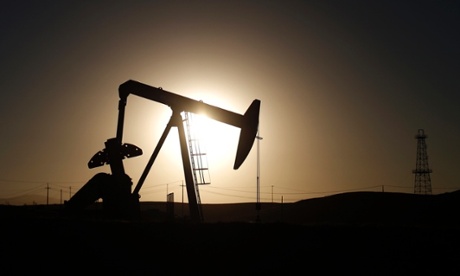
The oil price is sliding rapidly to fresh four-year lows, as traders come to the conclusion that OPEC will agree not to cut output at today’s meeting in Vienna.
Brent crude has slumped by 2.7%, or over $2 per barrel, to $75.60.
And US crude is down by over 2% to $72 per barrel.
There’s no news out of Vienna yet, where OPEC members have gathered this morning.
Neil Hume of the FT reports that oil ministers from Saudi Arabia, Qatar, Nigeria and Algeria have all declined to speak to the media as they rocked up.
Quite a media scrum too:
Media scrum building ahead of the arrival of opec ministers. pic.twitter.com/z7J9MyuZrk
— Neil Hume (@humenm) November 27, 2014
Now in the media holding pen (the stairwell) before start of opec meeting pic.twitter.com/fZ5uzDO77f
— Neil Hume (@humenm) November 27, 2014
Today’s OPEC meeting is a “watershed moment”, reckons Marc Ostwald, City analyst at ADM Investor Services, especially if the cartel declines to slice output.
He adds:
The signals from the various members appear to suggests that the Gulf oil producers (Kuwait, Qatar, UAE and Saudi Arabia) are set to reject demands from other members (and indeed Russia and Mexico) for an output cut, because they appear to be more concerned about “guarding market share”, which in turn will leave even more questions about the precarious budget positions of the other members.
Spanish and Saxony inflation weaker than expected
We have worrying inflation data from the eurozone too, which could increase the pressure on the ECB to launch a sovereign bond-buying programme.
Spain’s annual consumer prices index has fallen to minus 0.4%, down from -0.1% in October.
On a EU harmonised basis, inflation has fallen to -0.5%, an acceleration from -0.2% last month.
Deflation accelerated in Spain in November. EU HICP minus 0.5% y-o-y. pic.twitter.com/VCXArwz2mw
— Edward Hugh (@Edward_hugh) November 27, 2014
Inflationary pressures in the German province of Saxony have also weakened this month. Its annual inflation rate fell to +0.7%, from +1.0% last month. And prices shrank by 0.1% during the month.
#German #CPI - Saxony CPI first out: -0.1% m/m vs. expected Flat, 0.7% y/y vs. Oct 1.0%, ex-energy Flat m/m
— Marc Ostwald (@MOstwald1) November 27, 2014
Reminder: We get the wider German inflation rate at lunchtime, and then the eurozone figure tomorrow....
Updated
Brent crude has experienced a dramatic slide; down from $115 per barrel in late June to just $76 today, as this chart from Reuters’ Jamie McGeever shows:
As we wait for OPEC, a reminder how much and how quickly oil has fallen. -34% since June: pic.twitter.com/HcUxJ2sZSE
— Jamie McGeever (@ReutersJamie) November 27, 2014
But why?
There are several factors; weakening global growth means less demand for crude, while the stronger US currency has also pushed down the cost of commodities priced in US dollars.
Also, the shale gas revolution has boosted America’s oil production levels to their highest in decades.
Updated
JP Morgan analysts reckon the oil price will soon fall below $70 without Opec action; other analysts have suggested we could even see $60/barrel.
JPM expects OPEC not to reach an agreement on production cuts. In this event, oil prices will move down, possibly below $70/bbl for Brent.
— Holger Zschaepitz (@Schuldensuehner) November 27, 2014
Updated
Singapore-based Daniel Ang of Phillip Capital agrees that the “consensus” reached by Saudi Arabia, Kuwait, Qatar and the United Arab Emirates means no output cuts today:
He told Reuters:
“Dreams of rising oil prices [have been] smashed with pre-OPEC meeting sentiments. Brace yourselves for lower oil prices.”
Several other oil ministers have also indicated that Opec will resist pressure to cut output at today’s meeting.
UAE oil minister Suhail bin Mohammed al-Mazroui told the FT that the market will, eventually, fix the oversupply in the oil market.
“I don’t think we should panic. There is nothing that should cause us to panic.”
And Kuwait has suggested that Opec will cope, whether the oil price is $60 or $80.
"We have to live either $80 or with $60," says Kuwait oil minister: Oil prices fall to 4-year lows as OPEC pro... http://t.co/xjxonNHx7c
— Middle East Markets (@AB_Markets) November 27, 2014
Updated
Brent crude hits new four-year low
The oil price has hit a fresh four-year low this morning, as speculation grows that producers will not agree output cuts at the crucial OPEC meeting in Vienna today.
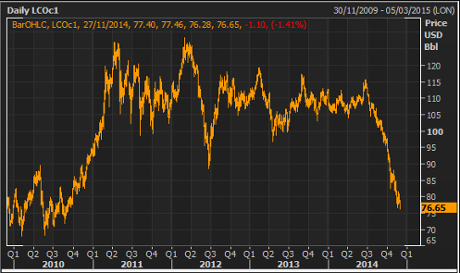
Brent crude oil slipped by over $1 per barrel, or 1.5%, to $76.58, extending the sell-off that began five months ago and has shaken the commodities market.
New York crude has also slipped, to around $73 per barrel.
The slide follows a stream of reports from Vienna that the Organization of Petroleum Exporting Countries will not agree to cut output at this week’s meeting.
Saudi Arabia’s oil minister, Ali Al-Naimi, has told reporters that Opec will take a “unified position” at today’s meeting. That follows days of leaks suggesting producers will not slash output.
Ian Williams of Peel Hunt explains:
Crude oil is trading at another four-year low this morning, as confirmation is beginning to emerge from the OPEC meeting that there will be no output cuts announced later today.
Updated
The Agenda: OPEC meeting, Greek strike, Draghi speech
Welcome to our rolling coverage of the financial markets, the world economy, business and the eurozone.
On the agenda today.... Members of the Opec oil cartel are meeting in Vienna today; despite recent price falls, they are thought unlikely to cut production. More on that in a moment.
A general strike has been called in Greece today, to protest against its austerity measures, hours after talks with its lenders over its bailout programme failed to reach a deal.
In the eurozone, we get the latest flash estimate German inflation data for November (1pm GMT).
Some economists think prices pressures have eased again this month, which could pull the wider euro area closer to deflation this month.
The latest German unemployment data is also due, at 8.55am GMT
There will probably be fresh chatter about the European Central Bank moving into full-blown quantitative easing today.
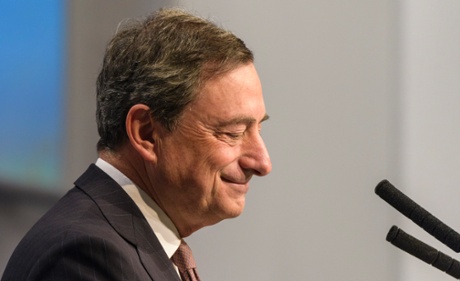
ECB president Mario Draghi is giving a speech in Helsinki at 11.30am; Germany’s top central banker, the hawkish Jens Weidmann, speaks 45 minutes later in Frankfurt.
Not expecting any news from the US, though, as it’s Thanksgiving.
German CPI, Draghi talking, holiday volumes and Opec could make European markets sporty today
— Nicola Duke (@NicTrades) November 27, 2014
And UK shoppers will learn this morning which British supermarkets have been particularly hit by the potentially lethal food-poisoning bug campylobacter.
As we report this morning:
The Food Standards Agency will publish rates of contamination for each supermarket chain. The industry is bracing itself for the results to be significantly worse than those published by the FSA in August, which found six in 10 chickens were contaminated.
Campylobacter rates tend to rise in the summer and averages similar to 75% found by the European Food Safety Authority in 2010 are expected.
Full story: Supermarkets prepare to be shamed over chicken contamination
I’ll be tracking all the main events through the day.
Updated