Zoe Williams addresses the complexity of the issues raised by the politicisation of Ofsted inspections with insight and even-handedness (The ‘swamp’, it seems, is in Ofsted’s head, 24 November). However, the problem of an acceptable relationship between religion and schooling can be tackled by rigorous secularisation. After all, Judaism, Christianity and Islam arose out of the same pre-Enlightenment, misogynist “values-swamp” within archaic pastoral cultures. Furthermore, the logic of secularisation means replacing religious education with cultural anthropology, so children are exposed to a more critical awareness of other cultures and worldviews.
As a retired social sciences teacher I have covered many RE lessons in academies and witnessed instances of proselytising masquerading as objective teaching. RE teachers tend to be practising Christians and are also heavily involved in PSHE (personal, social and health education), where biases about sexuality, sex and relationships are potentially problematic.
It should not be the role of Ofsted to operationalise political “moral panics” about faith (fundamentalist or moderate) into their inspection regime. Secularisation would remove this need. The whole notion of “British values” is a nonsense and impossible to police in a democracy.
Philip Wood
Kidlington, Oxfordshire
• There is no doubt that Ofsted should forsake its almost exclusive concern with measurable achievement and focus much more on how schools prepare their pupils for life in our fast-changing, pluralistic society (Editorial, 24 November). Schools would welcome such a shift of emphasis; senior figures in Ofsted are supportive, too, of change. The danger is that, in the light of the “Trojan horse” affair, Ofsted finds itself the arbiter of what constitutes extremism in schools – without any thought-through consensus on the “fundamental values” threatened by extremism or on the propriety of investing this responsibility to an organisation whose inspectors are not trained (who could be?) to undertake the task.
However sensitive an inspection (and many are), inevitably the notion of Orwell’s “thought police” comes to mind, especially to those singled out for criticism. The current situation is fraught with danger to community cohesion, cultural identity, school success – and also to Ofsted’s raison d’etre. To borrow religious vocabulary, Ofsted has got itself, and faith schools more generally, into an “unholy” mess as it trespasses on ground where any sensible angel (of whatever religious complexion) would fear to tread.
Professor Colin Richards
Spark Bridge, Cumbria
• Neither Zoe Williams nor your editorial which re-examines Ofsted’s difficulties when it comes to Muslim education, really identify how the problem came about and what we can do to rectify the issue.
Tony Blair sent his children to a Catholic school and encouraged the increase of faith schools, contrary to the evidence that segregation in education was part of the difficulty in Northern Ireland. Michael Gove compounded the problem by encouraging schools to become independent of local education authorities and employ non-certificated teachers. Through so doing, with no real structure in place to monitor on a regular basis the governance, financial and curriculum operation of this accelerated process, and discouraging any early intervention by Ofsted, he laid the foundations of the “swamp” Ofsted is now struggling in.
These “independent” schools have been allowed a more or less free hand in who they employ and what they spend. Imposing the market on a national education system has had the same kind of repercussions as those we have observed in the banking system. The consequences are clear for all to see.
David Selby
South Wonston, Hampshire
• Your report (Ofsted finds serious failings at six Muslim schools in London, 22 November) mentions two specific failings identified in one school.
The first was that pupils were unable to tell inspectors which of sharia law or English law was more important. That is not surprising, as the answer will depend on considering sub-questions, such as important for whom, in what circumstances and where.
The second “failing” related to the fact that some students told inspectors “Women stay at home and clean and look after the children. They cook and pray and wait for us to come back in from school and help with homework.” As a statement of fact that is probably true for quite a number of Muslim families, and there is nothing illegal or intrinsically wrong with such an arrangement.
If I were a Muslim I would regard these criticisms not only as unintelligent but as hostile and provocative.
If the government is so paranoid about the values taught in faith schools, it should simply abolish them and decree that all schools should be secular. Religious education could then be left to the mosques, churches, synagogues and temples. Ofsted could then concentrate on ensuring the delivery of a secular curriculum and abandon its inappropriate role as part of the government’s anti-terrorist strategy.
Judith Scott
London
• Ofsted’s trumpeting of the findings of its inspections in Tower Hamlets is regrettable on two counts.
First, I failed to find any reference to the amendment to the Education (Independent School Standards) (England)Regulations that made it a requirement that the school’s proprietor “actively promotes the fundamental British values of democracy, the rule of law, individual liberty, and mutual respect and tolerance of those with different faiths and beliefs”. The previous requirement was to encourage pupils to respect those aspects. To understand the significance of the change, consider replacing a requirement to encourage pupils to respect non-traditional family models with one that required the promotion of non-traditional family models. The inspections all started between 8 October and 16 October. The change in the regulations came into force on 29 September.
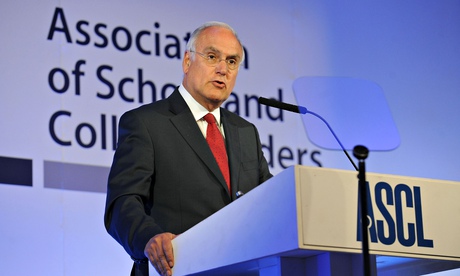
Second, Sir Michael Wilshaw expressed concern that the narrowness of the curriculum (an issue in four of the schools) may make pupils vulnerable to extremist influences and radicalisation. As an individual he is entitled to that opinion, but as head of Ofsted he should confine himself to evidence-based judgments, and no evidence has been produced to support that comment. It is unfortunate that the fundamental British values of transparency and fairness have been ignored, leaving the opportunity for those who so wish to detect intolerance of others’ faiths and beliefs.
John Gaskin
Driffield, Yorkshire
• The report on John Cass school’s downgrading from outstanding to inadequate (21 November) makes interesting reading. Given that one of the reasons is segregation between boys and girls in school areas, I can only assume that all single-sex schools will be deemed to be inadequate and required to produce action plans. When is Eton to be required to comply with these rules?
Carole Underwood
Kendal, Cumbria