OSAKA -- Officials missed three opportunities to address the risks posed by a block wall that collapsed in the earthquake that struck Osaka Prefecture last week, killing a 9-year-old girl.
The hypocenter of the earthquake, which measured up to lower 6 on the Japanese seismic intensity scale of 7, was in northern Osaka Prefecture. The wall that collapsed bordered a swimming pool at Juei Elementary School, a municipal school in Takatsuki, Osaka Prefecture.
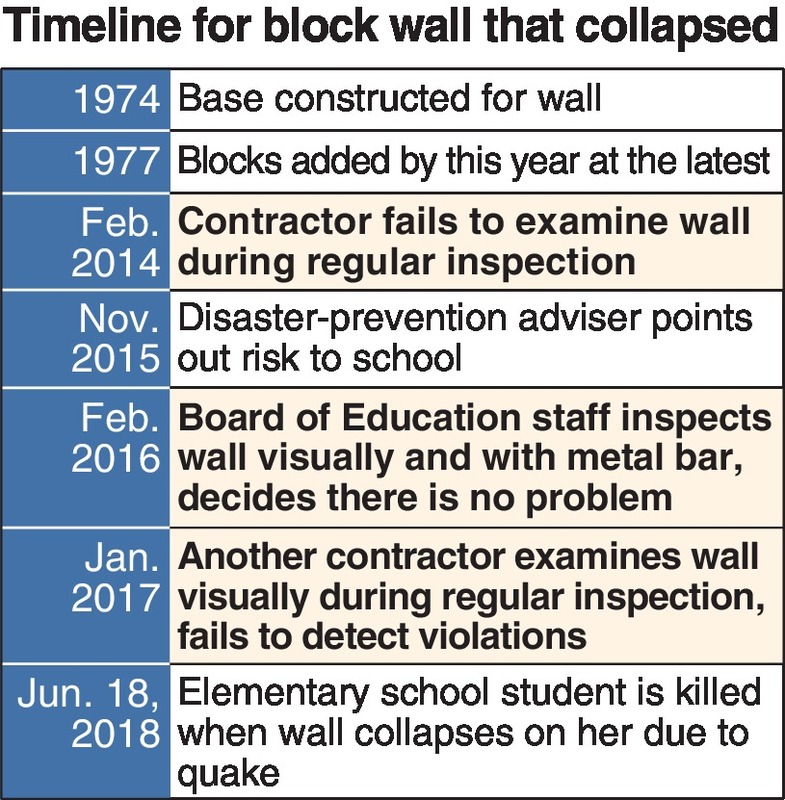
The wall's 1.9-meter-high base was constructed in 1974, and eight layers of concrete blocks reaching an additional 1.6 meters high were added by 1977 at the latest. Both the wall's height and its strength violated enforcement regulations of the Building Standards Law.
The first opportunity came during a regular inspection for fiscal 2013, performed in February 2014. According to the Takatsuki Board of Education, the contractor's report on its inspection merely contained a copy of the results from the previous inspection in fiscal 2010. The second opportunity was in November 2015, when a disaster-prevention adviser invited by the school pointed out that the wall was at risk of collapsing in a major earthquake.
The school consulted an official of the board of education, who in February 2016 pronounced there to be "no problem" with the wall after performing visual and other inspections. The information was not shared with outside parties.
The third opportunity was in the fiscal 2016 regular inspection, performed in January 2017. Another contractor visually inspected the wall, but failed to notice any violations.
"We can't deny that this could be considered a man-made disaster," a board of education official said.
55,000 elevators stopped
About 55,000 elevators stopped working after the large earthquake that struck northern Osaka Prefecture last week, mainly in Osaka city.
Most are now working again, but as of Friday evening at least 100 elevators were still out of service.
There were 339 incidents involving people trapped inside elevators, 1.6 times the number in the 2011 Great East Japan Earthquake and six times more than in the 2016 Kumamoto Earthquake. This highlights a potential problem should an earthquake occur directly beneath an urban area.
Interviews with four of the five biggest elevator maintenance and servicing companies revealed that most of the about 55,000 elevators that halted were in Osaka. The reasons why some elevators were still not running included being unable to confirm their safety and waiting for parts to arrive.
There were 267 incidents involving people trapped inside elevators in Osaka Prefecture, 41 incidents in Hyogo Prefecture, 25 incidents in Kyoto Prefecture, five incidents in Nara Prefecture and one incident in Shiga Prefecture, according to the Land, Infrastructure, Transport and Tourism Ministry.
There were 210 such incidents in the Great East Japan Earthquake and 54 incidents in the Kumamoto Earthquake.
Read more from The Japan News at https://japannews.yomiuri.co.jp/