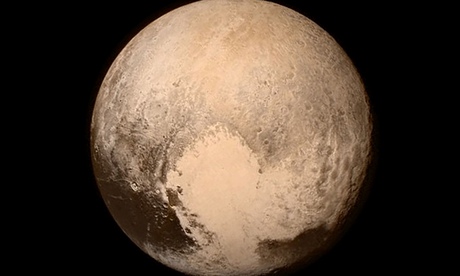
Hiding behind the cheers and the whoops that accompanied the triumph of Nasa’s New Horizons mission, there was an elephant in the room every bit as large as the world that the spacecraft had be sent to study. Embarrassingly, Pluto is no longer a planet according to the International Astronomical Union, astronomers’ regulating body.
That didn’t stop the mission’s principal investigator, Alan Stern, referring to it in passing as a planet during the press conference at closest approach. Nor did it stop Nasa’s chief administrator, Charles Bolden, using the p-word in the days leading up to the flyby. But the reality is that the argument over Pluto’s status has been rancorous, and highlights both the lofty ambition of science and the pettiness of its practice.
When New Horizons left Earth on 19 January 2006, Pluto was a planet. However, little more than six months later it was ignominiously demoted in a spat between astronomers in Prague, where the International Astronomical Union was meeting.
To be a planet, they decided, a celestial body had to be in orbit around the sun and it had to be spherical (more or less). So far, so logical. The problems began with the final clause: it had to have “cleared the neighbourhood of its orbit”.
This was the Pluto-killer because Pluto was diminutive and shared similar orbits with smaller asteroid-like objects. Clearly, it had not cleared out its orbit and so could not be a planet.
The trouble is that the third criteria makes little sense. Jupiter is dogged by asteroids called Trojans, Earth has the moon following its every move and Neptune crosses orbits with Pluto.
Until 2006, astronomers had bumbled along quite happily for centuries discussing whether new bodies were planets on a case by case basis. It allowed usage and culture to be the final arbiter of planethood. In attempting to make a scientifically binding definition, astronomers simply made things confusing.
There is no way the definition can be easily taught in schools or widely understood because it relies on byzantine knowledge of solar system dynamics and even then doesn’t actually make much sense.
Pluto is without question a small world. With a diameter of just 2,370 kilometres, it is smaller than our moon. Its volume is less than 1% of the Earth’s, meaning that it has a total surface area equivalent to that of Russia. Yet, this is should not necessarily ban it from being a planet.
To deny Pluto is also to deny the cultural history of astronomy. Its 1930 discovery by Clyde Tombaugh at the Lowell Observatory, Arizona, was a milestone in science that had a tremendous impact on the study of the celestial realms. It focused attention on the solar system’s outermost realms, and we must not just rewrite this history.
As the flyby images have shown, not only is Pluto an important world in its own right, it is the herald of the outer reaches where icy mingles with rock to sculpt the worlds we find there. It is not a leftover from the process of planet formation, it more likely the largest planet that could form in those rarefied conditions. Studying it may provide the very keys we need to understand the formation of our own much larger world.
Pluto is kin to the Earth. If it were not, the flyby would not have attracted such huge interest. However you look at this, Pluto deserves to be a planet, and astronomers deserve to put their efforts into understanding it.
It is time to strip back the rules of planethood, reinstate Pluto and accept that we live in a larger, more varied solar system than some would like. Vive les différences planétaires.