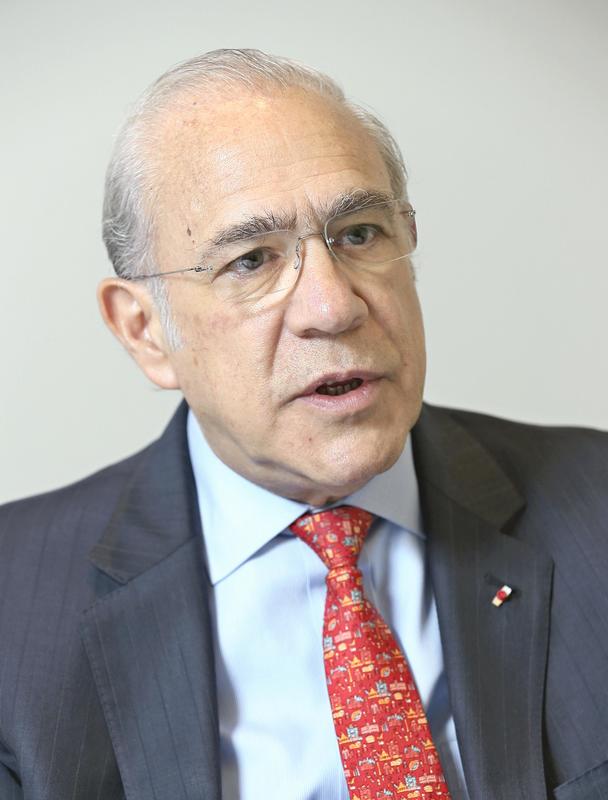
The Organisation of Economic Cooperation and Development published in April its policy proposal titled "Japan: Promoting inclusive growth for an ageing society." OECD Secretary General Angel Gurria spoke with The Japan News during his stay in Tokyo about Japan's wage gap between men and women, and the consumption tax increase scheduled for 2019. The following are excerpts compiled from one-to-one and written interviews.
The Japan News: Amid an unprecedented amount of public debt, should Japan increase the consumption tax rate from 8 percent to 10 percent in October 2019 as planned?
Gurria: Yes, it should. We are expecting that it happens. We understand the complexity politically. My recommendation is to go every year. Because you need the money, but also consumption tax does not distort the priorities and allows for more efficient allocation of resources. It can give you the money you require to support the more vulnerable people, the elderly and the young people to move from students to being in the work area, increase productivity, look at the aging problem.
Japan has the highest level of government debt ever recorded in the OECD and persistent budget deficits. Moreover, public spending related to aging -- health and long-term care and pensions -- is projected to rise by 7 percent of gross domestic product between 2020 and 2060. Japan definitely needs more government revenue.
Q: What measures will the government take to prevent losing economic momentum?
A: There are two priorities: 1) continued structural reform to promote strong economic growth; and 2) a supplementary budget to provide extra support when the tax hike is implemented. You do not lose economic momentum by increasing the consumption tax while at the same time you are reducing the income tax on the companies. Clearly there was some room to reduce the income tax, promote more investment and then reduce also tax on labor, because that was preventing the workers from having more net revenue and at the same time you had the lowest consumption tax.
The OECD recommended that even with a consumption tax rate of 10 percent Japan would remain among the OECD countries with low consumption tax rates, suggesting scope for further increase to help achieve fiscal sustainability.
Tax increase should be gradual
Q: How long do you think it will take Japan to gradually increase its tax rate to 19 percent, the average rate of OECD countries?
A: The experience of 2014 suggests that the pace of tax increases should be gradual. Following the consumption tax hike from 5 percent to 8 percent, Japan's economy went into a tailspin and the implementation of the legislated increase to 10 percent was postponed twice. In addition, numerous stimulus packages were introduced. In April 2016, I was invited by Prime Minister Shinzo Abe to participate in an experts meeting. In that meeting, I recommended that future hikes in the consumption tax rate above 10 percent be gradual. For example, hiking the rate by one percentage point per year would avoid the sharp fluctuations experienced after the hike from 5 percent to 8 percent.
Why? Because 1 percent doesn't really matter that much, and second because you do not have this up and down consumption, nobody is going to be changing the consumption pattern for 1 percent, and also if they know that it is coming over the years, then you will spread out your consumption over the time.
Q: Japan's tax revenue ratio against GDP is now over 30 percent. What do you think this situation will bring about?
A: In 2015, its tax-to-GDP ratio of 30.7 percent was still below the OECD average of 34 percent. With the rise in the government spending related to aging -- health and long-term care and pensions, Japan definitely needs more government revenue.
Q: Is there room for any measures regarding taxes related to environmental issues?
A: Measures to raise revenue should rely primarily on taxes that are less distortive. Greater use of green taxes would raise revenue and help achieve important environmental goals.
Effectively a green tax is designed to produce revenue over a relatively limited period of time but basically to change the pattern of conduct, to have less fossil fuel consumption and less unit power of GDP.
According to the OECD's report, the gender pay gap in Japan is 25.7 percent, the widest in the OECD after Estonia and South Korea. If the gender gap in labor force participation were halved over the 2013-25 period, Japan could boost total cumulative growth in GDP per capita over the entire period by almost four percentage points.
Q: Because Japan's working-age population is expected to decrease remarkably in the near future, the utilization of human resources is the biggest challenge in the labor market. What effects do you think Japan would get by shrinking this gap?
A: The point is you're aging and the labor force is totally shrinking. Dependency is growing, therefore you need to have all hands on deck. The wage gap is only one manifestation of the problem. We have to eliminate the wage gap.
The large gap reflects women's concentration in nonregular employment. In Japan's dual labor market, about two-thirds of the relatively low-paid non-regular employees are women. Even though young women are more likely than young men to have completed tertiary education, they are less likely to enter regular employment upon graduation and also less likely to enter fast-track career streams where workers are groomed for higher management.
Many employers still expect women to withdraw from the labor force around childbirth, and they are therefore less likely to invest in women's career development. This contributes to a very "leaky labor market pipeline" in Japan: While women's share of the labor force is around 43 percent, only 12 percent of management positions are held by women. The share of women on boards of directors of publicly listed companies in 2016 was less than 5 percent, compared to 20 percent on average in the OECD. Only women in South Korea fared worse. Reducing the gender wage gap would encourage women to work, thus mitigating the impact of population ageing and promoting inclusive growth.
Retirement at 60 inappropriate
Q: What kinds of labor market systems do you think Japan will reform, such as the mandatory retirement age system?
A: Employment rates of older workers are higher than the OECD average, but there is room for improvement. As in many other countries, the employment rate drops considerably from the 55-59 age groups (79.9 percent) to the 60-64 age groups (63.6 percent in 2016). Although many firms still set mandatory retirement at age 60, the employment rate of the 60-64 age group has been on an upward trend, due to the introduction of a continuous employment system under which employees can work as nonregular workers until age 65.
Given long life expectancy, mandatory retirement at age 60 is not appropriate. Accelerating the planned hike to age 65 for eligibility to an earnings-related pension would encourage employees to work longer. Further increases beyond age 65 for both the earnings-related pension age and the national pension would also improve the sustainability of public pensions.
The culture of long working hours needs to be curtailed so that workplaces become attractive to both fathers and mothers. Leadership in the workplace will be crucial to achieving this goal. Senior managers need to lead by example by taking their own holidays, or by making middle management accountable for both male and female employees actually using their parental leave entitlements. A firm's management and workers could agree on a limit to the amount of overtime, and the government should introduce a binding ceiling on overtime hours. The government should also serve as a role model by changing work habits and culture in the public service.
Use multilateral system
Q: Under U.S. President Donald Trump, a trade war between the United States and China has emerged. What do you think its impact on the global economy will be?
A: The only way to deal with the real problem is to have the global forum discuss how you are going to reduce capacity because the real problem is excess capacity. So by putting tariffs and tariffs and countertariffs and tit for tat and retaliation, this is not a solution, it only makes things worse. So I am saying let's use a multilateral system, let's use the rule-based system in order to deal with these issues.
The OECD strongly supports the rules-based international trading system. Safeguarding this system will help to support growth and jobs. On the other hand, a retreat from open markets would result in long-term growth prospects. The threat of protectionist measures has created uncertainty and some volatility in stock markets. Moreover, protectionist measures by China and the United States against each other would have implications for Japan, given that China and the United States are Japan's largest trade partners.
Q: The Bank of Japan can't achieve its 2 percent inflation target. How do you think Japan can overcome deflation, from the OECD's point of view?
A: Following the introduction of Quantitative-Qualitative Easing, core inflation (excluding energy and food) rose rapidly, from -0.7 percent (year-on-year) in the first quarter of 2013 to 0.9 percent in the first quarter of 2014.
However, the rise in inflation was partially reversed by weak demand following the consumption tax hike in 2014 and falling oil and commodity prices. Inflation has been picking up in recent months: Headline CPI inflation was around 1.5 percent (year-on-year) in the first two months of 2018, while core CPI (the BOJ's target measure), which excludes only fresh food, was close to 1 percent.
Definitively overcoming deflation is essential for Japan. Deflation lowers nominal GDP, thereby boosting the government debt ratio and threatening fiscal sustainability. Reducing the debt ratio in a deflationary context is thus very difficult, in part as deflation also has a negative impact on growth. We recommend, therefore, that monetary easing should be maintained until inflation is durably above the 2 percent target.
Q: In particular, there are few foreign workers in specialized fields in Japan. What kinds of measures does Japan need regarding foreign workers?
A: The possibilities to employ foreign workers have expanded in Japan in recent years. The number of foreign workers in employment rose by about 20 percent annually between 2015 and 2017, indicating employers' willingness to incorporate foreign workers into their labor force. The hiring of foreign workers in professional and technical fields has been actively promoted for almost two decades, and increasingly favorable conditions for the highly qualified have been offered since 2012.
Nevertheless, the number of foreign professionals remains low. Japan should promote other categories of foreign skilled professionals to increase the pool of candidates and to build on its comparative advantage. Similarly, recent changes in employment possibilities for foreign care workers with Japanese training should be used to increase the supply of foreign workers in this sector. Finally, with the recent reform of the technical intern program, employers may increase the number of trainees and keep them for up to five years.
Q: How do you think major events such as the Rugby World Cup and Tokyo Olympics will help Japan's economic growth?
A: Sports events require significant investments, particularly in facilities. A well-planned event with a carefully designed legacy will attract higher levels of domestic and foreign investment. With this in mind, Japan has explicitly linked the 2017 Asian Games through to the 2021 World Masters as opportunities to boost national recovery efforts and to benefit local areas throughout the country. Japan aims to use these events to boost tourism and local growth opportunities as well to promote sports in the country, and to raise the profile of Japan.
--This interview was conducted by Japan News Staff Writer Etsuo Kono.
-- Angel Gurria / OECD Secretary General
As secretary general of the OECD since 2006, Gurria has firmly established the organization as a pillar of the global economic governance architecture. Born in 1950, in Tampico, Mexico, Gurria came to the OECD following a career in public service in his country, including positions as minister of foreign affairs and minister of finance and public credit in the 1990s. He holds a B.A. degree in Economics from UNAM in Mexico and an M.A. degree in Economics from Leeds University in Britain.
Read more from The Japan News at https://japannews.yomiuri.co.jp/