Families at the heart of a review into maternity failings at Nottingham hospitals have told of their devastation over the deaths of their children and their continued fight for justice.
The inquiry, led by senior midwife Donna Ockenden and publishing on Wednesday, has been driven by families seeking answers as to why their healthy babies died during labour or shortly after birth, or were left with disabilities.
Around 2,500 families have contributed to the review, which is expected to expose failings at every level when it comes to maternity care.
In interviews with the Press Association, families have told how they have had to drive forward the search for answers.
Jack and Sarah Hawkins’ daughter Harriet should have been born healthy but instead was stillborn in 2016.
The couple were told by NUH the death was due to an infection and an internal hospital review concluded there were no errors in her care.
The couple, who worked at the trust as senior medical staff at the time of Harriet’s death, refused to accept this and uncovered harrowing details of how the hospital made a series of medical errors.
NUH staff also recorded a 2017 phone call made by Mr Hawkins without his consent and and played it at a meeting of senior midwives months later, where they allegedly mocked him. Mr and Mrs Hawkins were eventually awarded £2.8 million over the failures.
Mr Hawkins, 57, told PA: “Our biggest thing is, how has this happened in plain sight of the state, the mandarins in the Department of Health and Social Care, the board of NHS England?
“How on earth have we allowed it that there are 1,000 avoidable baby deaths in this country every year, and in a particular place, there are this many schools’ worth of children missing or damaged beyond belief, and dead mums and damaged mums? How have we got here?”
He said he expected the police investigations to result in prosecutions.
And he added: “There needs to be a statutory public inquiry. The public needs to know what’s been going on, and we need to stop it happening again…
“Why have there been so few prosecutions for so many avoidably dead babies?”
Mrs Hawkins, 43, said: “It’s massive because we worked there as well. So it was not only was our daughter killed, then we couldn’t go back to our careers, our jobs, everything. Every single aspect of life was changed.”
She said that it does help having contact with other families “from the point of view of, for so many years that we were referred to as a tragic, isolated case”.
Mrs Hawkins added: “We do feel like that was one of their (NUH’s) tactics – to make us feel like Harriet was the only one, when we knew she wouldn’t be.
“With other families… it is comforting from a point of view of, you aren’t alone, but obviously we wish we’d never met them.”
Mr Hawkins said the impact was not only on them, but also on their other daughter Lottie.
Asked how they cope, he said: “Harriet should be 10. Lottie’s on her own. She’s got a sister. It’s bad.”
Mrs Hawkins said: “I think there needs to be individual sanctions, because at the minute – and in Nottingham – you can harm or kill babies and nothing happens. There is no accountability.
“And if you set that as a standard, you’re not going to have an open and honest culture, because it’s just going to be swept under the carpet.”
The couple lost their jobs after Harriet’s death, something that has been difficult to deal with.
Mr Hawkins said: “When you retire or lose your job, it can be and is compared psychologically to a bereavement.
“So we were grieving, trying to grieve for Harriet’s death, and then our careers were ended.
“I did my O levels in order to do my A levels in order to get into medical school.
“From the age of 15, I was on that path, and then it just ended with a phone call one day, and my P45 in the post.”
Mrs Hawkins said: “I didn’t realise how much of my career was my identity.
“After your child dies, I was still a mum, but my kid wasn’t alive, and then I had no identity because I didn’t have my job any more.
“Every single aspect of my life changed.
“I loved my job and I trusted my colleagues but then to be on the other side of the fence, and then for basically our colleagues trying to blame us for our daughter’s death, not listening, covering it up, it really, really messed with my mind, basically.
“I couldn’t understand how people were doing this to us.”
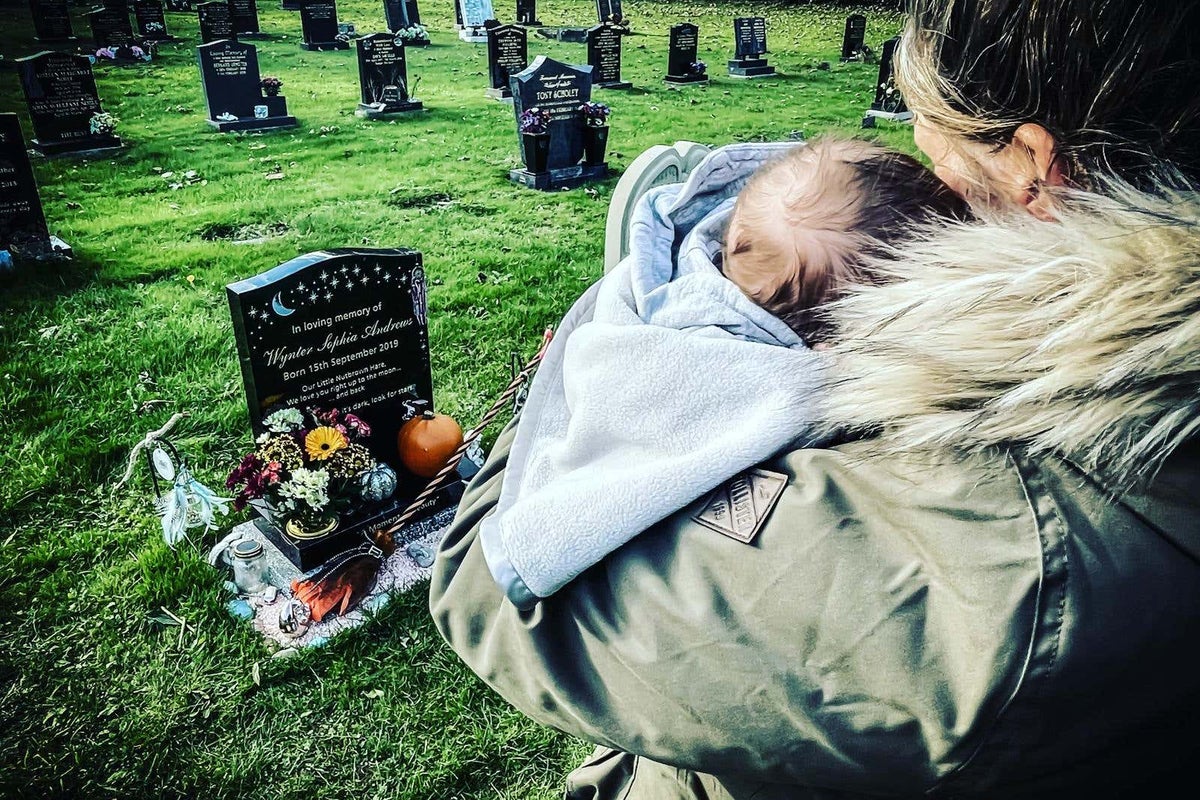
Sarah and Gary Andrews’ daughter Wynter died 23 minutes after being born in 2019.
NUH was fined £800,000 in 2023 after admitting failings in Wynter’s care in a criminal prosecution brought by the regulator the Care Quality Commission (CQC).
Mrs Andrews, 41, told PA: “I think for us the Ockenden report is just the start of the journey for Nottingham and nationally.
“I think it’s easy to see that it’s the conclusion of the report but actually it’s just the beginning of a long road of improvement.
“We need to make sure that history isn’t repeated again. We hope it will make some good change, and all we’ve ever wanted from the beginning is that no other families have to endure what we have.”
She said those contributing to the review will get individual feedback over the weeks following the release of the report.
“So I think for a lot of people it’ll be finding out things that they didn’t know, and it’s going to be a very emotional time,” she said.
Mr Andrews, 38, said: “The report being published today needs to serve as a wake-up call to the NHS locally and nationally, that what’s gone on before cannot be allowed to continue.”
He said he believes there is “still going to be this question mark over accountability, a call for a national public inquiry, because so many different organisations have failed to do their bit that feeds into a safe system”.
Mrs Andrews suggested a report into maternity care at other NHS trusts by Baroness Amos, which will report next week, has been ill-timed.
That review was ordered by former Health Secretary Wes Streeting.
She said: “As families, we found it quite disappointing that the Amos report is so quick after Ockenden, because we feel like actually people need time to digest Ockenden before then having Amos.
“We think releasing them too quickly after each other actually kind of muddies the water.
“We worry that releasing them too soon loses the impact for both reports.
“Families in Nottingham, in the weeks following, are going to be receiving their individual feedback, and it’s going to be re-living your trauma.
“It seems quite insensitive.
“I think both reports deserve their own space.
“There’s all those families that are going to be getting information that they’ve never had, and they’re getting it so close off the back of the Ockenden report that it all just feels rushed.”
Mr and Mrs Andrews, who have a four-year-old son, Bowie, said they continue to live with the harrowing effects of Wynter’s death.
Mrs Andrews said: “I think personally it’s got harder because we watch Bowie grow up and realise all the milestones we’re missing with Wynter and that’s heartbreaking.
“We should have never had to fight in the first place and actually we should not be doing it now. We shouldn’t have to be doing this.
“There should be accountability, and it shouldn’t be on families to have to fight to be heard and believed.
“And actually, the impact on our lives – the death of our daughter means we’ll never be the same again.”
Mr Andrews said: “One day we were expecting a baby, and next day we were leaving hospital with an empty car seat, and then you go to inquest, and you find out it was clear and obvious failings. Then suddenly, as any parent would, you try and find answers, and you come up against brick walls.
“But when the cameras and press go home, we still have to live our lives, and it’s extremely difficult.”
Beauty therapist Natalie Needham, 39, raised concerns about her son Kouper’s health when he was discharged from City Hospital in July 2019, hours before his death. She has contributed to the Ockenden review.
Mrs Needham, who has five other children, said Kouper had not fed, woken up or cried before he was sent home, but a midwife filled out discharge papers which said he was feeding and “awake, happy and content”.
The mother said: “My husband woke up at six in the morning and found him dead in his Moses basket.”
Mrs Needham added: “One hundred percent I feel like it could have been avoided.
“We’ve never had a determined cause of death. But even with what they think happened, there was definitely a chance for him to have survived.”
She continued: “It’s heartbreaking to come home and tell four children that their brother’s dead and he’s never coming back.”
Months after Kouper died, Mrs Needham said she received documents in the post which included MRI scans and a “full itemised bill” of Kouper’s death including costs for an ambulance, oxygen, adrenaline, and a £57 request for a nurse to tell her that her son had died.
Anthony May, chief executive of NUH, said: “The information sent to Natalie Needham and the way in which was sent was totally unacceptable. I would like to apologise to Natalie and her family for the distress caused.”
He said there are new processes in place to improve the accuracy, quality and security of the information shared to prevent this happening again.
Former teacher Mel Ibrahim, 53, delivered her daughter Amaya at around 24 weeks alone in a bathroom at Queen’s Medical Centre (QMC) in Nottingham in April 2016. She has also fed into the review.
Weighing 1lb 10oz at birth, Amaya spent months on a neonatal ward after suffering a bleed on her brain, contracting sepsis and being ventilated for chronic lung disease.
Now aged 10, Amaya has cerebral palsy, autism and is profoundly deaf, requiring constant supervision.
Ms Ibrahim said she has “nagging questions” about the care she and Amaya received before and after her birth.
She said: “When I went onto the antenatal ward… there’s no medical equipment whatsoever that is there in preparation for a preterm birth.
“I had Amaya on my own in the bathroom, and I only realised she was delivering because I’d been told to look for blood clots, and I looked down for blood clots and it was her head.
“I was fearful of so much when I delivered her. I was fearful of hurting her – she looked like a bird.
“Shock doesn’t even begin to describe how I felt. I was absolutely terrified. At the time, I didn’t realise I was also at risk of dying because I had the retained placenta and a haemorrhage.”
Ms Ibrahim continued: “Amaya – she was rushed into the neonatal unit and as I say she was fighting for her life. I can’t even begin to say how bad it was and how traumatic.
“We were told she will likely have experienced a brain bleed with the extreme prematurity. She spent four months in neonatal and the amount of times we nearly lost her is countless.”
She added: “Once she stopped fighting for her life, we had questions.
“Questions about what happened leading up to her birth, questions that happened during her birth and just slightly after that as well.”
Laura Flanagan, 45, said it felt like a “nightmare” when her son Archie became cold, looked grey and was “grunting with every breath” after he was born at QMC in January 2022.
Archie was moved to the neonatal intensive care unit at 13 hours old and was put on a ventilator 31 hours after he was born.
Ms Flanagan, who has seven children and has contributed to the Ockenden inquiry, said she was “constantly ignored, put down, made to feel like an inconvenience” by hospital staff after Archie’s birth.
Ms Flanagan has been told Archie possibly has mild autism, but she thinks there is “a lot more” to it because he is still in nappies at four, cannot feed himself, and his school has said his mental age is about two-and-a-half.