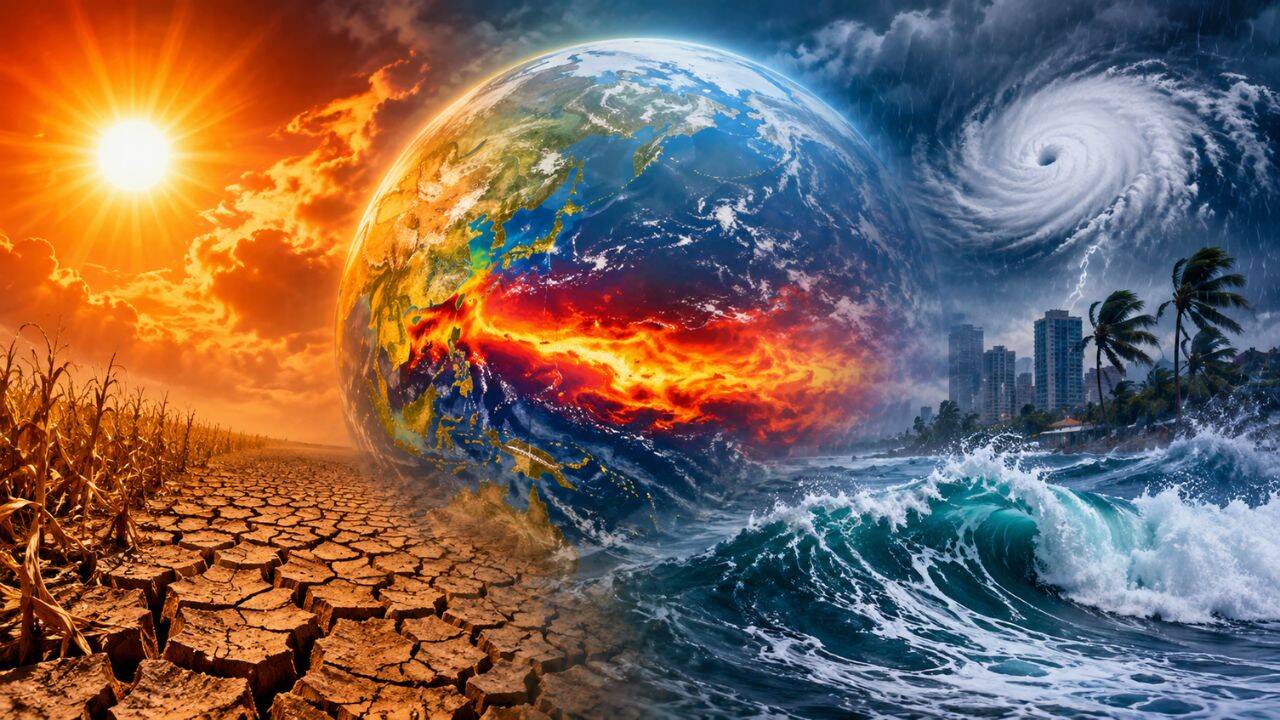
NEW DELHI: The world's oceans have reached their highest recorded temperatures for June, with scientists warning that the rapid development of El Niño is likely to amplify global heat, marine heatwaves, stronger cyclones, floods and droughts over the coming months. The warming oceans are not only reshaping weather patterns across continents but are also threatening marine ecosystems, agriculture and food security, including in countries such as India where authorities have already begun preparing for possible monsoon disruptions.
Get breaking news anytime, anywhere. Download the TOI app now!
The World Meteorological Organization (WMO) has warned that El Niño has officially developed in the tropical Pacific and is expected to strengthen rapidly between July and September. Sea surface temperatures in key regions of the central and eastern Pacific are forecast to exceed 2°C above average, increasing the likelihood of extreme weather across many parts of the world.
"This will intensify the chances of drought and heavy rainfall and increase the risk of heatwaves on land and marine heatwaves in many regions of the world," WMO Secretary-General Celeste Saulo said while announcing the latest global outlook.
The warning comes as global ocean temperatures have already reached unprecedented levels. According to climate scientists, the average sea surface temperature across the world's tropical and temperate oceans is now just under 21°C, the highest ever recorded for June. Before large-scale industrialisation around 1870, the average was about 19.6°C.
Although the increase may appear small, scientists say the amount of energy required to heat the world's oceans by more than one degree is enormous. More than 90 per cent of the excess heat trapped by greenhouse gases generated from burning coal, oil and natural gas has been absorbed by the oceans rather than the atmosphere.
Researchers estimate that during 2025 alone, the oceans absorbed heat equivalent to roughly 12 Hiroshima-sized atomic bombs exploding every second throughout the year. That relentless accumulation of heat has fundamentally altered the Earth's climate system.
Scientists say the current ocean temperatures are unlike anything seen in modern human civilisation. To find similar conditions, researchers estimate one would have to go back around 120,000 years, before the last Ice Age, when gradual changes in Earth's orbit warmed the planet over thousands of years. Human-driven climate change has produced a comparable rise in little more than a century.
Why warmer oceans matter
The heat stored in the oceans does not remain confined beneath the surface. It continuously interacts with the atmosphere, influencing weather systems across the globe.
Warmer oceans transfer more heat and moisture into the air, creating conditions favourable for stronger tropical cyclones, more intense rainfall, severe flooding and prolonged heatwaves over land. Higher sea surface temperatures also reduce the ocean's ability to cool nearby land during summer, allowing hot air masses to persist for longer periods.
Scientists say the developing El Niño will add another layer of warming to an already overheated climate.
The current event is forming in the tropical Pacific, where sea surface temperatures are already around 1.24°C above average across a vast stretch of the central and eastern Pacific Ocean. Even more concerning is the heat below the surface, with subsurface waters in parts of the eastern Pacific measuring more than 6°C above normal.
These unusually warm subsurface waters act as stored energy that can continue feeding El Niño for months, increasing its intensity and prolonging its influence on global weather.
Climate experts expect the event to trigger marine heatwaves across the western Indian Ocean, tropical Atlantic and eastern Pacific, while also raising global temperatures well beyond current levels.
Unlike short-lived weather events, El Niño typically lasts between nine months and a year. However, its strongest influence on global temperatures is often felt toward the latter part of its life cycle, when the enormous quantity of heat stored beneath the ocean surface rises back into the atmosphere.
That means while 2026 is already on course to rank among the hottest years ever recorded, scientists warn that 2027 could become even hotter if the current El Niño develops into a strong event, much like the powerful episodes witnessed during 2015-16 and 2023-24
Marine ecosystems and weather systems under pressure
The unprecedented warming of the oceans is already leaving visible scars on marine ecosystems. Scientists warn that rising sea temperatures, combined with increasingly frequent and longer-lasting marine heatwaves, pose a serious threat to coral reefs, seagrass meadows, kelp forests and coastal ecosystems that support millions of people through fisheries and tourism.
Research examining the 2023-24 El Niño and the exceptionally warm conditions of 2024 found widespread ecological damage across several ocean basins. Coral bleaching became more extensive, marine species shifted their habitats in search of cooler waters and fisheries in several regions experienced disruptions as warming altered ocean food chains.
Marine heatwaves have become both more frequent and more intense over the past few decades. Unlike heatwaves on land that last days or weeks, marine heatwaves can persist for months, exposing marine life to prolonged periods of thermal stress. Scientists say many species simply cannot adapt quickly enough to such rapid changes.
The impacts are not limited to the oceans. Heat stored in seawater eventually influences weather systems over land, creating a chain reaction that affects temperatures, rainfall and storms across continents.
How warmer oceans fuel extreme weather
Climate scientists often describe the oceans as the Earth's largest heat reservoir. When sea surface temperatures rise, evaporation increases, adding more moisture to the atmosphere. A warmer atmosphere can hold more water vapour, making rainfall events more intense when storms develop.
This combination of extra heat and moisture increases the likelihood of cloudbursts, flash floods and prolonged heavy rainfall events. At the same time, regions that receive less rainfall can experience longer dry spells and worsening drought conditions.
The consequences were evident during the record-breaking marine heatwave that developed over the North Atlantic in June 2023. Shortly afterwards, Europe experienced one of its most intense heatwaves on record. Spain witnessed devastating floods triggered by extreme rainfall, while several Mediterranean countries battled severe wildfires amid exceptionally hot and dry conditions.
Scientists caution that similar patterns could emerge again if ocean temperatures continue rising alongside a strengthening El Niño.
The developing climate pattern is also expected to influence tropical cyclone activity.
Regions such as the western Indian Ocean, where tropical cyclones regularly form, could experience stronger storms capable of carrying greater volumes of moisture. When these systems make landfall, they may produce heavier rainfall, increasing the risks of flooding, landslides and infrastructure damage.
The impacts vary from region to region because El Niño alters global atmospheric circulation.
Historically, El Niño has been associated with below-normal rainfall across parts of Australia, Indonesia and Southeast Asia, while western South America often experiences unusually heavy rainfall and flooding. Parts of eastern and southern Africa may also receive below-average rainfall, increasing drought risks.
According to the latest projections from the World Meteorological Organization, below-normal rainfall is expected across parts of the Indian subcontinent, much of Australia and sections of the tropical Indian Ocean during the coming months.
Above-normal rainfall is forecast across the central and eastern equatorial Pacific and parts of the Gulf of Guinea in West Africa. Wetter conditions are also expected in parts of South America, while the Greater Horn of Africa, Central America and sections of the Caribbean face an increased likelihood of drier-than-normal weather.
Europe is also witnessing the influence of unusually warm oceans.
The Mediterranean Sea has emerged as one of the world's major marine heatwave hotspots, with some areas recording sea surface temperatures up to 6°C above the long-term average. Parts of the North Sea are also around 3°C warmer than normal.
These unusually warm waters have contributed to the intense heat affecting southern Europe, where temperatures have repeatedly crossed seasonal records during recent weeks.
Scientists say the interaction between record ocean warmth and the developing El Niño could further amplify weather extremes through the remainder of 2026, making heatwaves, heavy rainfall events and marine heatwaves more frequent across several regions of the world.
What El Niño could mean for India and why governments are preparing
India is already beginning to feel the effects of the developing El Niño. The World Meteorological Organization has warned that the phenomenon is likely to strengthen rapidly during July to September, increasing the chances of heatwaves, droughts and erratic rainfall across the Indian subcontinent.
The warning comes as India recorded a rainfall deficit of around 40 per cent in June, affecting the sowing of kharif crops across several states. According to agriculture ministry data, the total area sown by late June stood at around 182 lakh hectares, about 23 per cent lower than the corresponding period last year. Oilseed cultivation has recorded the sharpest decline so far.
Although rainfall is expected to improve as the southwest monsoon advances across the country, experts say the distribution of rainfall will be as important as the total seasonal rainfall. Long dry spells interrupted by short periods of intense rain can be equally damaging for agriculture.
Recognising the risks, the Chhattisgarh government has already issued a detailed contingency plan for the 2026 kharif season.
The agriculture department has advised farmers to switch to short and medium-duration crop varieties, adopt water-saving cultivation methods and prepare for the possibility of delayed monsoon, early withdrawal and prolonged dry spells.
Farmers have also been encouraged to adopt Direct Seeded Rice (DSR) instead of conventional transplanting. Officials estimate the technique can reduce irrigation water use by about 20 per cent, lower cultivation costs by nearly Rs 5,000 per acre and allow harvesting up to two weeks earlier.
In rain-deficient upland areas, farmers have been advised to shift from paddy to relatively drought-resistant crops such as pigeon pea, green gram, black gram, soybean, sesame and groundnut.
The state government has also recommended row sowing, mandatory seed treatment before planting and balanced fertiliser use to improve crop resilience under uncertain rainfall conditions.
Chief Minister Vishnu Deo Sai has directed officials to prepare district-specific action plans, strengthen irrigation management and ensure there is no shortage of seeds, fertilisers or technical support during the kharif season.
The state has also appealed to farmers to use India Meteorological Department mobile applications such as Sachet, Damini and Meghdoot to receive timely weather forecasts and lightning alerts.
Forecasting is improving but scientists warn monitoring systems must be protected
While the climate outlook appears increasingly challenging, scientists say advances in forecasting are helping governments prepare for extreme weather before it strikes.
Over the past two years, researchers have significantly improved their ability to predict marine heatwaves three to four months in advance in countries including Australia and the United States. These forecasts are enabling fisheries, conservation agencies and coastal authorities to act before conditions become critical.
Advance warnings allow governments to temporarily reduce fishing pressure, protect vulnerable marine habitats and implement conservation measures before ecosystems experience severe stress.
Scientists believe similar improvements in seasonal forecasting could also help farmers, disaster management agencies and water resource planners prepare for droughts, floods and cyclones more effectively.
However, they also warn that these advances depend on continuous investment in global climate observation systems.
Recent proposals in the United States to reduce funding for climate data collection networks and scale back ocean monitoring programmes have raised concerns within the scientific community. Researchers argue that weakening these observation systems would reduce the accuracy of weather forecasts and climate predictions at a time when reliable information is becoming increasingly important.
Continuous monitoring of ocean temperatures, atmospheric conditions and global climate patterns provides the data used to forecast El Niño, marine heatwaves, tropical cyclones and seasonal rainfall.
Without these observations, scientists warn that governments could be forced to respond to increasingly severe climate events with far less warning.
Scientists stress that El Niño is a naturally occurring climate phenomenon that has existed for thousands of years. However, they say the background warming caused by greenhouse gas emissions is making each El Niño event more dangerous by adding extra heat to an already warming planet.
The record-breaking ocean temperatures seen today are therefore the combined result of long-term human-driven climate change and the arrival of another El Niño cycle.
As oceans continue to absorb more than 90 per cent of the excess heat generated by greenhouse gases, they are becoming an increasingly powerful driver of global weather extremes.
Researchers say early warning systems, better forecasting and improved disaster preparedness can help societies reduce losses from heatwaves, cyclones, floods and droughts. But adaptation alone will not be enough.
Scientists argue that the only long-term solution is to rapidly reduce greenhouse gas emissions and achieve net zero emissions as quickly as possible.
As they caution, stopping the measurement of climate change will not stop climate change itself. Until global emissions begin to decline substantially, the world's oceans will continue storing record amounts of heat, making extreme weather events more frequent, more intense and more costly for communities across the globe.