The Netherlands is often called the “drain” of Europe because it channels so many major rivers as they flow out to the sea. But along with the water from the Rhine, Meuse and Scheldt floats some of the plastic rubbish that is contributing to the crisis in our oceans.
“You see a lot of plastic coming through that’s German, Dutch, French, Swiss,” says Anne Marieke Eveleens, an amateur sailor who is taking the fight to clean up our oceans upstream by tackling plastic pollution in rivers. Her efforts, and the novel startup she co-founded, are a striking example of the kinds of ingenious innovations that have been prompted by humanity’s environmental emergencies.
Four years ago, Eveleens was sitting in an Amsterdam pub with her friends Francis Zoet and Saskia Studer, who shared her love of sailing and surfing. “Each time we met, we were more and more aware about [the problem of ocean] plastic pollution,” she recalls. And so they started mulling over potential solutions – with their back-of-a-coaster ideas spanning the full spectrum of practicality. “We were really inspired by other solutions on plastic pollution. We thought, maybe there’s a solution [based] in rivers?”
One of those ideas was to try and deflect the flow of plastic debris with an underwater barrier made entirely out of air bubbles – effectively, a wall of sparkling water. Unlike more conventional barriers, the air bubbles would allow both fish and boats to pass through, while stopping plastic litter.
“We went on Google and found we were not the first ones with the idea of a bubble screen,” recalls Eveleens. “But it had never been used to catch plastic – that was the challenge.”
Last year, Eveleens gave up her day job at the technology firm Atos to work full time as chief operating officer of The Great Bubble Barrier, the startup spawned by that original idea that she co-founded with Zoet and Studer.

Bubble curtains, also known as pneumatic barriers, are sometimes used to contain oil spills. They have also been used to reduce the shock waves from underwater pile driving. Eveleens and her team, including environmental engineer and co-inventor Philip Ehrhorn, decided to use similar devices to those employed by the oil industry. The company’s technique involves laying a long tube full of holes diagonally across a riverbed. Compressed air is pumped through the tube, creating a wall of rising bubbles to block the flow of plastic waste. The upward flow of the bubbles carries the debris up to the water’s surface, where, thanks to the barrier’s diagonal positioning, the river’s natural current then pushes it towards the banks – from where it can more easily be collected and removed. The system has been shown to work for plastic pieces measuring between 1mm and 1 metre.
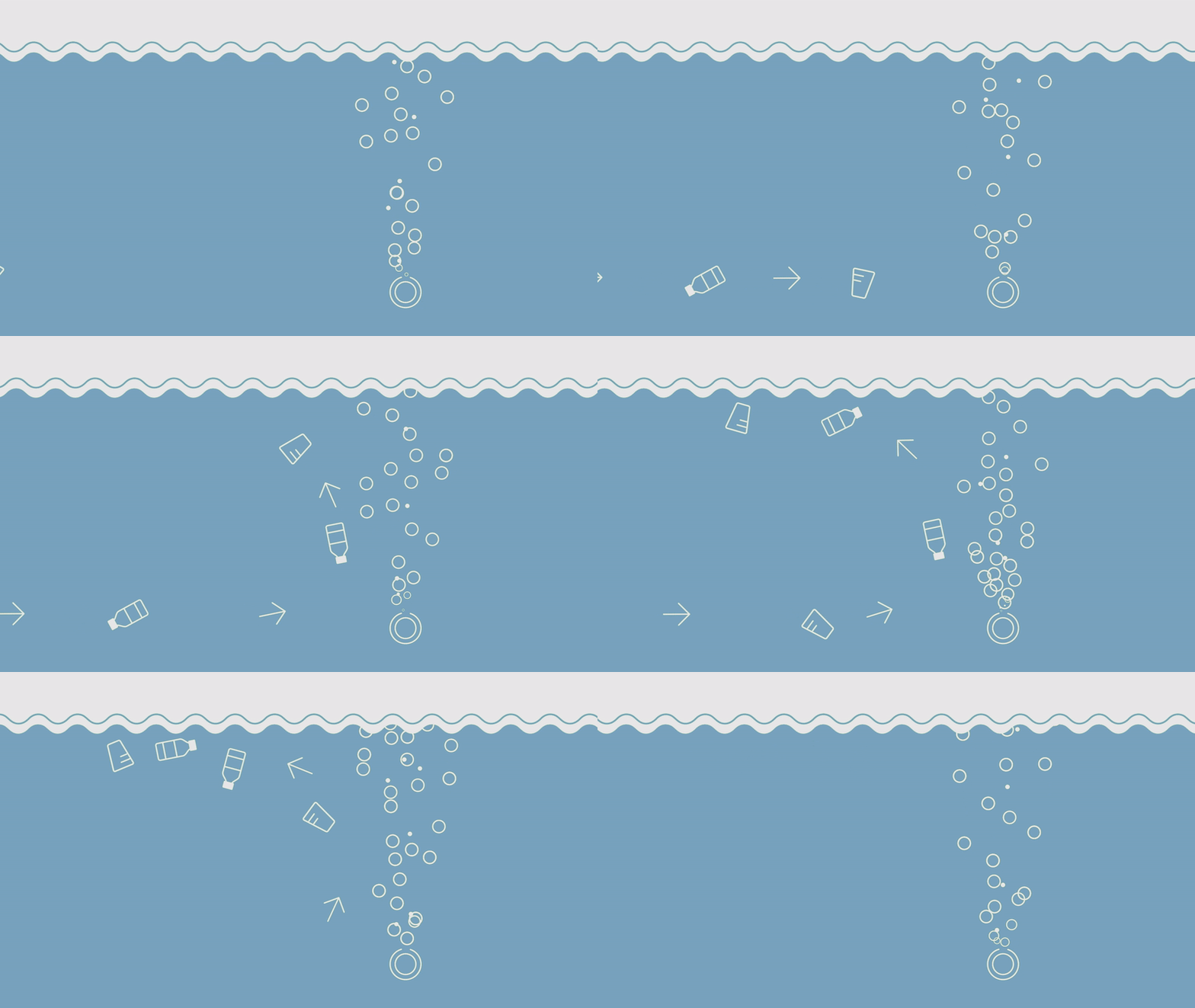
While bubble barriers by themselves will not solve the problem of ocean plastic pollution, Prof Peter Rem, resources and recycling professor at Delft University of Technology, points out that the river system is a logical place to catch plastic waste before it enters the ocean. Plus, it’s also an ideal location to try out new technologies and methods.
“What’s nice about it is that it takes us more to the source of the problem,” says Rem. “If you start looking for plastics in the ocean, that’s a vast enterprise and difficult to make into a business. We believe that up to 80% of plastics get into the ocean through rivers, and maybe an economically viable clean-up of the river is possible.”
The Great Bubble Barrier has been testing and refining its technique to ensure, among other things, that the bubbles are not overpowered by the strong river currents. In 2016, the team won a Dutch government-sponsored competition for startups working on plastic-free rivers. The prize was funding from Rijkswaterstaat (the ministry of infrastructure and water management) to set up a pilot across a 200-metre wide stretch of the river IJssel. The company’s bubble barrier system was installed for a month.
During this pilot, they set loose oranges and small wooden boats upstream of the bubble barrier and measured how many they could catch. “We could capture on average 86% of the material, and [other] material as small as 1mm,” says Eveleens. This included pieces of clingfilm and plastics that were being carried by a strong current well below the water surface.

After winning the first prize of €500,000 in last year’s Postcode Lotteries Green Challenge, the team is now refining its product for international rivers and looking for authorities keen to finance long-term pilots. Meanwhile, councillors at a town near the IJssel trial want a permanent version of the system.
But although The Great Bubble Barrier has received an enthusiastic response from many quarters, there are challenges to the business model.
“There is [carbon] pricing for the effects of CO2, so people start making a case for [paying to reduce] it, but we don’t have a price for plastic at the moment,” explains Eveleens. “Plastic pollution is going on, with a lot of environmental consequences, but there’s still no real allocated budget within government.”

At Delft University, Rem himself is working on a “plastic-free rivers programme” to create a costing model for local authorities and investors so that they can properly calculate and sub-divide the costs of cleaning up rivers. He is also working on a spin-off company to recycle plastic better through logarithmic sorting. “Today, only a very small percentage of the plastic flow can be treated by a plant and commercially sold, because there are so many different types and they are so thin,” he says.
Another organisation trying to solve the problem of ocean plastic pollution by tackling its source in rivers is the Swiss company Allseas, a specialist in installing offshore pipelines. The company is currently testing its solution with plastic waste in the Nieuwe Maas river in the Netherlands, where the Rhine meets the North Sea. It has EU funding to use this testing to develop and deploy technology to identify and catch plastic waste in waterways.
Meanwhile, The Ocean Cleanup, which is run by the young Dutchman Boyan Slat, has gained worldwide media attention for its efforts to catch ocean garbage in a floating barrier off the coast of San Francisco. However, the project has illustrated some of the difficulties inherent in trying to operate in such a large expanse, after running into problems with leaching plastic in December.
Of course, properly solving the ocean plastics crisis will require radical changes to the way we manufacture and consume countless everyday items. “Cleanups have an important role in dealing with plastic pollution, but the problems start long before it reaches our oceans, rivers, and beaches,” says Sander Defruyt, new plastics economy lead at the Ellen MacArthur Foundation. “We need to prevent plastic from becoming waste in the first place, by eliminating items we don’t need and innovating so all plastic we do need is designed to be safely reused, recycled, or composted.”
Are you working on an idea with the potential to contribute to a sustainable planet? The Postcode Lotteries Green Challenge is one of the world’s largest sustainable entrepreneurship competitions. This year’s contest is now open and looking for innovations with a viable business plan and the potential to scale. Find out more at greenchallenge.info. Deadline for entries: 1 May 2019.