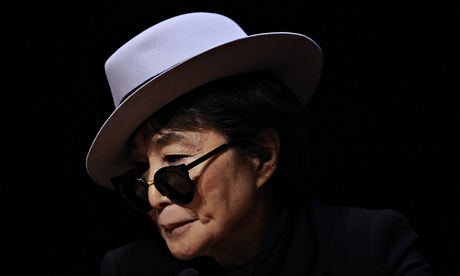
Communication with the world at large has been Yoko Ono’s lifelong mission – even when the world responded with hostility. She’s won the Lifetime Achievement Award for her activism over half a century, most of which is indivisible from her art. Think of the “Bed-In” that she and John Lennon staged in Amsterdam in 1969, or the billboard posters that announced: “War Is Over! If You Want It” the same year and her “Wish Trees”, an ongoing work started in 1981 where members of the public are encouraged to write their deepest wishes on labels and hang them from a tree.
“Art to me is a way of showing people how you can think,” Ono says. “Some people think of art as like beautiful wallpaper that you can sell, but I have always thought that it is to do with activism.”
Ono believes that activism can – and should – take many forms, and her range of causes is similarly broad: world peace, of course, but also the environment (in 2012 she embarked on a high-profile anti-fracking crusade), gun control and social issues, including feminism and same-sex marriage. She donated money after the Japanese tsunami, inaugurated the Yoko Ono Lennon Courage Award for the Arts in 2009 and was designated the first global autism ambassador in 2010. “To be an artist you need courage, and most people don’t think that,” she says.
The simplicity of her artwork may have been derided over the years, but it is exactly that which makes it hugely accessible. Her art and her activism has found a new audience with each successive generation. The apparent naivety of her peace activism is often couched in terms like: “A dream you dream alone is only a dream. A dream you dream together is reality” – the most famous maxim from her 1962 book Grapefruit. Yet in 2015 its aphoristic style, influenced by haikus, now seems perfect for the internet age, and has easily transferred to Twitter, Facebook and Instagram, where Ono has a large following of people who are interested in her rather than the Beatles.