It’s the first Saturday of October and as I sit in my front room keeping an eye on and an ear out for news from Anfield, desperately hoping Liverpool do not blow their 2-1 lead over West Bromwich Albion, my attention is taken by the sound of a crying child. It’s my three-year-old, bawling as she makes her way to the naughty step.
Soon my wife enters the room and tells me that our daughter has just muttered “fucking hell” and it’s definitely my fault as I said those two very words, out loud and laced with frustration, on hearing West Brom had equalised. “You’ve got to stop swearing in front of her,” she demands before storming out. Meanwhile from the naughty step, full-on crying has been replaced by gentle snivelling as a certain foul-mouthed toddler calms down and prepares to apologise to her mummy.
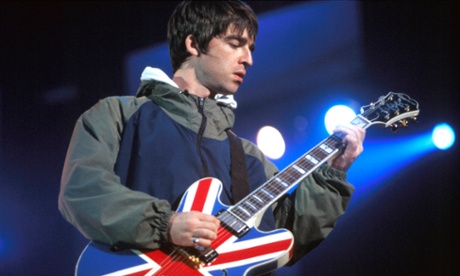
After the full-time whistle blows at Anfield and three extremely valuable points have been secured by Liverpool, I reflect on the afternoon’s other notable event and settle on two views: First, there are few things more funny than a child swearing, especially when it’s your own, and second, none of this is my fault anyway; it’s Noel Gallagher’s. Blame him.
Great musicians don’t just entertain, they also influence and no man - my dad aside - has had a greater impact on my life than Noel. OK, I probably would’ve been a big swearer regardless, but because of him and what he gave the world 20 years ago, there was simply no turning back from a life filled with bolshie “fucks” and the sense that this is how it’s supposed to be.
Released on 8 August 1994 as the third single from Oasis’s debut album Definitely Maybe, which itself came out at the end of that month, Live Forever is as much a statement of intent as it is a piece of art. Noel said he wrote it partly as a optimism-charged retort to the darker messages of early-90s grunge and it no doubt had the effect of making a generation of British teenagers stand a little taller and a feel a little bolder. I can testify to that as someone who was 13 when Live Forever came out and immediately felt its power surge through every pore of my body.
The moment is an unforgettable one – Saturday afternoon, lying on my parents’ bed as my mum vacuumed downstairs, watching The Chart Show on ITV and generally feeling fed up with the British music scene. It really was terrible back then. Truly great guitar bands were nowhere to be seen and as wewaited for the Stone Roses to make their next move, an endless stream of Eurodance/pop dross was invading the charts and dulling our collective senses.
There was nothing to believe in, nothing to get inspired by, and quite frankly I had all but given up the previous December when the battle for the Christmas No1, which still meant something back then, became a straight fight between Take That and Mr Blobby. Blobby won.
So on that Saturday I was staring at the TV mainly through habit. My eyes were glazed over, not really taking anything in. In truth, I was getting as much out of the hum of the vacuum downstairs as I was of the music videos in front of me.
And then it happened, a collection of sounds and images that shattered my teenage boredom …
A piercing whistle, coupled with a throaty, semi-threatening “Oh yeah!”
Heavy drum beat
A wall
A splash of water
More drums
The wall again
More water
A man with large dark shades sitting on a chair that is fixed high to the wall.
He sings: “Maaybeeee, I don’t really wanna knowwwww/ How your gaaden groooows,/ ’cos I just wanna flyyyyy/ Latelyyyyy, did you ever feel the paaaain/ In the mornin’ raaain, as it soaks you to the booone?”
“What’s this?!” I remember asking myself out loud as I sat up on the bed and took it all in. Just over four-and-a-half minutes later I was utterly hooked and desperate for more.
The first step was a backwards one, specifically finding out about the two singles that had come before, Supersonic and Shakermaker. For the life of me I don’t know how either of those, especially Supersonic, escaped my attention, but they did and there was some serious catching up to do. But in those early days, and in truth ever since, it has essentially been about Live Forever, the single most important single of my life.
It’s of course a huge cliché for a man in his 30s to talk about that song in that way, but in repetition often lies truth and what even Oasis’s biggest critics, those who dismiss them as three-chord charlatans, cannot disagree with is Live Forever’s perfectly constructed simplicity; a great melody allied to a great set of lyrics.
Musically the version of the song released in 1994 is pretty much the same as that which Noel wrote three years earlier, having in part been inspired to do so after hearing the Rolling Stones’ Shine a Light. The only significant difference to the original demo is those thudding introductory drums in place of an acoustic guitar, a decision taken by producer Owen Morris.
Lyrically the song is untouched, and perhaps not surprisingly that is the element of Live Forever – which peaked at No10 in the UK charts – Noel believes matter the most, particularly the line “We’ll see things they’ll never see.” The use of “we” is undeniably important, creating a link between writer, the band and fans – “we” are in this together and seek something beyond an era of monotonous, soulless dance tracks and a man in a plastic pink suit dicking around with Noel Edmonds.
In that sense Live Forever is very much Oasis’s take-off track, despite being the third song they released from their first album. Its rich sense of hope, of a desire to take life by the horns, is utterly tangible from the very first moment you hear it, as I did on an otherwise normal Saturday afternoon and realised this was the band that would define my transition from boy to man.
And while there are no swear words in Live Forever and, if I’m not mistaken, in Definitely Maybe as a whole, it was impossible for this impressionable adolescent not to soak up the ones that poured almost endlessly out of the band, Noel and Liam in particular, during their early interviews in print and on television. The cocksure attitude, love of alcohol and women were also absorbed and before anybody knew it I, and hundreds of like-minded teenage boys, were “fucking mad for beer and birds”.
The sadness for me is that Noel never came close to replicating Live Forever’s sheer force of personality. His defence has always been that neither has any other musician in the subsequent 20-and-a-bit years, but I always got the sense he simply accepted he’d reached a high point and gave up trying to go higher.
What followed instead were a series of songs on a series of albums that contained not an ounce of Live Forever’s single-minded and beautifully expressed message, with Oasis’s final studio album, 2008’s Dig Out Your Soul, a mediocre last throw from a band who knew the end was nigh. Indeed they split up 12 months later.
But this devotee is willing to forgive and forget, and two decades on remember with utter joy the song that ignited his youth. Live Forever may lack complicated harmonies and melancholic overtones but often the best and most influential tracks do, and back then, for that generation, it meant everything.
As my three-year-old daughter might say, Live Forever is fucking epic.
• A version of this article originally appeared in The Anfield Wrap online fanzine.